Kass: A January 2025 Market Top and the Beginning of the End of the Mag 7?
Many of our fundamental concerns are finally beginning to be accepted by investors — at a time in which valuations are elevated and consensus corporate profit estimates seem too optimistic.
You've reached your free article limit
You've read 0 of 1 free Pro articles.
* The equity risk premium is at a two decade low — thus, stocks are materially overvalued relative to bonds.
* Almost every other traditional valuation metric is above the 95%-tile.
* The promises of a new Administration (deregulation, pro growth economic policies and lower corporate/individual tax rates) have been fueling the animal spirits since the November election.
* As well, the dominance of passive investing products and strategies (that worship at the altar of price momentum) have, in turn, propelled equities higher as that momentum builds.
* Company buybacks have added to investors' glee and upwards price momentum since early 2024.
* Nonetheless, based on history, today's valuations (statistically) represent a very poor launching pad for future equity returns.
* January 2025 (the end of The Nifty Fifty) resembles January 1973 (the possible end of The Magnificent Seven) in so many ways.
* Unexpected corners of speculation and leverage could lay the ground for a more significant market decline (than is represented by our baseline expectation (of about a -10% drop).
The December 2024/January 2025 period marks the beginning of what I expect to be a lower-trending market accompanied by rising volatility.
I expect 2025 to look far different than last year.
While, in managing my hedge fund, I predominantly focus on an assessment of reward vs. risk on individual stocks — if I was forced to hazard a precise forecast I would project only about a 5% upside and a 10% to 15% downside for the S&P 500 Index in 2025 (or roughly 2-times to 3-times more risk than reward).
This commentary will explain why heady valuations are rarely a good launching pad for higher stock prices.
I will explore and summarize some of our fundamental near and intermediate-term concerns.
I will compare today with early 1973 (which marked the end of the Nifty Fifty era) and produced years of subpar returns for the major market averages. Then, I will highlight some longer-term existential market threats that few discuss, but that have a reasonable chance of emerging.
As I wrote to my Limited Partners several weeks ago:
"Many of our fundamental concerns (growing policy (fiscal and monetary) risks, sticky inflation, slowing economic growth and rising interest (higher for longer)) are finally beginning to be accepted by investors — at a point in time in which valuations are elevated and consensus corporate profit estimates seem too optimistic. We are increasingly more confident that stocks will correct to more attractive levels than exist right now — at which time we can begin to accumulate selected stocks that meet our investing criteria and standards."
You're the top!
You're the Coliseum
You're the top!
You're the Louver Museum
You're a melody from a symphony by Strauss
You're a Bendel bonnet
A Shakespeare's sonnet
You're Mickey Mouse
You're the Nile
You're the Tower of Pisa
You're the smile on the Mona Lisa
I'm a worthless check, a total wreck, a flop
But if, baby, I'm the bottom, you're the top
- Cole Porter, "You're the Top"
Other Cautionary Signs Pose Near-Term Risks
Besides the greatest degree of optimism that has prevailed since 2022, extended valuations, the likelihood that some (much?) of the appreciation in equities stems from automated buying by Index investors (without regard for their intrinsic value) and the multiple factors discussed in recent months — there are other cautionary signposts:
* The enthusiasm surrounding quantum computing and AI.
* The implicit assumption that the constituents of the Magnificent Seven will continue to be successful.
* The relative valuations of U.S. stocks compared to the rest of the world.
* Though unrelated to equities, the price of bitcoin (regardless of worthiness) has risen by over 450% over the last 24 months — this obviously doesn't suggest an overabundance of caution!
Looking Back on the Year
What differentiates our hedge fund, Seabreeze, from many "long/short funds" is that, in times of market concern, we run a bona fide "hedged" portfolio.
Most of the larger "long/short" hedge funds have abandoned short selling of individual equities altogether for a variety of reasons — not the least of which is that they can't get scale on the short side in specific names. Instead, these Funds often resort to shorting Indices, if they do anything on the short side at all.
As many recognize by now, I am as comfortable being short as being long.
A closer examination of our short book should make our differentiated approach apparent. We don't seek drama and beta in our shorts. Rather, we typically focus on non-crowded shorts (in which the short interest as a percent of float and average daily trading volume are low).
We don't short valuations. Our short selection is based on a bottom-up analysis; it's most often an assessment that companies' business models are deteriorating or broken relative to consensus expectations.
Here are examples of some of our individual shorts that we have held throughout most of the year:
The Coca-Cola Company KO, Starbucks SBUX, Chegg CHGG, Winnebago Industries WGO, FIGS FIGS, Medical Properties Trust MPW, Blackstone Mortgage Trust BXMT, Sleep Number Corporation SNBR, Aegon AEG, Walgreens Boots Alliance, Inc. WBA (now covered), Warner Bros. Discovery WBD, F45 Training Holdings Inc. FXLV, Petco Health and Wellness Company WOOF, B. Riley Financial RILY and Intuit INTU.
Our short book is hardly a "who's who" with regard to familiarity by most investors! You won't see a Mag 7 short in our holdings. By staying away from high-risk popular and crowded shorts — despite the market's sea of green in 2024 — our individual equity shorts contributed positively to last year's investment returns.
Price Is What You Pay, Value Is What You Get
"What the wise man does in the beginning, the fool does in the end."
- Warren Buffett
" A bull market is like sex, it feels best just before it ends."
- Barton Biggs
It should not come as a surprise that the return of an investment is significantly a function of the price paid for it. For that reason, investors clearly shouldn't be indifferent to today's heady market valuations.
As expressed earlier, equities begin 2025 at an historically high level. The CAPE price-to-earnings multiple cyclically adjusted price-to-earnings ratio developed by Yale University's Bob Shiller (I have lectured in his class since 2011!) is at 37-times, having expanded from 32-times a year ago and 27-times two years back. The last time valuations were so high was at the beginning of 2022 — a year in which the S&P Index fell by 20%. Before the CAPE was that high in 2001 — the start of a major bear market. In fact, in the last century the CAPE multiple has been this high only three percent of the time — making the current ratio a 2.3 standard-deviation event.
S&P 500 CAPE Multiple
United States (ratio)
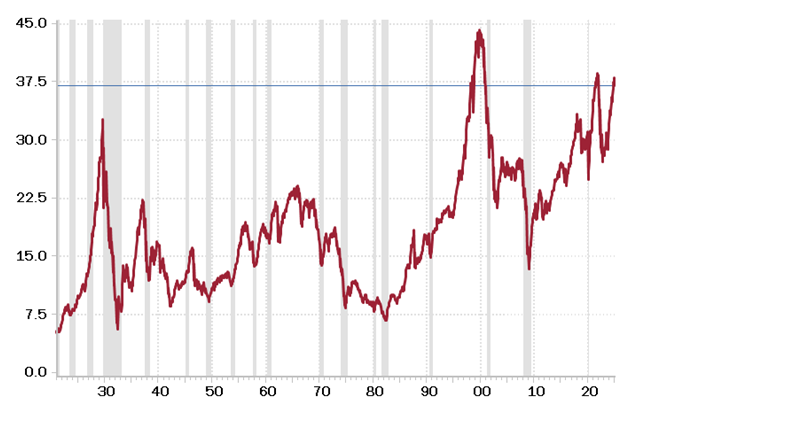
Historically, a high CAPE is a launching pad for inferior returns:
United States

My friend, Oaktree's Howard Marks recently discussed this subject in one of his memorandums:
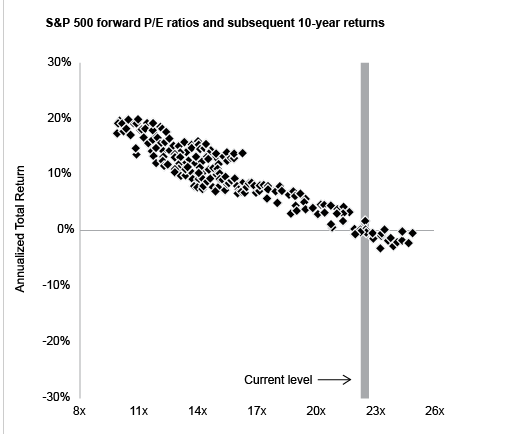
The above graph, from J.P. Morgan Asset Management, has a square for each month from 1988 through late 2024, meaning there are just short of 324 monthly observations (27 years x 12). Each square shows the forward P/E ratio on the S&P 500 at the time and the annualized return over the subsequent 10 years. The graph gives rise to some important observations:
- There’s a strong relationship between starting valuations and subsequent annualized 10-year returns. Higher starting valuations consistently lead to lower returns, and vice versa. There are minor variations in the observations, but no serious exceptions.
- Today’s P/E ratio is clearly well into the top decile of observations.
- In that 27-year period, when people bought the S&P at P/E ratios in line with today’s multiple of 22, they always earned 10-year returns between plus 2% and minus 2%.
In November, a couple of leading banks came out with projected 10-year returns for the S&P 500 in the low- to mid-single digits. The above relationship is the reason. It shouldn’t come as a surprise that the return on an investment is significantly a function of the price paid for it. For that reason, investors clearly shouldn’t be indifferent to today’s market valuation.
You might say, “making plus-or-minus-2% wouldn’t be the worst thing in the world,” and that’s certainly true if stocks were to sit still for the next 10 years as the companies’ earnings rose, bringing the multiples back to earth. But another possibility is that the multiple correction is compressed into a year or two, implying a big decline in stock prices such as we saw in 1973-74 and 2000-02. The result in that case wouldn’t be benign.
Stocks Remain Defiant in the Face of Higher Yields and Sticky Inflation
Most recently interest rates have climbed much higher than consensus expectations — with the yield on the 10-year Treasury note approaching 4.75%, a multiple-month high.
Investors have continued to ignore the signposts of continuing inflation:
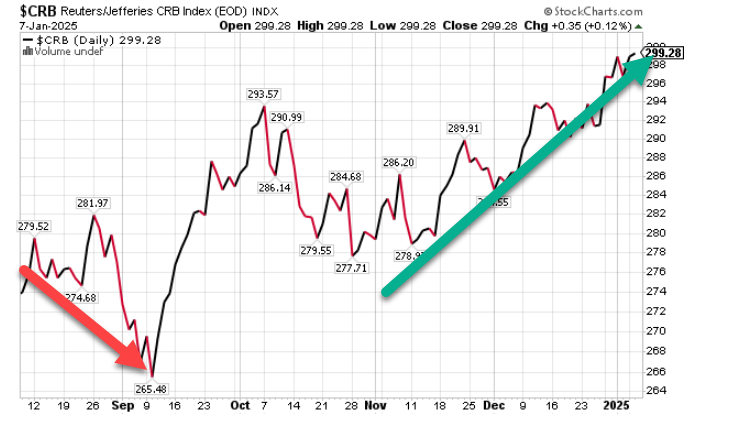
The recent disaster in Los Angeles will likely serve to exacerbate inflationary pressures — as building material prices rise and insurance premiums are poised to take off.
Importantly, the increase in interest rates and the absence of a more favorable EPS backdrop have contributed to an ever-thinning equity risk premium — in which the spread between the S&P Index's forward earnings yield and the 10-year Treasury yield has reached a 23-year low:
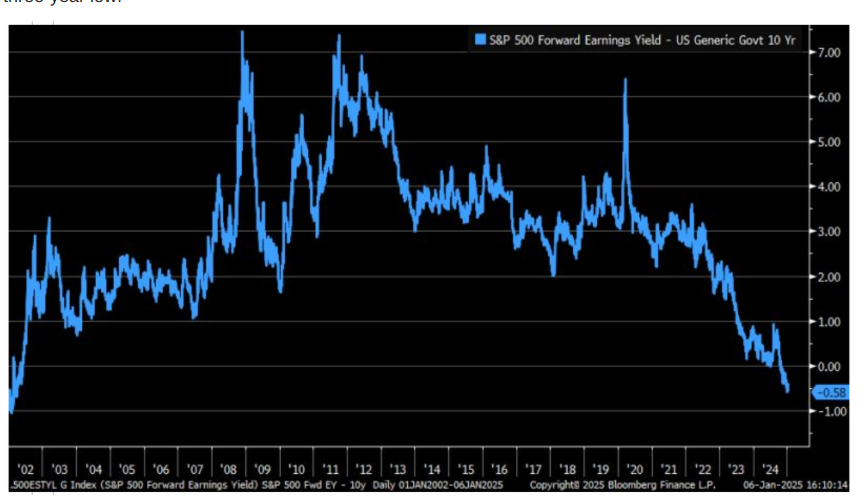
David Rosenberg provides a succinct explanation to high valuation and for the equity market's indifference to the mounting concerns of sticky inflation, rising interest rates and other possible negative outcomes:
"Because I believe that earnings growth estimates are too lofty, even with the AI craze and how it will change the world, and because I believe that the ERP should be above zero (as risky assets should command a risk premium against riskless assets), I am still largely on the sidelines. I also believe that by the time the top is turned in, there will be a mad scramble to get out because the two extreme primal emotions of investing, fear and greed, never go out of style. Greed has been working, and may continue to work in 2025, but nothing lasts forever.
The problem is that because there is so much overexposure to equities on household balance sheets, everyone is going to be trying to bail out together with precious few buyers on the other side, because there aren’t exactly a whole lot of folks out there with a cash position like mine (oh, save for Warren Buffett… the two of us will be there, rest assured, to provide liquidity when the time comes). I don’t know when that time will be, but I do know it will come."
For now, it is clear that investors have lengthened their time horizons amid a perceived shift in the technology and productivity curves. This has meant that historical analysis of classic short-term valuations has not worked.
However, we can say with a fair degree of certainty that we don't expect this to be a permanent condition.
What We Failed To Expect in 2024
"A mistake that people often make is they compare themselves with others who are making more money than they are and conclude that they should emulate the others’ actions...after they’ve worked. This is the herd behavior that so often gets them into trouble."
- Howard Marks
"We derive no comfort because important people, vocal people, or great numbers of people agree with us. Nor do we derive comfort if they don't. A public opinion poll is no substitute for thought."
- Warren Buffett"
With the benefit of hindsight — "animal spirits" and the fear of missing out — were the key factors that contributed to the 2024 reset in valuations. Specifically, about $1 trillion of inflows into equity mutual funds/ETFs and an equivalent amount of company share buybacks spurred the advance in price earnings multiples.
I did not expect such a strong reset in valuations in the face of limited changes in profit expectations.
January 2025 Resembles January 1973
The conditions that exist today remind us of an important market top that took place in January 1973.
Like 52 years ago, today we face a combative President (Nixon/Trump), market leadership is narrow (it was The Nifty Fifty in the early 1970s and The Magnificent Seven in recent years), interest rates and inflation have turned up (from the prior few decades) and public sector debt has been climbing rapidly. Also, like in 1973, we lack visibility today with regard to any fiscal discipline by our government.
In both periods, the forward price-to-earnings was extremely elevated (today, at 23x, in the 96%-tile), the market advance was not broadening out, the "animal spirits" took stock prices higher without a commensurate change in future profit forecasts, and the equity risk premium was paper thin.
An epic market top was completed in January 1973 — leading to a poor year for the S&P Index, which marked the beginning of the end of the Nifty Fifty and several years of weak performance in the Indexes.
I expect something similar in January 2025 — an important market top, a down year for the averages and marked by the beginning of the end of the Mag 7, which could extend multiple years.
The Unexpected and Leveraged Corners of Speculation
* As we have already noted, the entirety of the recent market advance has been based on an expansion in price-earnings multiples.
* As narratives multiply and fear/doubt disappear, guards and disciplines are dropped with many asset classes at all-time highs.
* But as asset prices rise, diligence and the assessment of reward vs. risk should take on greater irrelevance — unfortunately, just the opposite is occurring.
* And so should the concept of "a margin of safety" be evermore embraced — as it is an essential and integral ingredient to investing over a "market cycle."
* Expect the unexpected...in the corners of leverage and those that are endorsing the narrative of a "new paradigm" (of higher valuations).
Over history, market inflection points and economic dislocations often come from places not anticipated. Indeed, the most important turning points in markets (and in life) often come at the most unexpected times and in the most unexpected ways. In particular, leverage, as proven by history, is often uncovered in unexpected places.
Think about the collapse of a generally unknown currency, the Thai Bhat that gripped Asia in 1997 and then spread to other countries (with a ripple effect), raising fears of financial contagion and a worldwide economic meltdown. Or the failure of the highly leveraged (and formerly successful) Long Term Capital hedge fund (managed by several Nobel Prize winners in economics) in the following year — which was, in part precipitated by the Russian Debt crisis in 1998 and required a multibillion-dollar bailout by 14 banks (orchestrated by The New York Federal Reserve). But the best example of hidden leverage (where no one was looking) was seen in The Great Financial Crisis of 2007-09 when one overleveraged segment, real estate, proved to be the Achilles Heel for the global economy.
Indeed, what started out as what many believed to be only a few California mortgages underwater, multiplied geometrically and almost bankrupted our worldwide financial system — as the layers of leverage were swiftly uncovered and spread rapidly.
This commentary will highlight several significant market (and economic) risks that are not regularly discussed. The "failure" or combustion of any of these factors could have an adverse impact on equities and the domestic economy:
* The U.S. economy has never been more levered to the U.S. stock market. Indeed, one can argue that — with household ownership of equities at an all-time high, with a chorus of "it’s different this time" and with dreams of a new investing paradigm (of higher valuations) dominating the narrative. As discussed below, it is almost as if the domestic economy is being collateralized by a foundation asset, equities.
From Tom Dyson:
"The US stock market is such a foundational asset. You could say, the US stock market has become the collateral that backs the world economy, and all its debt. As long as the stock market keeps rising, everything’ll be okay. But as soon as it turns down, things will start breaking. Employment, real estate values, consumption, trade… and even the government’s finances. It’s the wealth effect, when the stock market is such an important store of wealth. They all rely on a strong stock market to function. The fact that the world’s prosperity has one single point of failure – even as it rises day after day – should terrify you. The market’s function should be to allocate scarce capital efficiently… not collateralize the entire system. In effect, it’s become too big to fail, which is an acute fragility for our capitalist system. As allocators of capital ourselves, how should we approach our investment discipline in a market where expectations (and stock market values) are literally “off the charts”? The bears say "every other time this has happened, there's been a big wreck." The bulls say "this time is different, and besides, the trend is your friend and getting the timing wrong is the same as being wrong. “What do you do? Neither position is falsifiable. Which means there is no way to figure out the correct answer with logic… or research… or data. So it comes down to philosophy. Are you a contrarian? Or are you a trend-follower?... The global debt stock surged by over $12 trillion in the first three quarters of 2024 to a record high of nearly $323 trillion. It’s a huge wealth bubble and when it pops, $400 trillion or $500 trillion of (mostly) paper claims ($323 trillion in debt plus whatever owners’ equity the system has) will rush for the exits and seek safety. And policy makers won’t be able to stop it."
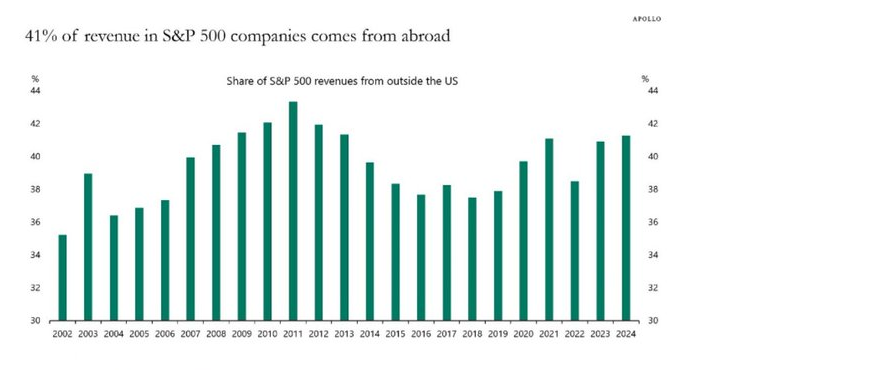
* No country is an island. The current narrative is that the outlook for the U.S. is great but the outlook for Europe, U.K. and China is not good. The problem with this optimistic line of thinking is that over 40% of revenues in the S&P 500 come from abroad:
* Elon Musk's health and business/innovative successes are critical to a continuation of economic growth and stock market gains. Musk's broad reach — on the road, underground, in space, over the internet, in defense, in artificial intelligence — has now advanced into Washington, and in the formulation and implementation of policy. To have one person so immersed and involved in all these critical areas could pose broad risks — in many ways.
* An extremely leveraged cryptocurrency market represents potential systemic risks. It is my view that cryptocurrency is "the mother of all bubbles" perpetuated by a number of factors (including the rejection of fiat money) and developing digital narratives — many of which have a weak foundation of logic. The absurd notion that the limiting of supply of bitcoin is as stupid as it is damning — as there is no limit to the supply of other cryptocurrencies. To us, the sheer market size of Bitcoin and other cryptocurrencies is a manifestation of the risks.
When the cryptocurrency markets implode, which is my baseline expectation, the contagion effect will likely be pronounced on all of the capital markets.
* Both fiscal and monetary policy — which is needed to secure the foundation of growth — are travesties. Neither political party has been fiscally responsible — the profligate spending over the last few decades continues apace. (I do not, in any way, buy Elon Musk's objective of cutting $2 trillion from the U.S. budget, as when you go over the numbers only about $1.5 trillion can be cut (and that is if one cut all that was "available" to be cut in total). As well, the Federal Reserve has been guilty of reckless, feckless, and fatuous policy in its delayed response to inflation and then, in effecting a rapid rise in interest rates. I have little confidence in Powell's Fed steering clear of debris in his remaining time at that institution. Nor am I confident in any Fed chairman that might replace him.
* Changing market structure poses a significant market risk. Passive investing has engulfed the stock market landscape. We are all traders now, on the same side of the boat and worshiping at the altar of price momentum.
Massive inflows into passive strategies and products have been the straw that has stirred the market's drink. In part, those inflows, have contributed to a near-unprecedented narrowing in the equity risk premium (to 20-year lows) while the risk to earnings growth is at 20-year highs:
I can guarantee you (and history has proven) that these inflows — as well as FOMO and the animal spirits — will also not be permanent conditions. And when market momentum is broken and inflows turn into outflows, markets will likely suffer more meaningfully than most investors expect.
Bottom Line
As we enter the new year, we are of the view that stocks are increasingly vulnerable.
Specifically, we estimate that the market’s downside is probably between 2-times to 3-times the upside.
Despite heady valuations, the short-term headwinds are multiple, and the intermediate-term and other existential risks are considerable and growing.
On the latter point, as the New York Times columnist Ezra Klein writes about existential (society) risks:
"Donald Trump is returning, artificial intelligence is maturing, the planet is warming, and the global fertility rate is collapsing.
"To look at any of these stories in isolation is to miss what they collectively represent: the unsteady, unpredictable emergence of a different world. Much that we took for granted over the last 50 years — from the climate to birthrates to political institutions — is breaking down; movements and technologies that seek to upend the next 50 years are breaking through.
"Any one of these challenges would be plenty on its own. Together they augur a new and frightening era. I find myself returning to a famous translation of a line from Antonio Gramsci: “The old world is dying, and the new world struggles to be born: Now is the time of monsters.”
That said, and as I have discussed in the past — I am fully cognizant that short selling preserves capital (in tough times) and long buying creates capital (in good times).
As I have reminded my investors and our subscribers in the past, our cautious investment stance — leading to a portfolio consisting of pairs trades and a sliver of a net short exposure — is not permanent by any means. Equities tend to rise most of the time and being long has an inherent advantage over being short. (Longs theoretically have no limitation to the upside in percentage terms, while shorts can only return 100% (upon bankruptcy).
If I am correct in our ursine view, a top-heavy technology-based Mag 7-led market should soon begin to topple, finally providing us with some long opportunities in the months ahead (or even sooner).
This article is a compilation of recent commentary in my Daily Diary on the TheStreet Pro and comments delivered to my investors at my hedge fund, Seabreeze Partners.)
At the time of publication, Kass was short KO (VS), SBUX (VS), CHGG (VS), WGO (S), FIGS (VS), MPW (VS), BXMT (VS), SNBR (S), AEG (VS), WBD (S), FXLV (VS), WOOF (VS), RILY (VS), INTU (S).