Is It Too Late for Copper Bulls After Trump Shakes the Market to Its Core?
Getting the urge to get bullish after the president's copper tariffs trigger the largest intraday rally since the 1980s? Read this first.
You've reached your free article limit
You've read 0 of 1 free Pro articles.
The President of the United States casually revealed the intent to impose a whopping 50% tariff on copper imports during a recent cabinet meeting. Soon after, it was confirmed to take effect on August 1.
The news, but more prominently the magnitude of the levy, shook the copper market to its core. Within minutes, futures contracts representing the industrial metal soared as much as a dollar per pound marking the largest single session since the late 1980s.
I’ve been a commodity broker for over two decades, and I’ve spent a significant portion of that time warning people about the dangers of copper trading. In fact, for the first 10 to 15 years of my career, I advised option traders to steer clear due to a lack of liquidity.
For years, the limited trading volume caused substantial slippage in option trades on a good day, but on a bad day, it made it impossible to exit. However, in recent years, the CME Group has focused on encouraging market makers to create a viable copper option market. As a result, trading conditions have improved dramatically. That is, until Tuesday’s surprise copper rally took traders and market makers by storm.
For the remainder of the trading session, the option market was essentially broken. The closer expirations had market maker bids and asks, but they were wide enough to drive a truck through, and, for a good reason, option pricing was wildly inflated.
Ironically, the sudden increase in volatility not only exploded the value of the call options in all expiration dates, but put options also increased in value despite a once-in-a-lifetime rally! Lastly, if you were trading back months, as we were, there were no “options.” Market maker quotes were absent, and we attempted to place orders at fair theoretical prices, but nobody would take the other side.
This isn’t to say copper options should be off limits by speculators; this happens in all markets, even the deepest, such as the E-mini S&P 500. However, the liquidity usually returns in minutes or hours, not the next day, as was the case this time. Thus, extra caution is warranted, and quantity risk must be managed. In other words, this isn’t the market to load up large contract sizes in; even if your account size, risk tolerance, and margin allow, keep it small so you can play offense when unusual opportunities arise.
If you are getting the urge to get bullish on copper because of the 50% tariff being applied next month, tap the brakes on your enthusiasm. There are a few key fundamental points to consider.
For starters, the U.S. produces about half of its current copper needs in-house and imports the remaining demand from Chile, Canada, Mexico, Peru, and the Democratic Republic of Congo, in that order. Yet, the accumulation of environmental red tape is believed to have slashed U.S. production by about half of what its true capabilities are. Thus, assuming the removal of such regulations wouldn’t be detrimental to the environment, it could be argued that we have plenty of spare capacity to come online to fill the gap. If so, there is a good argument that the tariff impact is more than priced into the market. Further, that tariff impact is likely to thwart demand as consumers and producers adjust to the new reality. If so, copper prices could easily trade back into the low $4.00s in the coming months.
Let’s not forget that seasonality for metals markets is generally sluggish, and those who want to be long or bullish on copper have probably already acted. After all, the Bullish Consensus Sentiment reading is in the mid-70%, which means the masses are expecting higher prices. As we know, the masses generally don’t get what they are looking for.
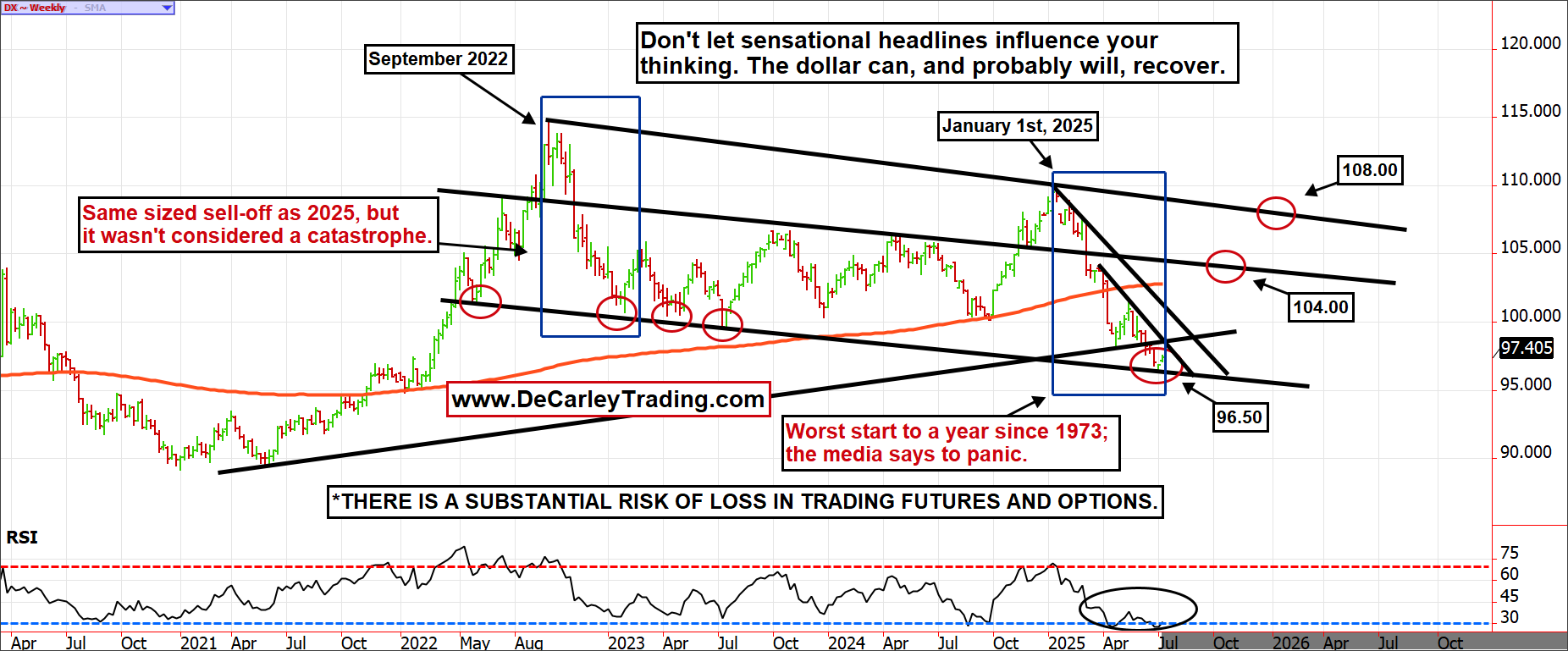
Perhaps the most significant headwind against the copper rally will be the U.S. dollar. We’ve all read the stats: This is the worst start to a year for the U.S. dollar since 1973. But those types of data points are only made possible when a market comes into the year on a high note, and with everyone long the market. In other words, it isn’t necessarily an unprecedented move; we saw the same-sized selloff from September 2022 to February 2023, but because it didn’t begin at the turn of the year, it didn’t qualify for sensational headlines.
In any case, nothing is suggesting that the greenback will stay down here. There is a good chance we will see the dollar retrace most of its recent selloff in the coming months. If so, that will put pressure on copper and most other commodities regardless of fundamentals or even a 50% tariff.
If you weren’t long copper going into the news, it is probably too late to get involved. Chasing headline-driven commodity rallies is a fool’s errand. Oil traders learned this lesson a few weeks ago when trying to buy into the rally that occurred on the heels of U.S. bombs dropping in Iran.
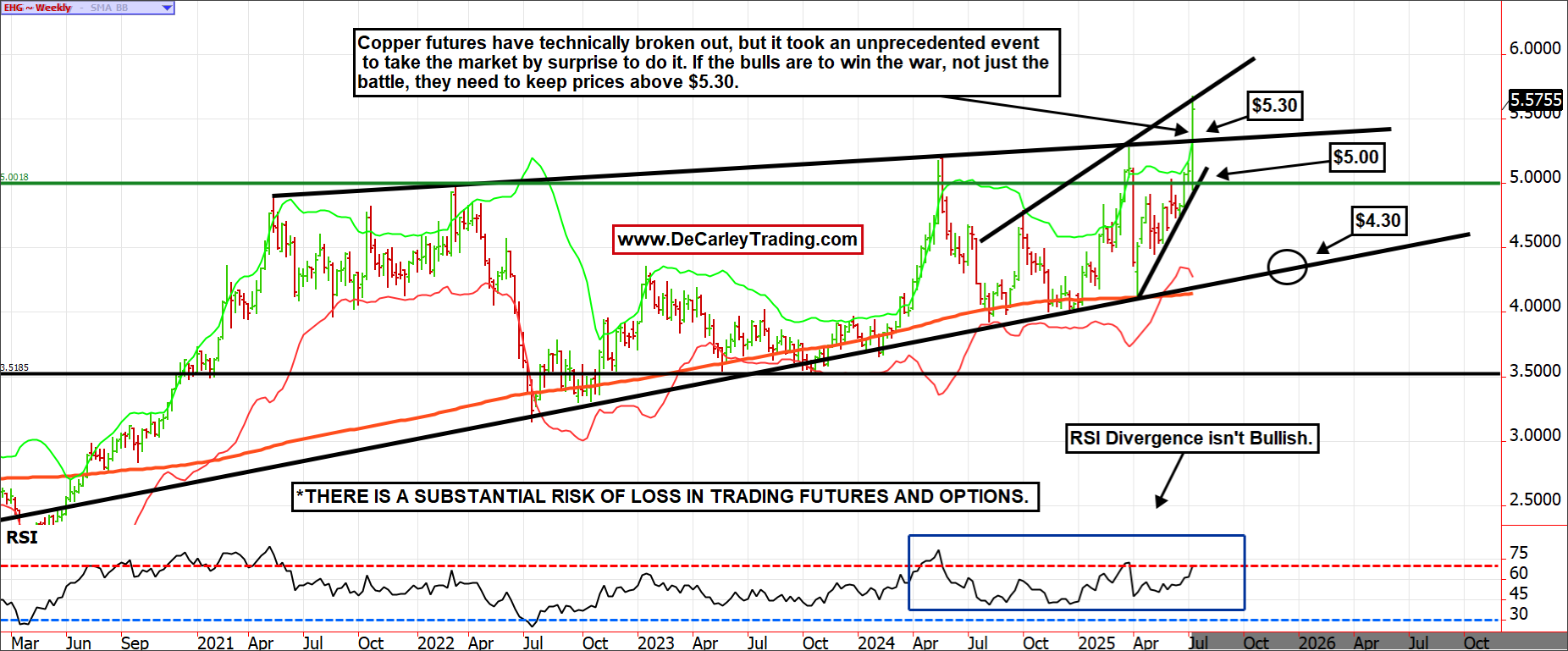
Technically, the weekly chart suggests a breakout, but copper breakouts are rare and untrustworthy. The bulls will need to keep prices above $5.30 to stave off mass liquidation. If you recall, $5.30 was the blow-off top reached around the “Liberation Day” chaos. A break of $5.30 support would be concerning for the bulls, but a close below $5.00 opens the door for a move to $4.30. We believe this is the most likely scenario.
If you were on the other side of the coin and went into the copper tariff announcement short the market, as we did (with option spreads), the best move is likely to hedge your bets and let the market work things out. With time, gravity likely comes into play.