Is Beef the New Eggs or Will Consumers Continue to Pay a Premium for the Protein?
The cattle market has made a lot of smart people look foolish. Will this be the only commodity to ever defy gravity?
You've reached your free article limit
You've read 0 of 1 free Pro articles.
Occasionally, commodity bull markets get carried away. In some cases, it appears that there are no limits to the chaotic price discovery process. However, since the beginning of commodity markets, at least of the renewable variety, high prices have always cured high prices. Yet, the cattle market has put on quite the display of resiliency.
Cattle, and therefore, beef pricing, have exceeded the most wildly bullish expectations, both in terms of the magnitude of appreciation and the longevity of elevated prices. As we have said before, we doubt this will be the only commodity to ever avoid the inevitable, but thus far that has been an incorrect take.
Over the weekend, I posted a picture of a pack of red meat being sold at Costco on social media. I posted it from the perspective of a consumer, but because I am a commodity broker by trade who services cattle ranchers, some took exception.
The premise was that at Costco COST, there was a choice between three large Prime-grade ribeye steaks for $80.00 or five Choice-grade New York strips for the same price. Either way, they wanted $80.00 from consumers (ignoring a few other options such as $40.00 for a tri-tip roast or $34 for six pounds of ground beef).
The reason high commodity prices cure high commodity prices is because the consumer pulls back as prices increase. It is hard to believe that too many families out there can afford, or would choose to afford, $80.00 for a single dinner protein before considering sides. To be fair, a single quality steak in Las Vegas can range anywhere from $80.00 to $200, but those are prepared nicely and served on a fancy plate. Further, for most consumers, that would be a spurge experience, not an everyday event.
In short, unless consumers have unlimited budgets or prioritize red meat over most things in their life, demand for beef isn’t guaranteed. I, like many, am choosing alternatives such as chicken, pork, turkey, and fish.
Aside from demand destruction, there are other reasons to suspect the cattle rally is nearing completion. For starters, supply has historically been tight, which is what has led us to this point. But closure of the Southern border to the meat trade due to threats posed by the screwworm fly and fresh tariffs on Brazil have exacerbated the situation. Yet, as bullish as the news and supply demand statistics are, the market is mostly ignoring the fact that while there are fewer head of cattle, each animal weighs more now than it ever has. So, supply is stretched, but one could argue the market is overpricing that narrative.
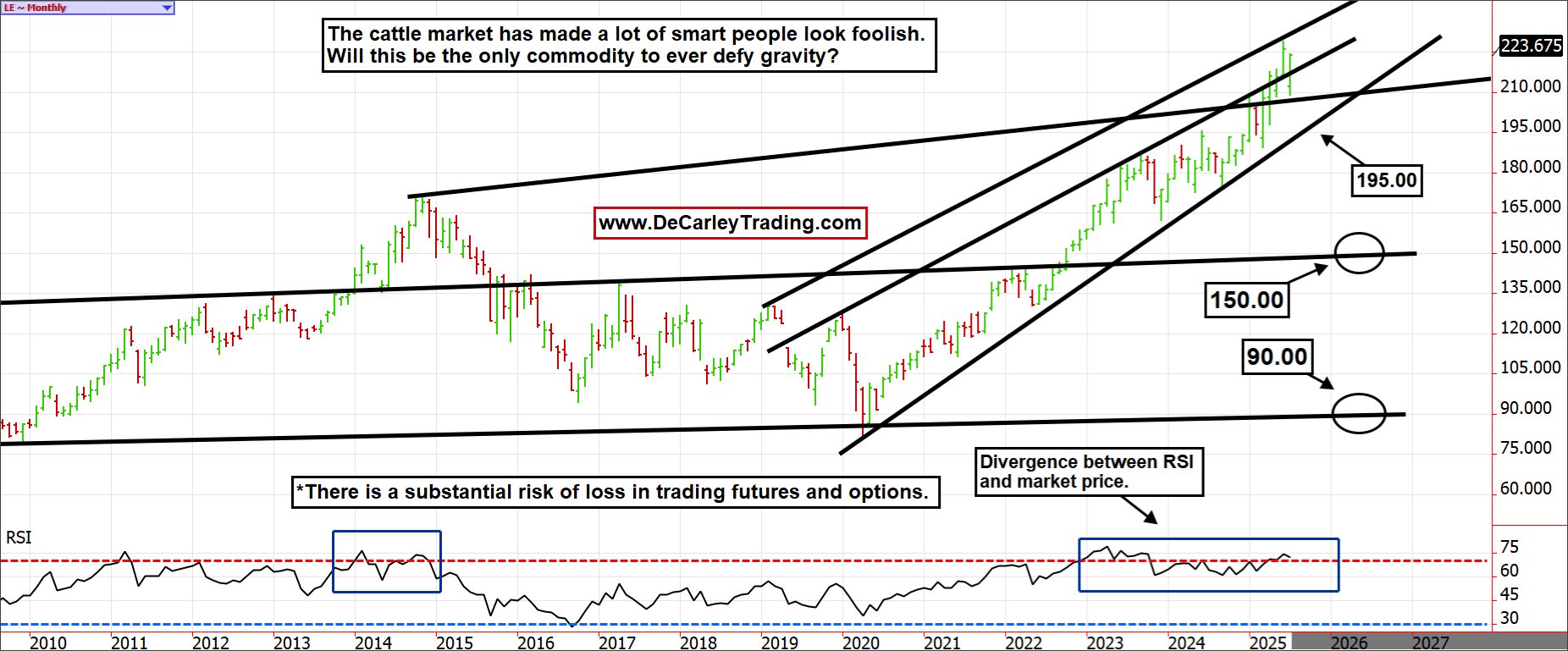
Cattle Market Follows the S&P 500 Herd
A monthly chart of live cattle futures is operating with a monthly RSI (Relative Strength Index) over 70.00. This is a relatively rare occurrence, and in cattle, or any other commodity, it can persist but isn’t sustainable in the long run. Unlike stocks, which can and do move higher overall, commodities generally trade sideways to lower over time. This is because technology is deflationary, and consumer demand is elastic.
In addition to traditional fundamentals, the direction of the cattle market has become wildly dependent on the direction of the S&P 500. Over the previous 60 trading days, the S&P and cattle have moved in the same direction 80% of the time. There is a good explanation for this; higher equities lead to a more active consumer due to the wealth effect. Both of these markets are entrenched in uptrends. But with the masses already owning or bullish on these assets, we could be in the final stages.
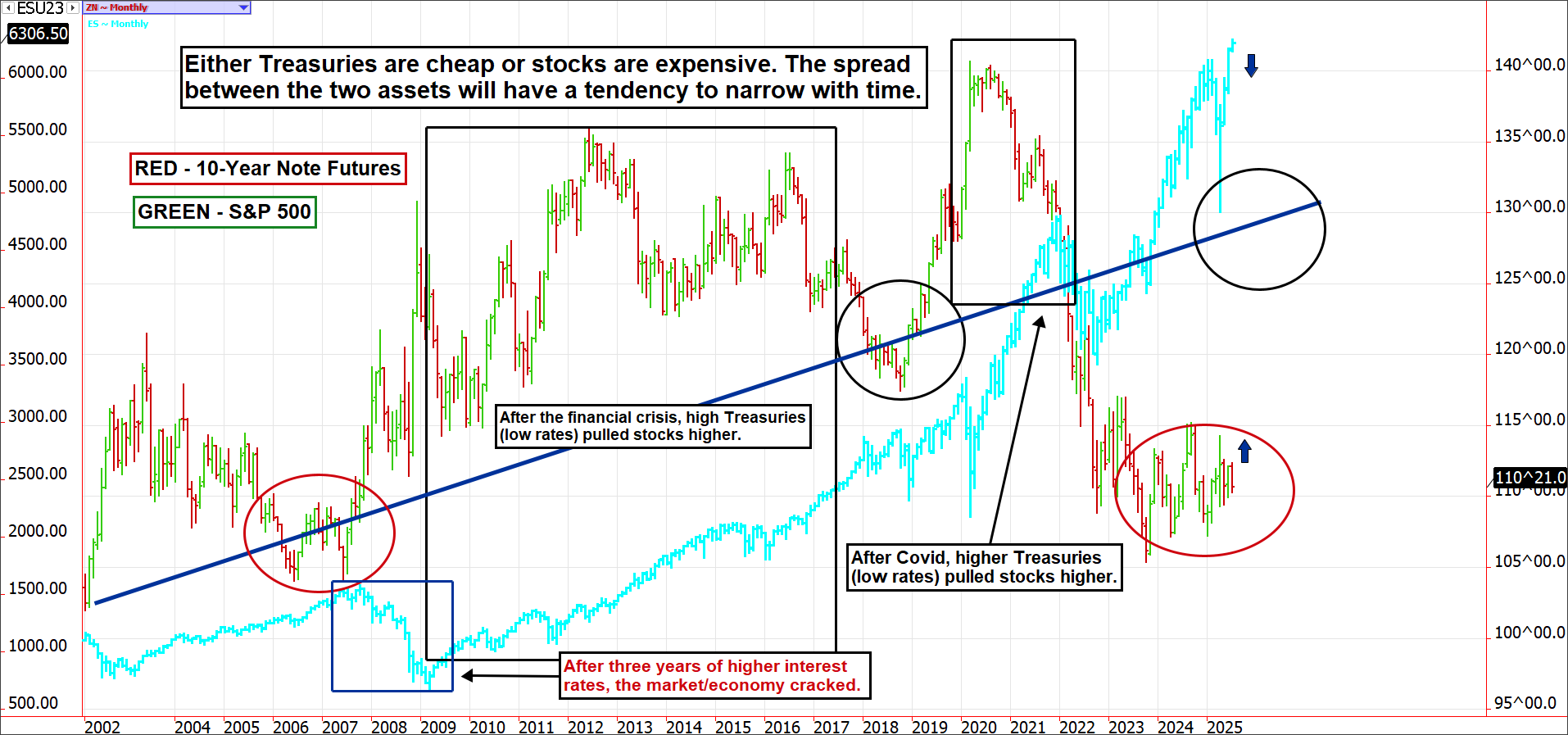
I've shared the chart below several times, including at the MoneyShow this week here in Las Vegas. However, this time around, I want to focus on the left-hand side of the chart, rather than the right.
In the three years before the Global Financial Crisis, the 10-year note futures traded near the same level as it is trading today (a yield of 4% to 5%). The Fed had increased rates at the short end of the curve, and the long end was following.
The stock market and the economy continued to hum along, seemingly unaffected by the higher rates. However, eventually, the higher rate environment and an overleveraged system began to reveal who was swimming naked.
In subsequent years, the S&P 500 was shaved in half, and the Fed dropped interest rates to nearly zero (Treasuries rallied). We don't know if this will happen again, but we should be aware of the possibility. Markets often rhyme.
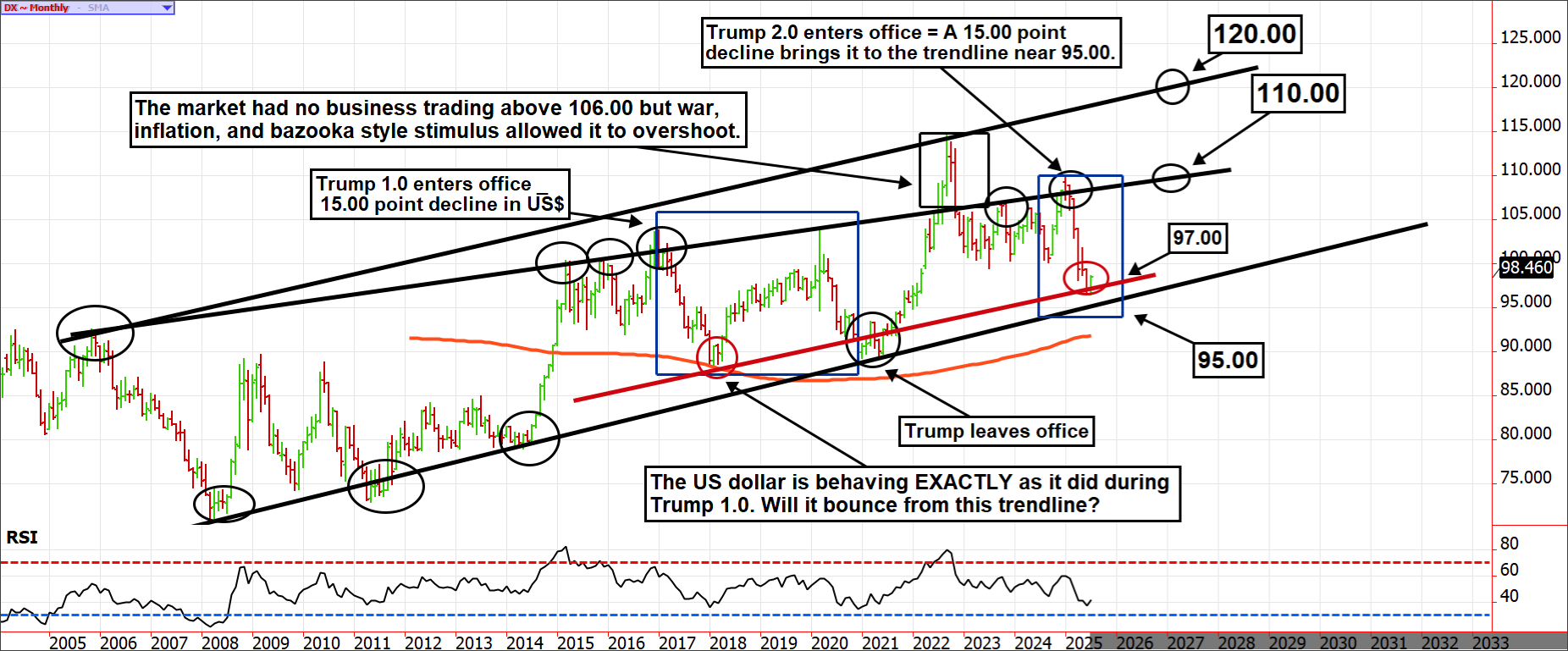
Cattle Futures and the Dollar
Another correlation we are monitoring in the livestock market is the relationship between the U.S. dollar index and cattle futures. Throughout the previous 60 trading sessions, the U.S. dollar index and live cattle futures have settled in the opposite direction just under half of the time. While this is less compelling than the positive correlation to stocks, we can assume a higher dollar would work against cattle prices.
With that thought in mind, a monthly chart of the U.S. dollar index futures contract appears to have put in a bottom. Thus far, Trump 2.0 has played out identically to Trump 1.0 regarding the greenback. If this pattern continues, 110.00 should be seen. To put this in perspective, just the change in currency, all else being equal, could equate to $1.80 live cattle.
The fundamental narrative is always the loudest at the top and bottom of any market. The quintessential example is the crude oil top of 2008. A single barrel of crude was temporarily valued at $150 because the world was convinced that we were running out of fossil fuels. As it turned out, we weren’t running out; we just needed to invent the right technology to allow more efficient extraction from the earth.
Livestock is obviously a different “animal”; rebuilding herds takes time because Mother Nature limits the industry. Nevertheless, high prices not only thwart demand (eventually) but they encourage producers to accelerate their operations to take advantage of the pricing.
I, for one, am not interested in lab-grown meat or bugs, but others might be. Additionally, consumers can opt for chicken, pork, or various fish varieties at a lower cost per pound compared to ground beef (the lowest quality of red meat). Eventually, this will matter.
Lastly, the government took unprecedented action to increase the supply of eggs and lower market prices. There are whispers that a similar approach might be employed to help tame elevated beef prices.