Iran Is Everything
More than this week's earnings (Goldman, BofA, Netflix) and more than the big economic data, what matters most now is what happens with Iran. Also, let's check the ugly CPI, consumer sentiment and the chart.
You've reached your free article limit
You've read 0 of 1 free Pro articles.
 Market_Recon_TSP1_KL
The Dark Horse
Yea, I'm the dark horse
Maybe a lost cause
I should be the last thing on your mind
And it's never easy
And it never will be
Wished it was different this time
No, not this time
No, not this time
- Riley, Frohlich, Griffin, Nickels (Riley' LA Guns), 2024
Tumbleweed
Dust and debris blew across a quiet street. Sounds echo from afar. The entire world, or maybe just the entire financial world, waited for 6 p.m. ET and the opening of U.S. equity index futures markets. Many folks outside of the industry don't know that on Wall Street, Monday morning starts on Sunday night. That's why your "financial" friends disappear early on Sunday and seem to always cut their weekends short.
It was ugly on Sunday evening. Really ugly. That said, as the night wore on and Sunday evening melted into the "zero-dark" hours of Monday morning, there was visible support for the very same markets that had been smashed earlier. A very dour tone had been taken on early by the keyword reading algorithms that now control market-based price discovery in the wake of the failed peace talks between the U.S. and Iranian delegations in Pakistan over the weekend.
After talks broke down over the weekend, reportedly due to the Iranian delegation's insistence on that nation's right to build, field and threaten neighbors with nuclear weapons. Vice President JD Vance, who led the U.S. delegation in Islamabad, said, “The simple fact is that we need to see an affirmative commitment that they will not seek a nuclear weapon and that they will not seek the tools that would enable them to quickly achieve a nuclear weapon.”
Apparently, the problem for the U.S. side is that consistent heavy bombing as well as undeterred naval and air supremacy around and over Iran have indeed dismantled much of Iran’s nuclear program. These conditions, however, have not yet put these kinds of weapons out of reach.
Related: 3 Reasons Why Investors Are Unconcerned About Failed U.S.-Iran Negotiations
In Response...
On Sunday, U.S. Pres. Donald Trump announced that the U.S. Navy would launch a blockade of the Strait of Hormuz after Iran had failed to surrender, even after a decisive military defeat, their nuclear weapons program. The president posted to social media, "Effective immediately, the United States Navy, the Finest in the World, will begin the process of BLOCKADING any and all Ships trying to enter, or leave, the Strait of Hormuz."
The president said that he had asked the Navy to "interdict" any ship that had paid a toll to Iran for safe passage through the Strait. Trump wrote, "No one who pays an illegal toll will have safe passage on the high seas." As for the implementation of said blockade, CENTCOM (U.S. Central Command) has stated that the Navy will effectively blockade these Iranian ports starting at 10 a.m. this (Monday) morning. This action will very likely, for all intents and purposes, completely collapse what is left of the Iranian economy, while for now, accelerating oil and gas prices for the rest of the world, Asia in particular.
The blockade will include all Iranian ports on the Arabian Gulf and the Gulf of Oman. Vessels traversing the Strait of Hormuz without stopping at Iranian ports will not be stopped by the U.S. Navy. Front month WTI Crude futures, that traded with a $95 handle on Friday evening, have traded with a $105 handle overnight. S&P futures are trading lower this morning relative to Friday evening but are well off of their Sunday night lows.
Additionally, the Wall Street Journal is reporting that the Trump administration is considering the resumption of bombing raids into Iran that could be anywhere from limited in scope to something more complete. The president is said to still favor a diplomatic solution and would likely rather target energy and infrastructure support while strangling the economy externally than simply continue with the heavy bombing campaign.
Good & Bad
The economic data posted by U.S. agencies on Friday was mixed. First, the Bureau of Labor Statistics published its March consumer price index data. These numbers were ugly, but less ugly than expected. At the headline, for March, consumer prices increased 0.9% (as expected) on a month over month basis, and 3.3% (below the projected 3.4%) on an annual basis. That was still up from 2.4% for February.
At the core, which excludes food and energy prices, consumer prices grew just 0.2% in March, in line with February and below the consensus view, which was for growth of 0.3%. On a year-over-year basis, for March, core CPI printed at growth of 2.6%, below expectations for growth of 2.7%, but up from growth of 2.5% for February.
Later on, the University of Michigan preliminary survey for April consumer sentiment showed that headline sentiment had sunk to 47.6 from 53.3 in March. This is the all-time record low reading for this monthly series that goes all the way back to 1978. According to the survey, U.S. consumer inflation expectations for one year down the road increased from a median projection for a 3.8% general price increase all the way to 4.8%. Not pretty.
Hang Tough, Gang...
For shelter is gone
when the night is o'er
And bread lasts only a day.
But the touch of the hand
And the source of the voice
Sing on in the soul always
- Spencer Michael Free (The Human Touch), 1925
Week Ahead
What matters right now...
- The Situation in Iran: Quite honestly, nothing matters more at the moment.
- Macro: This will not be an exceptionally heavy week for the U.S. domestic macroeconomic data-point release schedule. March producer price index will hit the tape on Tuesday morning. Then, we'll see regional manufacturing survey results for April from both the New York and Philadelphia Feds on Wednesday and Thursday respectively. The Federal Reserve will also post March data for Industrial Production and Capacity Utilization on Thursday.
- The Federal Reserve: This will be a very heavy week for our nation's central bankers. The headliners will be Fed Govs. Christopher Waller, Michelle Bowman and Stephen Miran. Waller does not speak to Friday but is very influential. Bowman will speak on Wednesday and is also considered to be one to watch. Miran, who is an unfettered Trump ally and has been far too dovish even for me, will speak on both Monday and Thursday. The Fed will also release its latest Beige Book full of anecdotal economic evidence from across the twelve regional districts, on Wednesday afternoon. New York Fed Pres. John Williams, who I don't have a high opinion of as an economist, but does hold permanent policy voting rights, will speak on Thursday as well.
- Earnings: First-quarter earnings season finally gets underway this week. Goldman Sachs (GS) will kick off the season this evening. Citigroup (C) ), BlackRock (BLK) , Johnson & Johnson (JNJ) , JP Morgan Chase (JPM) and Wells Fargo (WFC) will all heat things up on Tuesday. On Wednesday, we'll hear from Bank of America (BAC) , and Morgan Stanley (MS) . Thursday will bring numbers posted by Abbott Labs (ABT) , and PepsiCo (PEP) in the morning and Netflix (NFLX) in the evening. Friday will be quiet on the earnings front.
The Week That Was...
U.S. financial markets posted a second consecutive winning week going into the peace talks in Pakistan...
- The S&P 500 gave up 0.11% on Friday but gained 3.56% for the week.
- The Nasdaq Composite added 0.35% on Friday, and 4.68% for the week. - The Nasdaq 100 tacked on 0.14% on Friday and 4.45% for the week.
- The Russell 2000 lost 0.22% on Friday but gained 3.97% for the week.
- The S&P Small Cap 600 gave back 0.44% on Friday but added 3.76% for the week.
- The S&P Midcap 400 gave up 0.32% on Friday but added 3.36% for the week.
- The Dow Transports lost 0.57% on Friday but gained a nice 6.55% for the week.
- The Philly Semis popped for 2.31% on Friday and for a stunning 13.49% for the week.
- The KBW Bank Index slipped 0.69% on Friday but added 5.64% for the week.
On Friday, just four of the eleven S&P sector SPDR ETFs closed out the session in the green. These funds were led higher by the Materials (XLB) . The losers were led lower by Health Care (XLV) and the Staples (XLP) as the more defensive sectors underperformed.
For the week, 10 of the 11 S&P sector SPDR ETFs traded higher, as technology (XLK) , the industrials (XLI) and the discretionaries (XLY) all took off. Energy (XLE) , for obvious reasons, tumbles going into the talks this weekend.
The Chart
Does the chart matter in light of this weekend's news? You bet your tail it does.
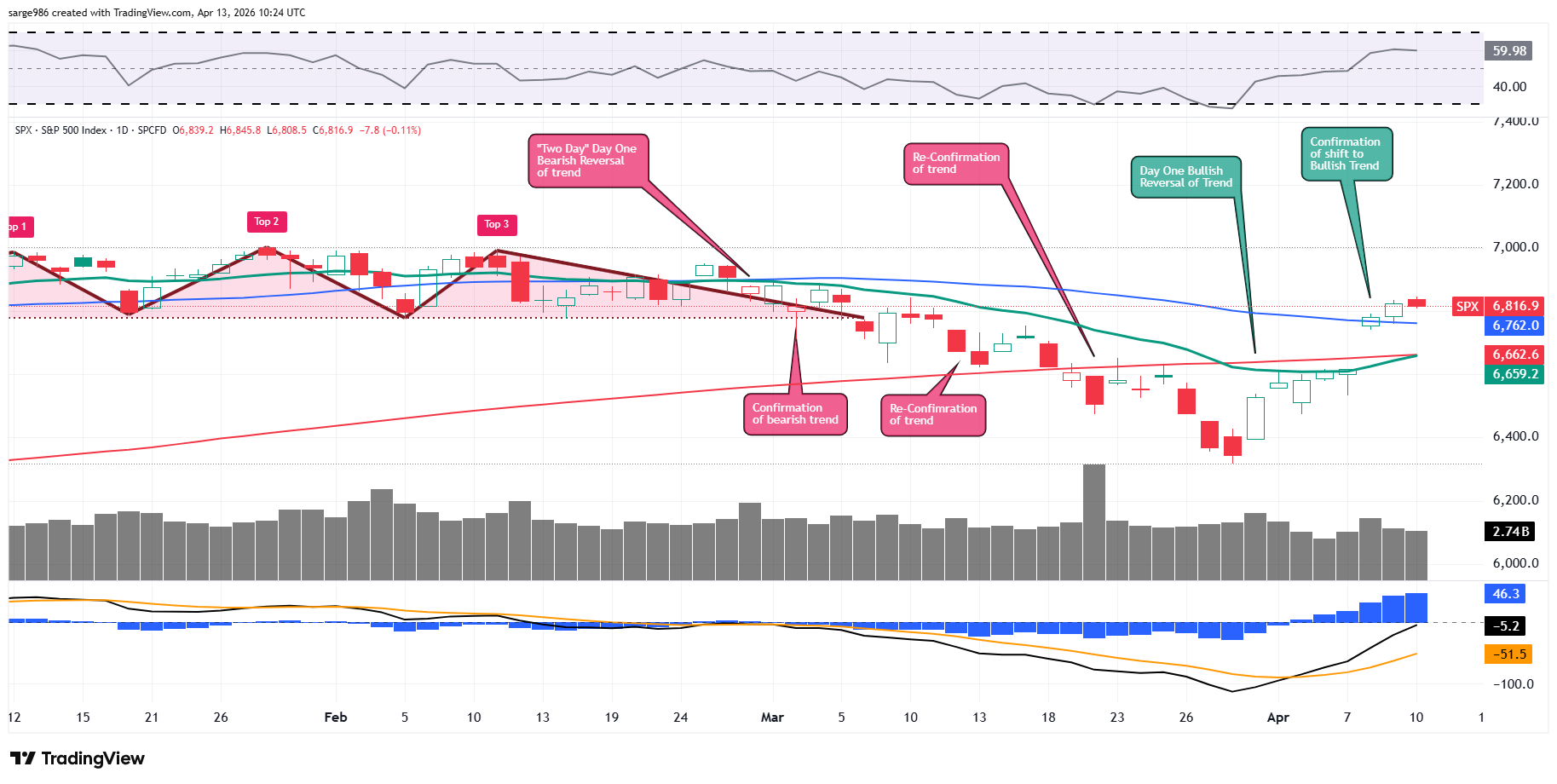
Holding onto the 50-day simple moving average and especially the 200-day simple moving average, even as peace talks failed would be crucial to keeping capital already invested where it is. Nothing else needs to be looked at for the moment.
Earnings
As of April 10, according to FactSet, for the first quarter, Wall Street now expects to see year-over-year earnings growth for the S&P 500 of 12.6%, down from 13.2% last week, but up from 11.6% a month ago. Wall Street also sees revenue growth of 9.8%, up from 9.7% a week ago. For the full year of 2026, Wall Street looks for earnings growth of 17.6%, up from 17.4% last week, and up from 14.7% a month back, on revenue growth of 9%, up from 8.8% last week and up from 7.7% a month ago. The outlook for the second quarter continues to improve quite dramatically.
At the moment, the Technology sector is projected to have grown earnings a stunning 45% for the first quarter with the materials in second place at growth of 24.2%. Three sectors, health care, communication services and energy are projected to have suffered a Q1 earnings contraction.
Valuation
Still using data provided by FactSet, the S&P 500 ended last week trading at 20.4-times 12 months' forward-looking earnings, up from 19.8 times last week, but down from 21.6 times a month prior. This is back above the five-year average of 19.9 times for the index as well as being well above its ten-year average of 18.9 times.
The S&P 500 also ended last week trading at 27.2 times trailing 12 months' earnings, up from 26.2 times one week ago, but still down from 27.8 times more than a month ago. That also stands well above the five-year (24.7 times) and 10-year (23.2 times) averages for the index.
Just six of the 11 sectors are now trading above their five-year average valuations, led by the discretionaries (26.7 times), the industrials (26 times) and the staples (22.5 times). Only tech and the REITs closed out last week undervalued relative to their five-year norms.
Fed Funds Futures
Fed Funds futures trading in Chicago are currently pricing in a 96% probability for no change to be made to the target range for the Fed Funds rate at the next federal open market committee policy meeting on April 29. There is a 4% probability for a rate hike priced in at the moment. There are still no rate cuts priced in for calendar year 2026. In fact, no cuts or hikes are priced into these markets until October of 2027. That said, keep in mind that we can expect that everything will change several times over as the year progresses, especially as the midterm elections approach.
Economics
(All Times Eastern)
08:30 - Existing Home Sales (Mar): Expecting 4.04M, Last 4.09M SAAR.
The Fed
(All Times Eastern)
6:20 p.m. - Speaker: Reserve Board Gov. Stephen Miran.
Today's Earnings Highlights
(Consensus EPS Expectations)
Before the Open: (FAST) (.30), (GS) (16.24)
At the time of publication, Guilfoyle had no position in any security mentioned.