In the End It Isn't How Much You Make, It's How Much You Keep
This is the most fantastic bull market of most of our lifetimes, but what has been mostly forgotten is that participating in it comes with risk.
You've reached your free article limit
You've read 0 of 1 free Pro articles.
I pride myself on being an optimistic person and loathe the idea of being permanently bearish on a market that has generally risen since its inception. Yet, I have a hard time looking at a monthly chart of the S&P 500 with a positive outlook, at least in the short run.
Furthermore, although not a scientific poll, anyone who has spent time on social media knows that there aren’t many stock market bears. In fact, I’ve encountered multiple lengthy and detailed threads insulting the intelligence of anyone who is not using leverage to buy stocks, either directly (through futures contracts or borrowing shares) or indirectly (by choosing not to pay off debt and instead investing that money in the stock market). The same insulting tone is aimed at anyone who holds bonds of any duration or category in their portfolio.
It is easy to see how we got here. The stock and crypto markets have essentially printed wealth for risk-takers during this cycle, particularly since late 2022. Who wants 4% to 5% in Treasuries when you can earn 20%+ in risk assets?
I’ve also spoken to many who are using AI to select stocks and allocate portfolios for them. The assumption is that AI knows what will happen next, but that isn’t true. AI scrubs the internet for data and compiles it. AI, like many market participants, operates with a short-term memory bias. It isn’t telling us what will happen next, it is confirming what has already happened. Additionally, in the trading industry, AI has been used for two decades. We call it algorithmic or system trading, and the performance of these computerized systems is just as fallible, or even more so, than human decision-making.
On the surface, the math between holding stocks versus the safety of bonds or paying down debt seems obvious. But what has been mostly forgotten is that participating in the stock market comes with risk. I know dozens of traders who made millions during the dot-com bubble and crashed and burned in the years that followed. Some of these people were friends and family, who suffered financially and emotionally; tough downsizing decisions, divorces, and worse, plagued the rest of their lives.
My neighbor, a currently retired former blue-collar worker, recently shared his story. As a government employee, he had his retirement account invested in typical 401 (k) offerings. The early 2000s equity market struggles forced him to go back to work for another three or four years to make the math work. I don’t know if this type of extreme devastation is around the corner, but I know it is possible because we’ve seen it before. Thus, it is vital to ensure that anyone over 40 is mindful of the reality of risk. It comes quickly, and sometimes it lingers for a while — even a decade or two (as Japanese investors can attest).
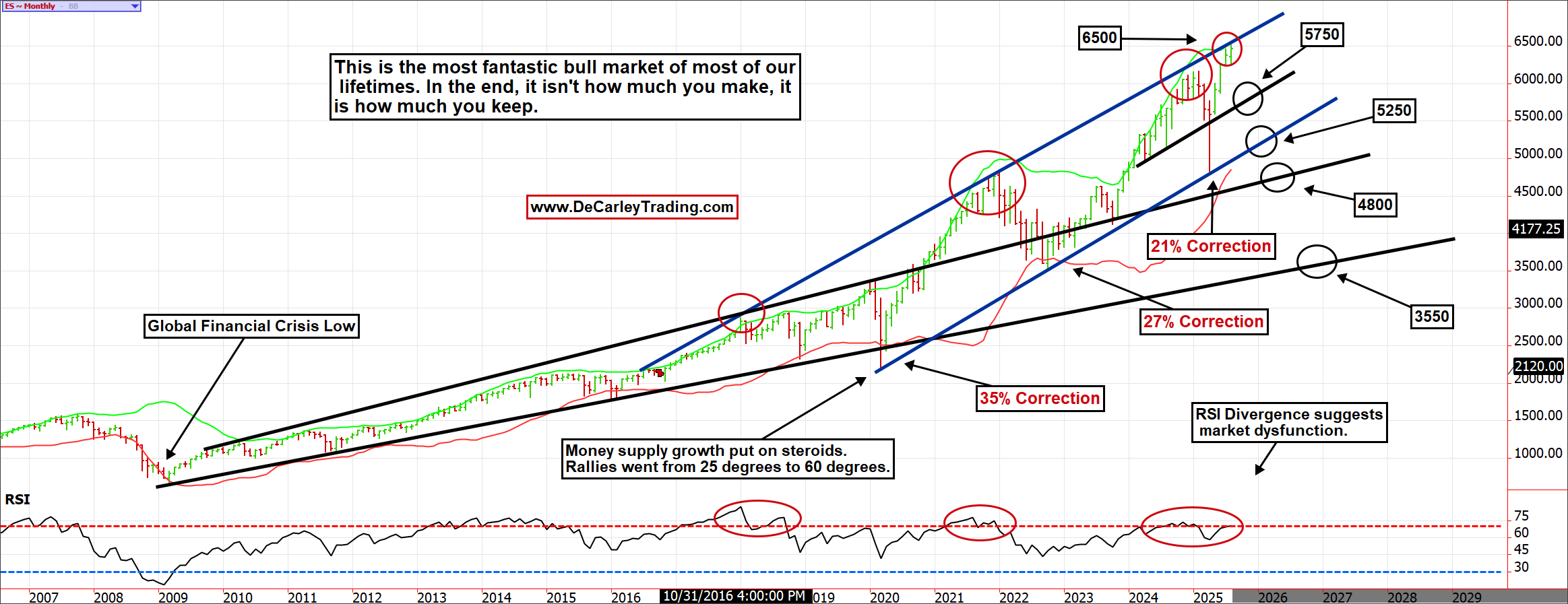
The E-mini S&P 500 is bumping against its monthly uptrend resistance line. This barrier has successfully turned rallies around all three times it was tested; we are currently entering the fourth test.
Similar to the 2018 and late-2021 patterns, the RSI (Relative Strength Index) is forming a double top from overbought territory. This suggests momentum is waning and a correction is likely.
In 2018, the rally stalled but didn’t actually roll over until two years later. In 2021, the process was significantly faster. Obviously, we won’t know how this plays out until we know, but we do know the current setup has presented investors with more downside risk than upside profit potential.
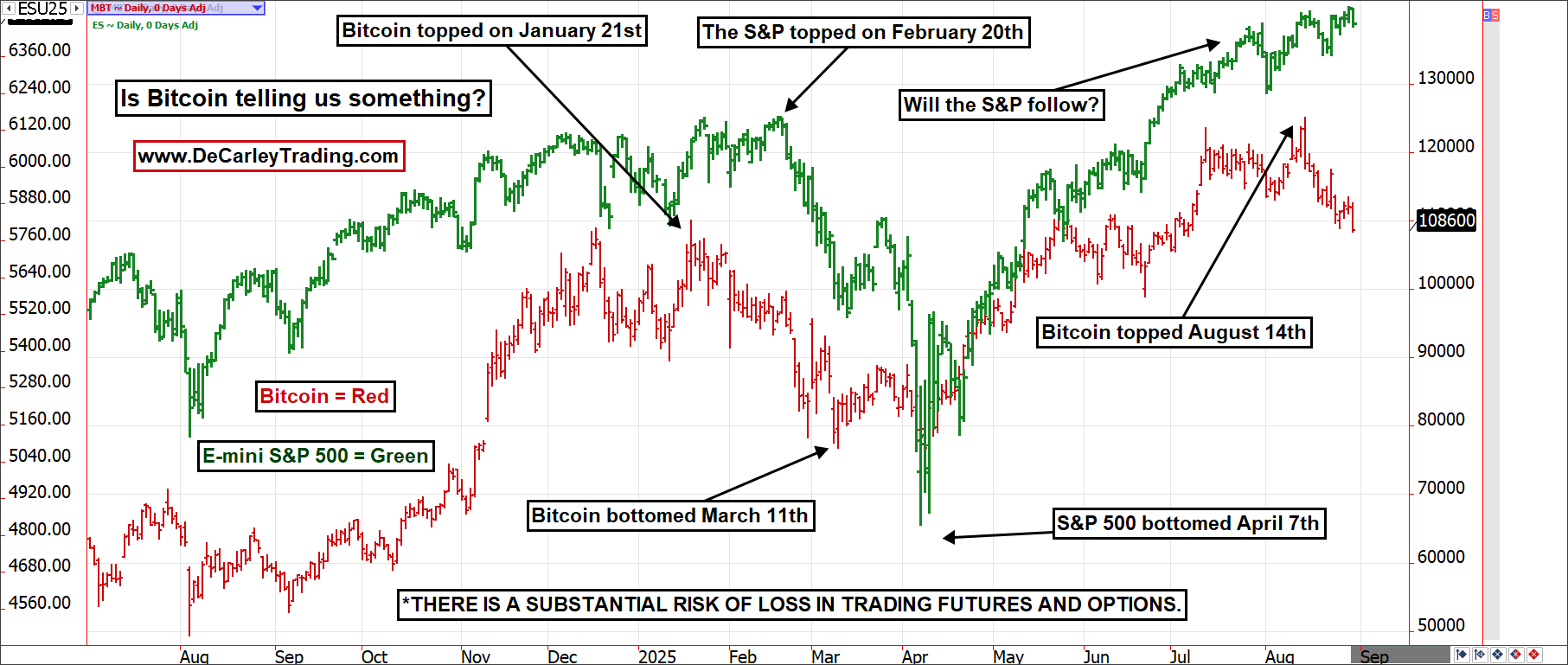
We are hardly experts on Bitcoin, but we can’t ignore patterns. For reasons that are inexplicable to me, Bitcoin has been leading the stock market.
In early 2025, Bitcoin stopped making new highs on January 21 but the S&P 500 didn’t make its last new pre-correction high until February 20. Similarly, Bitcoin stopped making new lows on March 11, but the S&P made its last lower low on April 7. Bitcoin made its last high on August 14. If it can’t recover, it will likely pull the equity market with it.
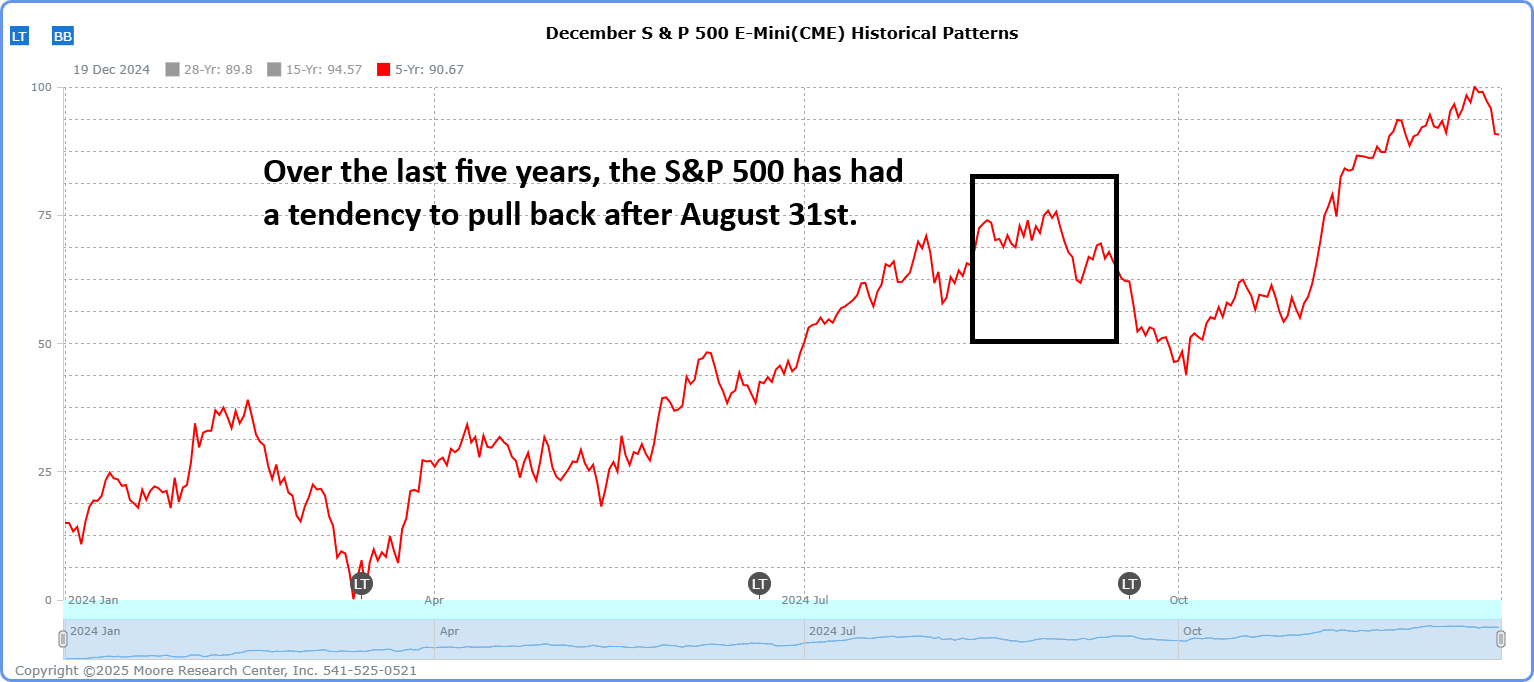
Finally, the December E-mini S&P 500 futures contract has been habitually pulling back on or around August 31 in recent years.
Bottom Line
Even in a market that perpetually moves higher over time due to the time value of earnings and dividends, there is a time for investors to hit the gas and a time to tap the brakes. This is likely the latter.