I Don’t Know Where Gold's Historic Rally Ends. I Do Know How It Ends.
The gold market is the most overbought it has been since 1979. If this isn't a blow-off top in metals, I don't know what is.
You've reached your free article limit
You've read 0 of 1 free Pro articles.
I have no doubt I’ll be talking about 2025 for years to come in a similar way I referred to the global financial crisis and the pandemic markets. I’ve made some mistakes in analysis and strategy, based on the expectation that markets would behave similarly to previous cycles, but this time has been different. While I believe the outcome will eventually conform to historical norms, the size and scope of volatility have been eye-opening.
Before going further, I’ll start by saying history doesn’t always repeat, but it often rhymes. This rhyming is the result of habitual human reactions and behaviors. We, as humans, rarely learn from our mistakes; we are prone to repeating them. Yet, in 2025, there was something else at play that I hadn’t fully appreciated until being forced to: money supply and lower barriers to leverage.
The M2 money supply grew by roughly 40% from February 2020 to December 2021. This expansion was the fastest in U.S. history to reverse a multi-year trend of 6% to 7% annual growth. We were obviously aware these factors were at play. Still, we underestimated their longevity and magnitude.
I won’t deny the positive fundamental narratives driving markets such as gold, crypto, cattle, coffee, and even equities. Still, there is little doubt in my mind that these rallies wouldn't have had the juice to achieve current valuations without the pandemic-induced liquidity injection. Lastly, I underestimated the ability of this liquidity to interfere with logical price discovery five years after the fact, turning some assets into meme stocks as the process of having too many dollars chasing too few goods.
Let’s look at the hottest commodity of the year: gold.
There were several compelling reasons to consider buying gold in 2022 and 2023, as the metal languished between $1,600 and $2,000. Interest rates were still relatively low (high rates are a competition to gold allocation), inflation was on the rise, the equity market had just endured a significant correction, and global conflicts were escalating.
At the time, we were looking for a move to what had been a decade-long trendline as a potential bullish target in the high $2,000s. As it turned out, that wasn’t the end of the rally, not even close. I realize this view contradicts other opinions, but I believe that in a more normal environment, the gold rally would have been limited to the high $2,000s or low $3,000s. Of course, we will never know, and it really doesn’t matter; the market is always right.
Market pricing doesn’t have to make sense. A prime example in recent history is NFTs and GameStop (GME) shares — sometimes, the only thing that matters is the motivation of buyers and sellers. I realize this is an unpopular opinion, but in my mind, buying gold near $4,000 — an asset with no cash flows or earnings — is akin to purchasing the Everydays by Beeple (a collage Non-Fungible Token) sold for over $69 million in March 2021. We won’t know what it is worth today because there isn’t much of a market for it, but similar tokens are trading between $15,000 to $37,000, still arguably too much for a non-productive asset.
Currently, investors are pouring money into the gold market in hopes of diversification away from equities and to hedge against a declining dollar. Yet, over the last 30 days, gold and the S&P 500 have traded with a nearly 90% correlation. Because they are both moving higher together, they are likely to both move lower together should something trigger profit-taking.
Similarly, the negative correlation between gold and the U.S. dollar in the same period was merely 30%; this suggests the metals market has probably exceeded reality. In other words, gold has likely already been priced in a much weaker dollar.
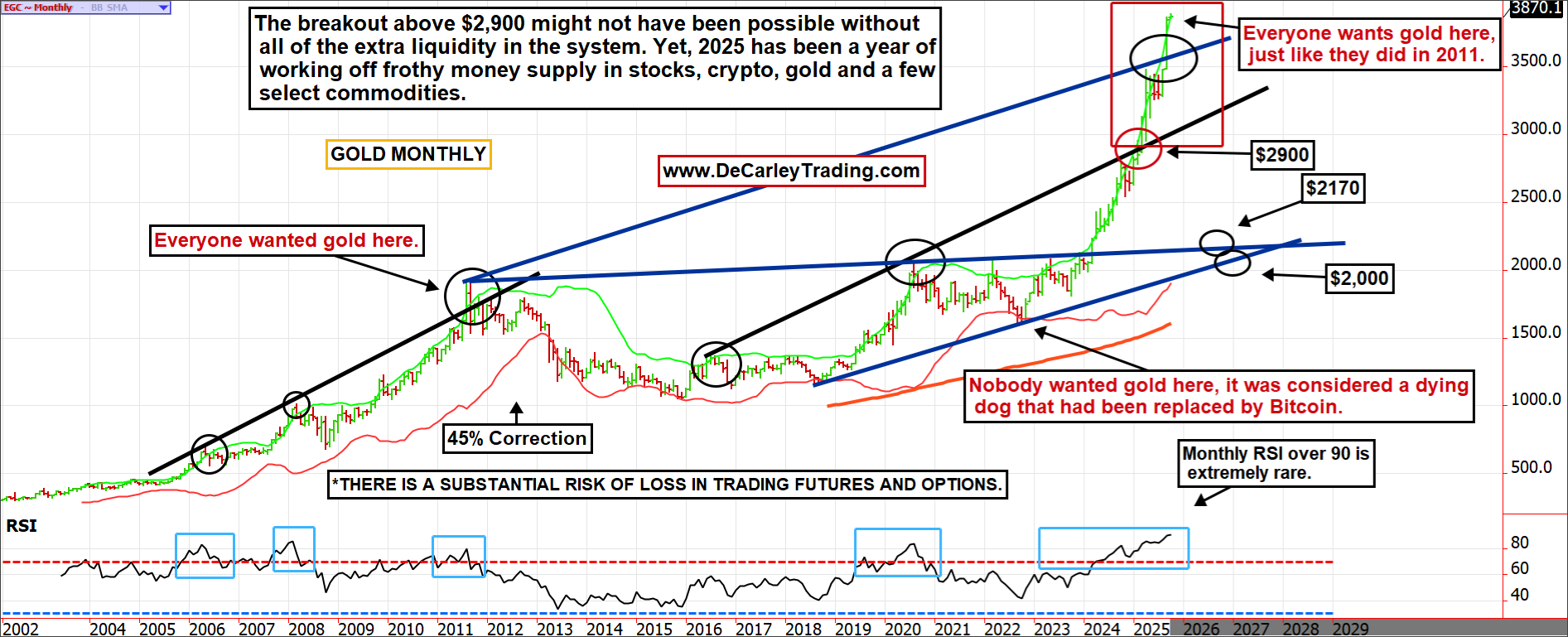
The gold market is the most overbought it has been since 1979, when measured by the RSI, which is over 90.0 on a monthly chart. Furthermore, we are witnessing monthly price bars extending over the upper Bollinger Band, which suggests a high probability of a mean-reversion event.
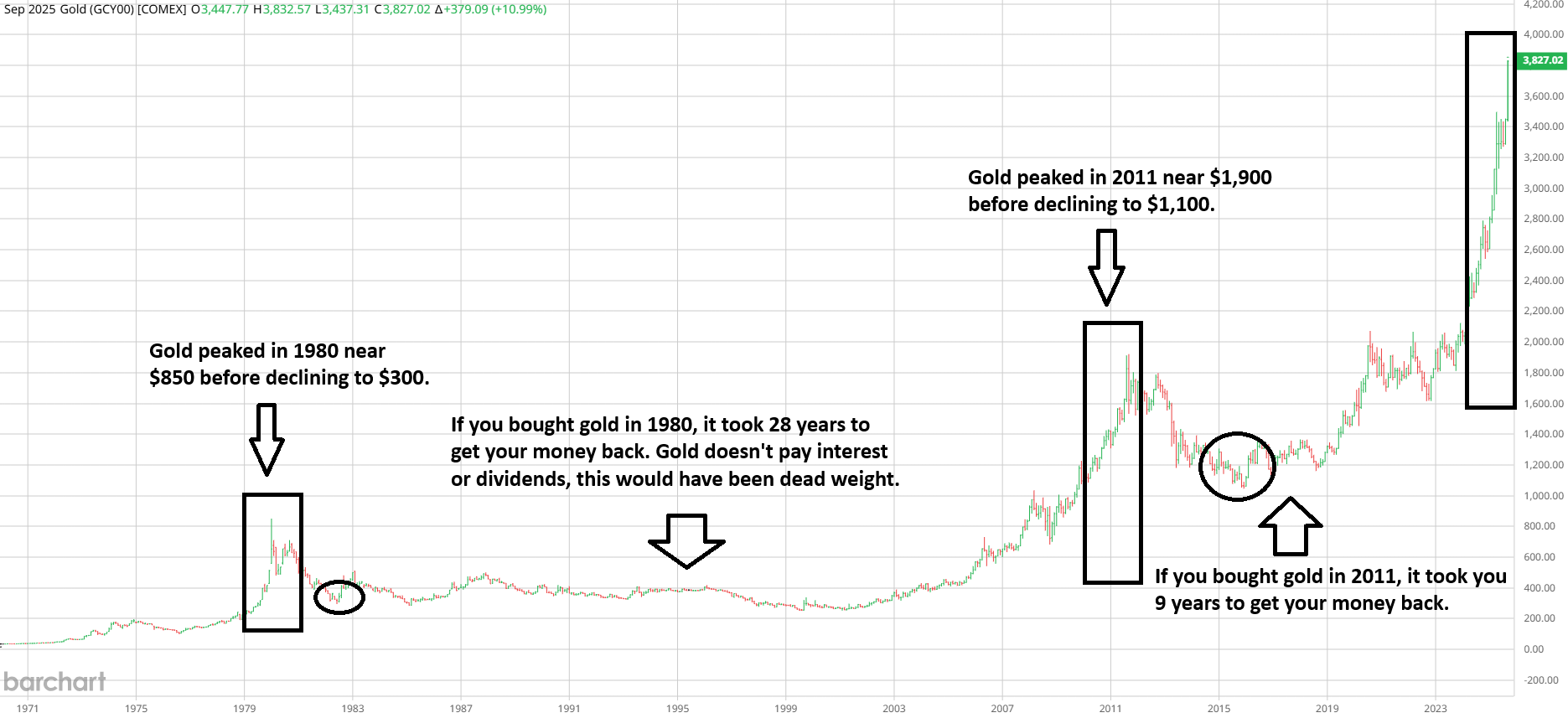
I’ve been following markets for decades and have only seen this level of extreme directional persistence a handful of times. I don’t know where or when it ends, but I have a good idea of how it ends.
I hope there are investors and traders out there who have called, but more importantly, played, the gold market better than I have. I encourage those on the right side of what is essentially a black swan event to protect profits and/or take money off the table. In this business, it isn’t how much you make that matters; it is how much you keep.
This week, I am reminding myself that "You are never as smart as you think you are when you are winning. And, you are never as dumb as you think you are when you are losing." I know I've been wrong on gold, but if this isn't a blow-off top in metals, I don't know what is.
We focus on probabilities and historical patterns; it was highly improbable for gold to behave in this manner. As previously mentioned, we have only seen it one other time in history (1979/80) — and it did not end well for the rally chasers.
Ultimately, there is nothing normal or healthy about the current state of the metals markets. Those buying gold because they believe it is a safe haven might be surprised at how unsafe this asset can be following a historic rally. Regardless of your position, your P&L, or your opinion, pay more attention to risk than profit potential.