How Could the Government Shutdown Affect Your Investments?
Let's take a close look at how stocks, bonds, gold, and more reacted during the prior shutdown.
You've reached your free article limit
You've read 0 of 1 free Pro articles.
Since 1980, there have been 10 U.S. government shutdowns. Four lasted for a day or less, which means that by the time you read this article, a settlement may already have been reached.
In addition, three shutdowns lasted for 3-to-5 days, and another three lingered from 2-to-5 weeks.
How could the U.S. government shutdown affect your holdings? Let’s look at the longest shutdown, which also happens to be the most recent.
A Caveat
Before we begin, one caveat — history doesn’t always repeat itself. There are many variables at work.
For example, stocks were plunging ahead of the previous shutdown, leading to a snapback rally. In 2025, stocks are trading near all-time highs on the eve of a possible shutdown.
Because of this variable and many like it, I don’t expect this non-scientific study to unlock any secrets for trading or investing during a shutdown. However, I do believe it’s helpful to understand what happened in the past, so that if history does repeat, we’re not caught off guard.
The Shutdown of 2018/2019
The most recent U.S. government shutdown occurred during President Trump’s first term. It lasted 35 days, from December 22, 2018 to January 25, 2019.
How did markets react at that time?
Stocks
Are you wondering why stocks are rallying, despite the fact that the U.S. government is on the brink of a potential shutdown? It could be because the previous shutdown led to significant gains in the S&P 500 (left chart) and the Nasdaq Composite (right chart).
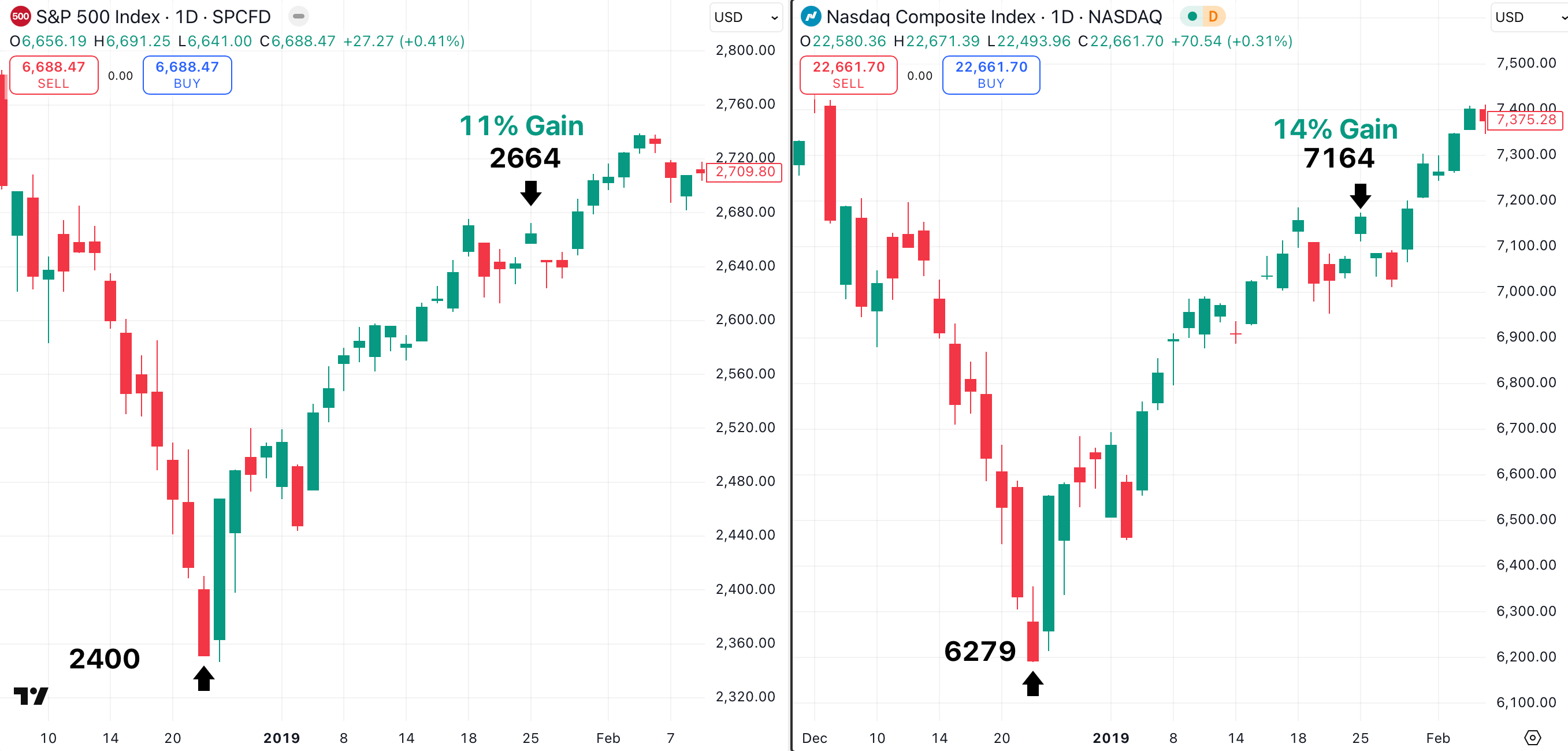
On December 24, stocks traded for the first time since the start of the shutdown. Over the next 35 calendar days, the S&P 500 gained 11%, while the Nasdaq Composite climbed by 14%.
Gold
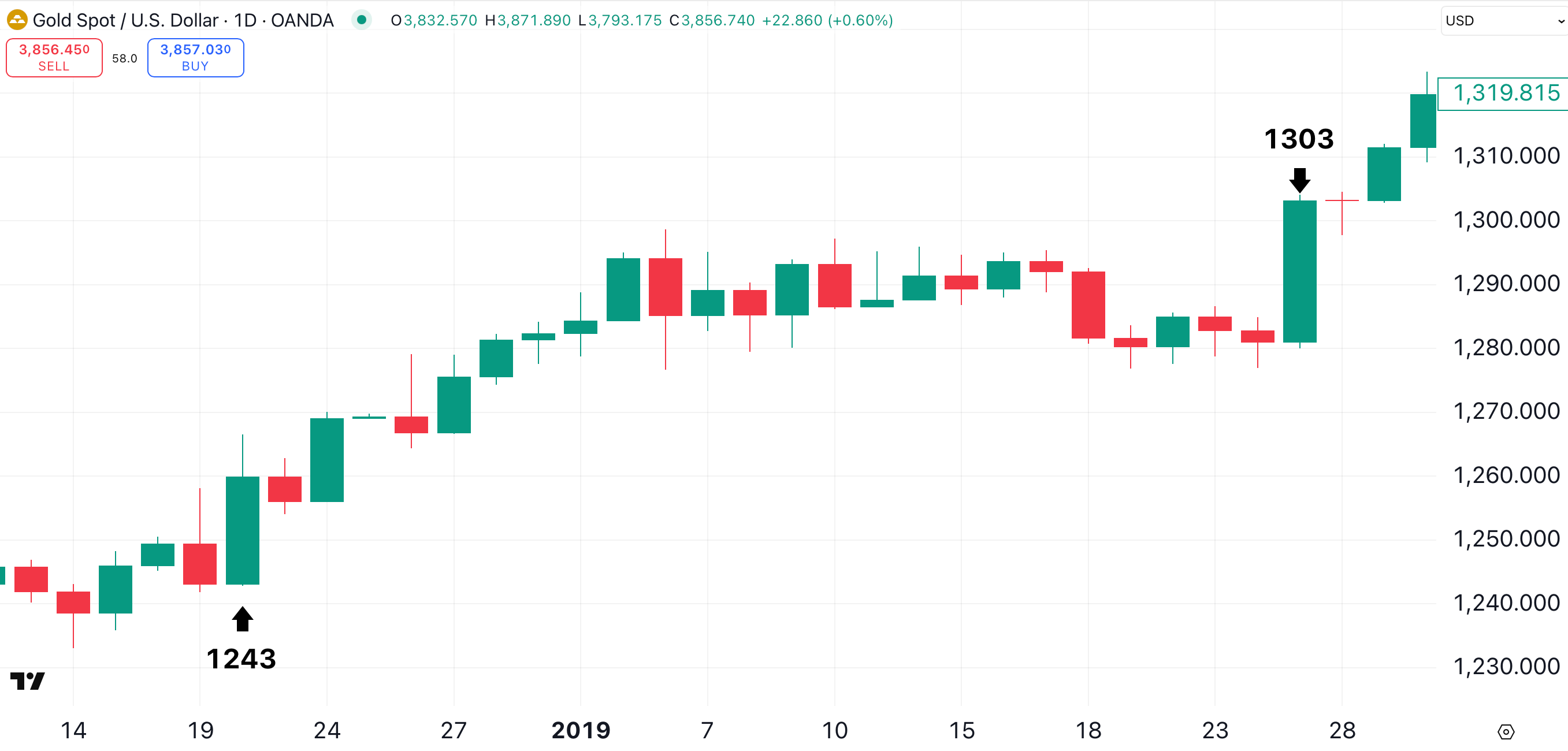
On December 24, 2018, the first trading day of the shutdown, spot gold opened at $1,243 per ounce. By the close of January 25, 2019, gold had climbed to $1,303, for a gain of nearly 5%. Gold continued to rally after the shutdown was resolved.
Bonds
The 2018/2019 shutdown had little effect on long-term bonds. The iShares 20+ Year Treasury Bond ETF (TLT) fell from $121.13 to $120.53, a decline of less than 1%.
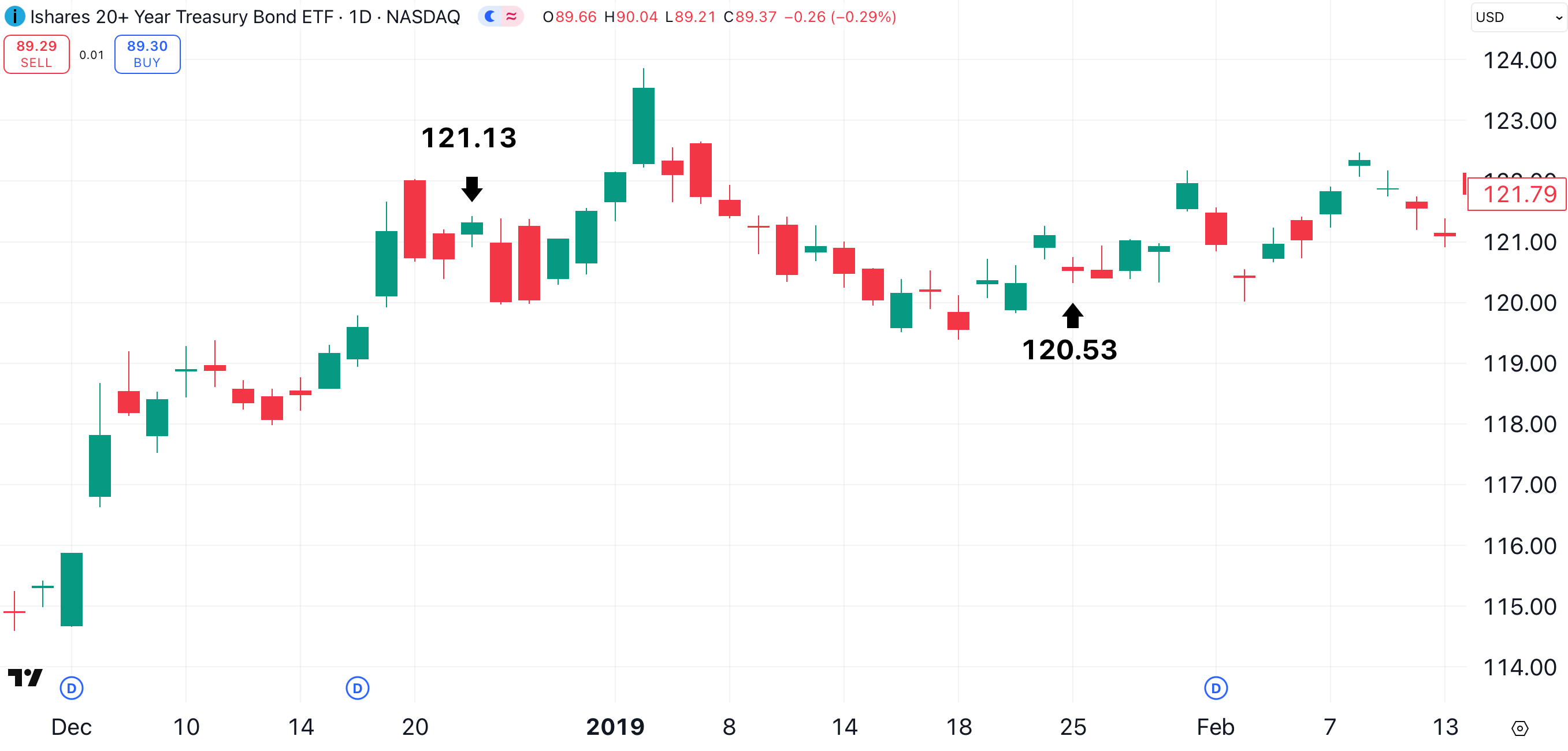
Because long-term bonds were relatively unaffected, the same could be said for long-term interest rates. Bonds and interest rates have an inverse relationship, so as bond prices gently dipped, their corresponding interest rates likely drifted higher.
U.S. Dollar
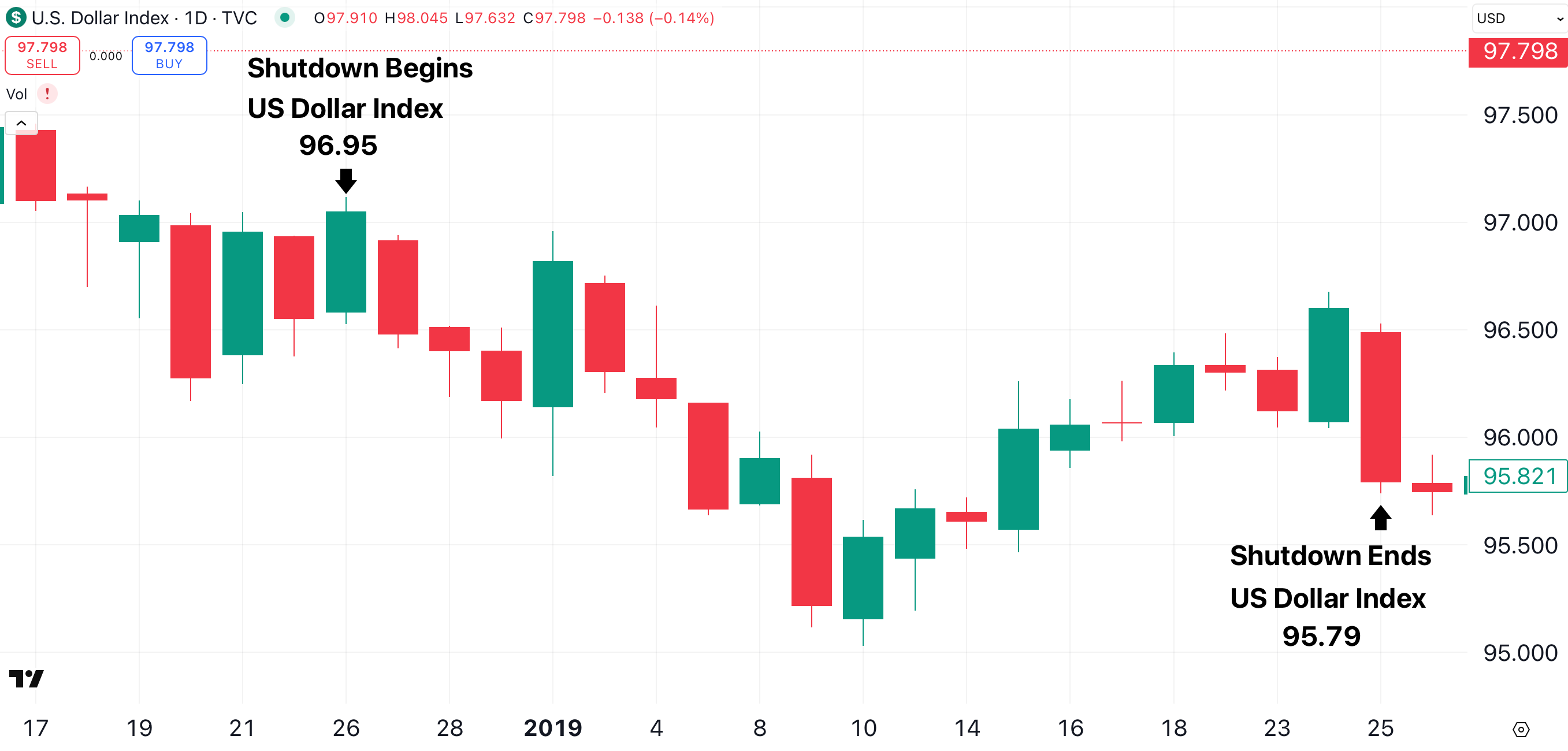
At the beginning of the shutdown, the U.S. Dollar Index traded at 96.95. By the time the shutdown ended, the greenback had fallen to 95.79, for a negative net result.
GDP
The majority of the 2018/2019 shutdown occurred during the first quarter of 2019. Therefore, its effect on the economy should be reflected in the 2019 first quarter gross domestic product (GDP). That reading covers the period from the start of January through the end of March 2019.
Result: Due to the shutdown, Q1 2019 GDP fell sharply, at a -5% rate. GDP then bounced back, growing at 2% in Q2 and 2.1% in Q3 of 2019.
Then GDP began to decline again, as the pandemic took hold in 2020.
Bottom Line
Regardless of whether a shutdown is long, short, or doesn't occur at all, it's good to have an idea of what we might expect. Democrats and Republicans seem far apart as I write this, but 40% of the shutdowns that have occurred since 1980 were resolved in three days or less.
At the time of publication, Ponsi had no positions in any securities mentioned.