Hong Kong Fire Hits Hard, and Close to Home
The tragedy of the high-rise fire at Wang Fuk Court will leave a painful legacy.
You've reached your free article limit
You've read 0 of 1 free Pro articles.
Asian equities are little-changed Friday, as you might expect given the lack of guidance from Wall Street overnight. Korea was down 1.5% as its chipmakers slide, Japan’s market rose 0.3%, and mainland China moved 0.3% higher just as Hong Kong, across the border, slipped by the same 0.3% margin.
Those are the market moves. But it’s hard to pay much attention against the backdrop of the terrible fire in Hong Kong.
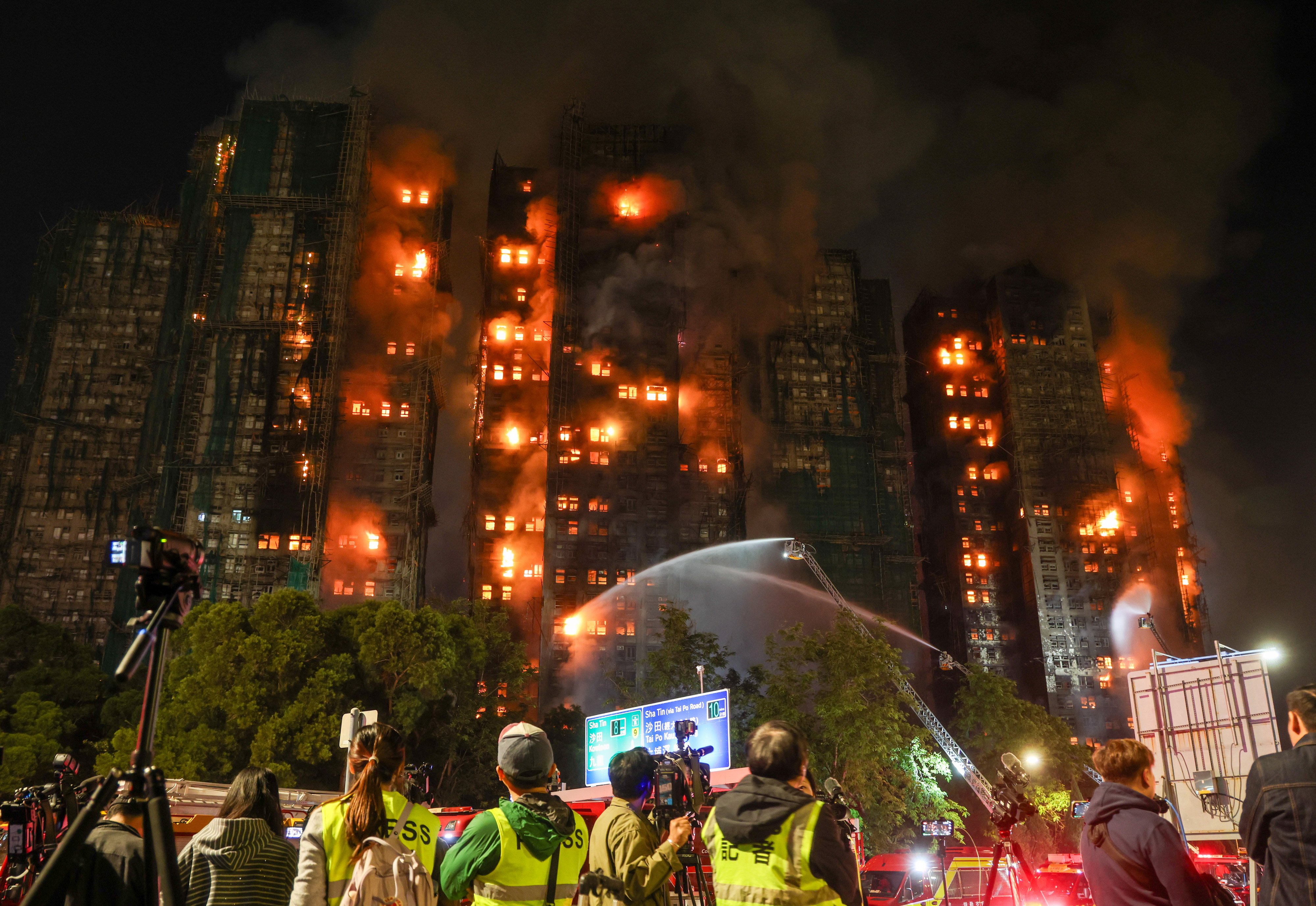
The death count of the multistory, multitower blaze is already topping 128 as of Friday, and surely set to rise, with some 200 people still missing, too.
Close to Home
I live in Tai Po district, remarkably close to the fire — it’s at the local roundabout, on the main Kwong Fuk Road through the neighborhood, and just down the hill from my house. If I need to catch a bus out of Tai Po, I’d normally wait to take it at the foot of one of the eight towers in the Wang Fuk Court development that’s involved.
The eight towers, each 32 floors, are the first buildings you see on entering Tai Po. They’re the last towers as you leave the former market town to get on the highway. Always there in the background, until now fairly nondescript high-rise residential towers, a common sight in Hong Kong’s New Territories, it's a complex that nevertheless housed around 4,600 people.
Though I’ve lived in Hong Kong the last 25 years, I happen to be in Britain at the moment, with my family, so we are totally unscathed. But watching the whole disaster unfold in real time has been a shock to anyone with ties to the city.
So I’m thankful today, just after Thanksgiving but a truly black Friday in Hong Kong, of all that my family is so lucky to have — health, safety, a roof over our heads. I'm conscious of the 1,984 households displaced by the fire. The toll on those with loved ones missing or confirmed dead is, frankly, unimaginable.
Lots of Questions
I’ll keep my post short today because there’s still a lot to process. A lot of questions, too.
How did the fire start on Wednesday? And how did it get out of hand so quickly?
How did it spread from tower to tower, blocks with at least 8-10 meters between them? There are 13-17 meters between Wang Cheong House, the first tower to catch fire, and its immediate neighbors.
Why were the fire alarms disabled? And no sprinklers working?
The investigations are already under way. The police initially arrested three people on suspicion of manslaughter, and the anti-corruption watchdog has Friday arrested eight more individuals on suspicion of corruption surrounding the HK$330 million (US$42 million) renovation of the blocks.
Renovation Works Gone Wrong
It’s clear something has gone very wrong with the safety standards and the materials used on the renovation. The block, built in 1983, received a mandatory order to revamp its exterior, work that started in July 2024. I remember the scaffolding going up, and the repairs starting. They were due to wrap up early next year.
Hong Kong is a city of skyscrapers, with more of them than any other city on earth, according to the Council on Tall Buildings and Urban Habitat. It has 569 structures that top 150 floors, making it the “tallest city in the world,” the council finds.
It’s also true that most people live in high-rise towers. Hong Kong is remarkably tightly packed, with its Mong Kok neighborhood the densest urban area on earth, and vertical. There are some 9,000 buildings that are “high rise,” which the council defines as anything over 12 storeys tall.
Much has been made of the bamboo scaffolding in use in Hong Kong. This is an unnecessary distraction. You’ll notice in some of the shots after the fire that much of the bamboo remains on some of the buildings. The green mesh on the outside, used to stop construction waste falling onto those below, has almost completely burnt. To my eye, the mesh quickly spread the flames.
The contractors also used foam boards to protect windows in the elevator lobbies and also many apartments. These are flammable and normally used only in uninhabited buildings that are under construction. Officials are pointing to that as a factor contributing to how fast the fire spread, trapping the flames before igniting themselves.
A Fire Unlike Any Other
A fire like this hasn’t happened before. Yes, there have been blazes in multistory towers, but they haven’t flared so out of control.
In fact, residents of the Wang Fuk towers warned about the flammability of the materials being used, after a fire on Chinachem Tower, a commercial building downtown, last month. That blaze was put out within four hours, with four people reported hurt.
Hong Kong’s deadliest fire came in 1948, caused by an explosion in a five-storey warehouse owned by the Wing On department store chain. The warehouse was storing oil, rubber and celluloid film, which ignited, trapping those in the floors above, which housed some workers. That disaster caused 176 deaths, and led to tighter restrictions on the storage of dangerous goods, as well as the separation of commercial and residential purposes.
It is possible that this fire will exceed that terrible count.
There will be legal changes now, I'm sure, and recriminations, too.
Residents have been complaining since September 2024 that the materials represented a fire hazard, including the green mesh in use. Officials reviewed the safety certification and told residents its “flame-retardant performance” met standards, Reuters reports. The police, though, faulted the “protective nets, membranes, waterproof tarpaulins, and plastic sheets” used in making their arrests.
Cause Still Unclear
The exact cause of the fire isn’t clear. But it spread unusually quickly, and residents were given little warning. The foam over the windows prevented some residents from realizing they needed to evacuate.
There was already a movement underway to push bamboo scaffolding out of the city. The Development Bureau issued a memo in March requiring half of government projects to use metal scaffolding, in a push to widen its use. You can find a fascinating profile of a female bamboo scaffolding master, and how the material is deployed in building projects, here.
The conspiracy minded say that this change is designed with mainland Chinese construction companies in mind. China has already switched almost exclusively to steel scaffolding, making the most of the country’s massive overproduction of the metal.
Was there corruption involved concerning the materials used in this case? Should officials, who conducted 16 safety inspections at Wang Fuk Court and issued six “improvement notices,” taken firmer action? Why did they initially, incorrectly, inform residents that there are no rules about the use of flammable materials in the protective netting?
These answers will come. And still be insufficient. Such queries pale in the face of this very human disaster. Anger and heartache pervade.
Any solutions, any long-term changes on building safety, will come too late for those rendered homeless. Or whose search for their loved ones continues, as hopes of finding them alive fade.