Here's How to Get Through This Market ... and Win
I see a Confirmation Day, so let's rip off the Band-Aid, chart the markets and review some hard lessons.
You've reached your free article limit
You've read 0 of 1 free Pro articles.
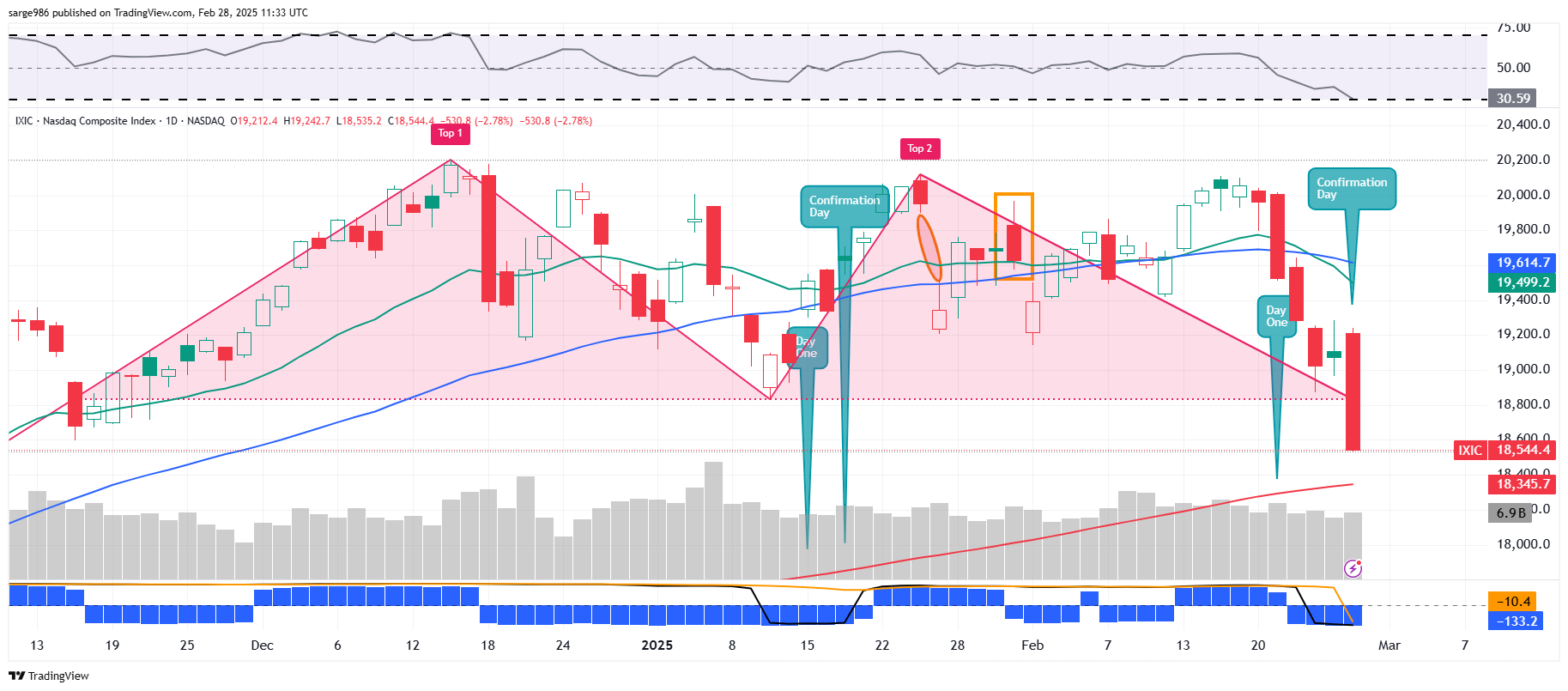
Confirmation Day.... It is really far better to rip the Band-Aid off and suffer through this confirmation of a change in trend quickly than have it drag out for weeks, which we have seen at times. Now that we have experienced a "confirmation day" that properly followed a "day one" with some separation between the initial selloff and the confirmation, what does that mean for us? Simply put, it means that long-side exposure, if not already reduced from recent levels, should probably be taken lower until the market presents us with something that looks a little more constructive.
How long will the change in trend last? Over the years, I have seen these changes in trend last months and I have seen them last less than a week. That's why we look at these charts every single day, or even several times each day. The charts of any index, fund, commodity or single stock are living documents. They change; they evolve. For that reason, we, as hunter-gatherers, must adapt. Without the ability to adapt, there can be no sustainability, and victories will become more random, driven more by luck than by tactics or strategy.
This is why, for each and everything we do in the marketplace, we have a pivot point that creates the set-up for our target price. The pivot is the key, not only do pivots create positive set-ups, but also rejection. Pivots are where plans come both to fruition and failure. We must also have "panic points" and optionally, "add" levels. These are spots on the chart where ahead of time, so as to enforce personal discipline and remove all emotion from decision making, decisions are made to either add or cut exposure.
In reality, these "panic" points are quite the opposite of actual panic. For just as target prices force us to act, so do these levels that are actually the result of being "cool as a cucumber" when under pressure. Why always have target prices, pivot points and panic points? Well, how on earth are traders and investors supposed to get where they need or want to go if they don't know where they want to go... and just as importantly, where they do not want to go. In my experience, all victory is the result of active risk management. This is how one establishes control over the magnitude of defeat.
Rules for Investing, Trading and Life...
Understand: Everything we do or do not do; we do or do not do for a reason that we could explain to a child. If you do not understand something, then do not get yourself exposed to it.
Identify: There are three items that need to be identified as we move along. We need to be able to recognize perceived threats, avenues of attack or approach and targets of opportunity.
Adapt: Environments change. So must we. There are no standard operating procedures. There are ways of getting things done and these methods change. We don't trade in Spanish pieces of eight anymore and professional trading is no longer done by humans. This is why creating the above levels is so key to success. Become what is required when necessary. No excuses. People are counting on you. Failure is not an option.
Overcome: Find a way, even in the face of persistent failure or constantly changing obstacles. Expect victory and make it happen through discipline and strategy. Plan, calculate and act when the probabilities are in your favor. Fade when they are not. Do not fear. Fear is but for the wicked and scared money does not make money.
Carry On: OK, you won one or you lost one. No emotion. You've been there before. Hand the ref the football and jog back to the sideline. In short, carry on with the mission. The game is not over.
Remember always that you are a competitor and will have to fight for your family and their way of life. No one will hand you anything. The machines ... high-speed, keyword reading algorithms, are designed to force market overshoot. When I was young, trades were timed in minutes. Now, trades are timed in microseconds because milliseconds are too slow. That's one millionth of a second, because one thousandth of a second is too slow.
Understand that. That's how your enemy thinks. This market model is not the ongoing, two-sided auction market model that you grew up with. That model was designed to create transparency. You had to identify yourself by naming the firm you were representing and announcing your badge number. Where do you think my "986" came from? This ensured fairness in the process of price discovery at a centralized point of sale.
This current market model is designed to intentionally shield large players from market transparency and prevent fair price discovery by spreading the last sale across a number of fast-moving market centers. Recognize that the scales are imbalanced and as a retail investor, these cretins have decided that you are fodder for their profit. Take offense to that. Let it burn, while remaining in control. Lay in wait for them. They are reading the sports pages while you focus on victory. Know what you want to do when opportunity becomes apparent.
Just because "they" have the advantage doesn't mean that they have ever competed against someone who knows they are the enemy and is ready to defend his or her household. Yes, this is challenging. Yes, we are the mighty. Rock on, my friends.
What Happened?
Where do we begin? A market under pressure. Several days of weaker macroeconomic data capped off by rising state-level claims for unemployment benefits. President Trump's social media post on Thursday announcing that the 25% tariffs on both Canadian and Mexican goods will proceed next week as will the 10% additional tariff on Chinese goods.
I am not being critical of this trade strategy as a means to an end, but understand that for now, even if this ends up boosting the middle class of the U.S., financial markets are not going to like these shifts. The market is also not in love with the idea of austerity, which is what cracking down on fiscally reckless behavior is. Markets love easy money. They love liquidity. Reducing federal spending, while obviously the right thing to do by the taxpayers, will force a reduced pace of economic activity.
The U.S. Dollar Index soared on Thursday, as Treasury debt securities -- after holding onto this week's gains through the regular session -- rallied again overnight. It's weeks like this that I notice my bonds and bond funds. Thank goodness. This is why we diversify across not just sectors of the equity marketplace, but across asset classes as well.
Equity markets received a visit from the "ugly stick" on Thursday. The Nasdaq Composite gave up 2.78% for the day and is now down 3.97% year to date. The S&P 500 lost 1.59% on Thursday and is now down 0.34% for 2025. The Dow Transports, the S&P Midcap 400, the S&P Smallcap 600, and the Russell 2000. They were all down for the day and they are all down year to date. Oh, and get this... the Philadelphia Semiconductor Index gave back a whopping 6.09% on Thursday as Nvidia NVDA, Marvell Technology MRVL and Broadcom AVGO were all taken out to the woodshed. That index is now down 5.89% 2025 to date.
Maybe some month-end window dressing today. Maybe. Let's dig in...
Marketplace
Eight of the 11 S&P sector SPDR exchange-traded funds closed out Thursday in the red. Technology XLK obviously led the way lower as both the semiconductors and the Magnificent Seven were pounded. Interestingly, as the Philadelphia Semiconductor Index gave up 6.09%, the Dow Jones US Semiconductor Index was slapped around for a loss of 7.36%.
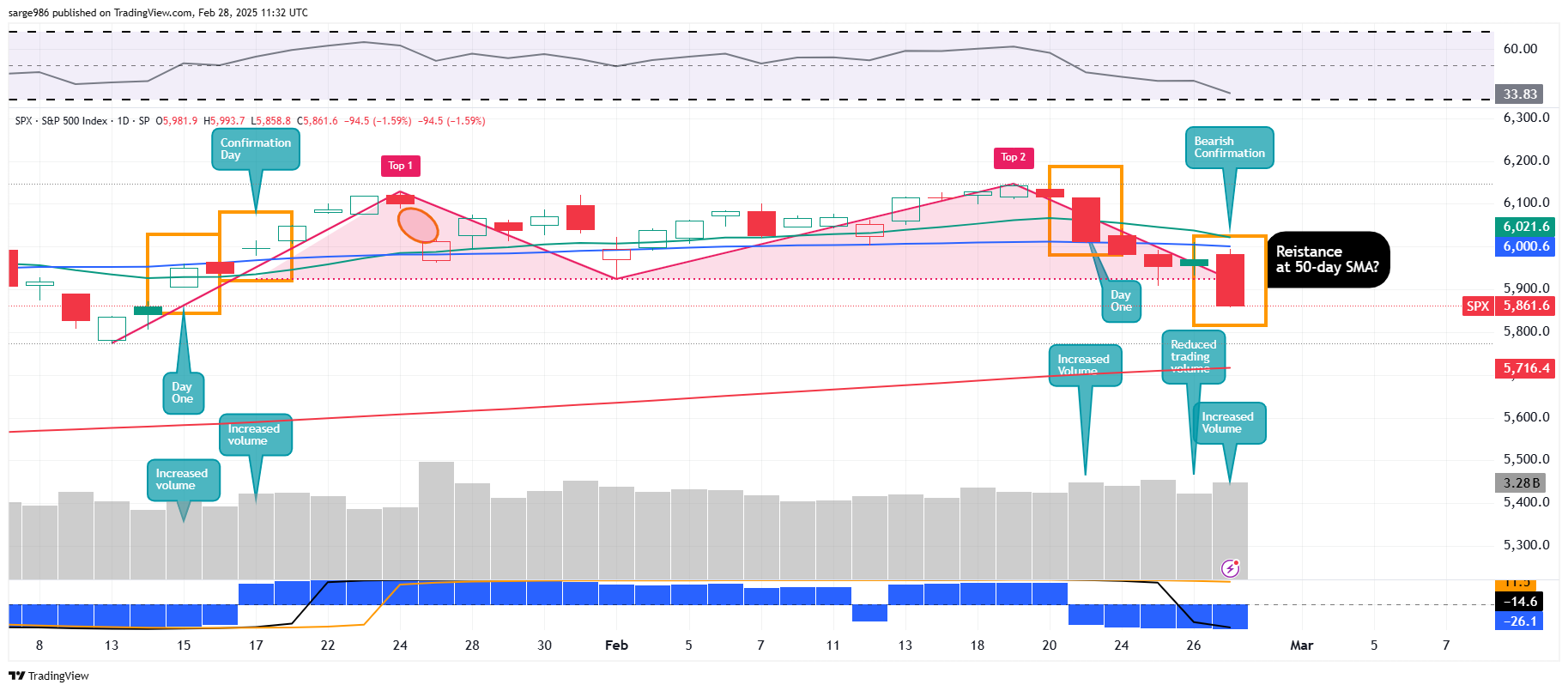
As for breadth, losers beat winners by more than a 2-to-1 margin at the NYSE and by more than a 5-to-2 margin at the Nasdaq on Thursday. Advancing volume took a 31.9% share of composite NYSE-listed trade and just a 29.1% share of composite Nasdaq-listed activity. But aggregate trading volume increased across the listings of the NYSE (+3.9%), the listings of the Nasdaq (+9.5%) and across the membership of the S&P 500 as well. This is largely why we have a "confirmation day" for the market's downward change of trend.
Readers will see the increased trading volume for the S&P 500 on Thursday. This came after an "up" day on lower trading volume on Wednesday. That was the space that we needed between the "day one" and the day of confirmation that separates the two moves. A change in trend cannot be confirmed by one long move. There has to be a sign that portfolio managers paused, thought about what they were doing, and decided to resume their reduction of long-side exposure. We have that here.
Note that the Nasdaq Composite is in worse shape technically than is the S&P 500. Here we see a reading for Relative Strength (above the chart) that has reached "oversold" levels, and a simply awful looking daily Moving Average Convergence Divergence indicator (below the chart). This index has completely lost contact with its 50-day simple moving average and appears to be in the range of at least considering a run at its 200-day simple moving average.
Note To Readers
I will be filling in for legendary hedge fund trader Doug Kass today elsewhere on this TheStreet PRO, so feel free to join me today. We'll be taking on the markets together.
Economics (All Times Eastern)
08:30 - Personal Income (Jan): Expecting 0.3% m/m, Last 0.4% m/m.
08:30 - Consumer Spending (Jan): Expecting 0.2% m/m, Last 0.7% m/m.
08:30 - PCE Price Index (Jan): Expecting 0.4 m/m, Last 0.3 m/m.
08:30 - Core PCE Price Index (Jan): Expecting 0.3% m/m, Last 0.2% m/m.
08:30 - PCE Price Index (Jan): Expecting 2.5% y/y, Last 2.6% y/y.
08:30 - Core PCE Price Index (Jan): Expecting 2.7% y/y, Last 2.8% y/y.
08:30 - Wholesale Inventories (Jan-adv): Expecting 0.1% m/m, Last -0.5% m/m.
08:30 - Goods Trade Balance (Jan-adv): Last $-122.11B.
09:45 - Chicago PMI (Feb): Expecting 40.3, Last 39.5.
1:00 p.m. - Baker Hughes Total Rig Count (Weekly): Last 592.
1:00 - Baker Hughes Oil Rig Count (Weekly): Last 487.
The Fed (All Times Eastern)
No public appearances scheduled.
Today's Earnings Highlights (Consensus EPS Expectations)
Before the Open: FUBU (-.11)
At the time of publication, Guilfoyle was long NVDA equity.