Global Market Reacts Poorly After Hong Kong Fire Is Met With CCP Playbook
The official response to the Wang Fuk Court fire has been to silence dissent, as critics question the lack of self-scrutiny in the government.
You've reached your free article limit
You've read 0 of 1 free Pro articles.
The tower inferno in Hong Kong that has so far claimed 156 lives has spilled over into global markets on Tuesday, with shares in a Danish facilities management company sinking.
ISS A/S (CPH:ISS) shares fell as much as 11.6% on Nasdaq Copenhagen, after opening higher on Tuesday, as the company confirmed that its Hong Kong branch is the property manager of the eight-tower Wang Fuk Court development.
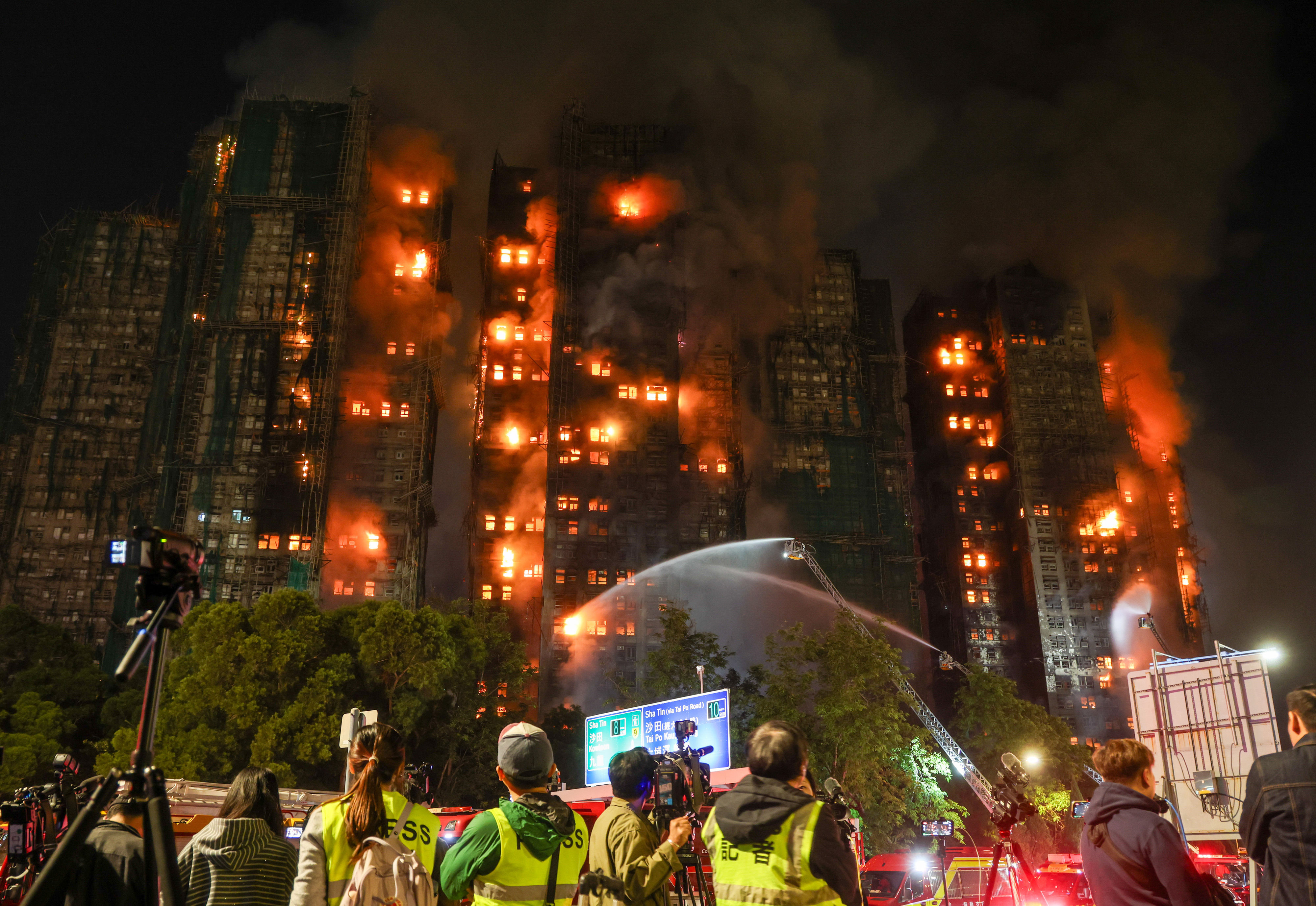
Hong Kong-based ISS EastPoint Properties said it provides administrative support for the homeowners’ association that approved and was supervising the renovation of the eight blocks. Seven of the 31-story towers burst rapidly into flames last week, with investigation under way into the materials used, and a corruption inquiry into the HK$330 million ($42 million) renovation of the blocks, home to 1,984 units and some 4,600 people.
Hong Kong Starts 'Judge-Led' Committee
Hong Kong’s leader, chief executive John Lee, meanwhile has announced a “judge-led” independent committee to examine the incident, in which seven of the eight buildings ignited rapidly, overwhelming fire-fighting efforts.
But the Hong Kong government has fallen short of declaring a formal Commission of Inquiry, the most-powerful form of investigative body, with the power to summon witnesses, demand evidence and compel testimony.
Instead, the police have arrested citizens demanding answers from the government, with police officers also disrupting vigils and other events in honor of the dead, apparently keen to prevent any such events from morphing into a protest.
College Student Arrested on Suspicion of Sedition
College student Miles Kwan initiated a petition seeking answers to “four big demands” from officials: to ensure accommodation for displaced residents; to set up an independent investigation committee to investigate conflicts of interest; to review the construction-supervision system; and to probe regulatory neglect while holding government officials accountable.
Kwan, 24, was arrested on Saturday on suspicion of “sedition” for his pains. Such demands would be standard-issue fare in any democratic nation with freedom of speech. However, Hong Kong has undermined efforts to hold the government accountable, and has eliminated all political opposition within the city.
Hong Kong national-security police have also arrested a pro-democracy lawyer and grassroots activist, Bruce Liu, who was due to speak at a civic-society press conference concerning the fire. The event was cancelled four hours before it was due to take place, due to “notification from relevant (government) departments.”
And police have also arrested ex-district councillor Kenneth Cheung, as well as a volunteer who was handling supplies given to the victims of the fire, both also on suspicion of sedition. Cheung declined to give details about his arrest, citing a confidentiality order for national-security cases.
Questions to the Top
A reporter asked chief executive Lee, a former policeman and national security official, what seditious acts these people have taken, and why Lee deserves to keep his job when he has pledged to take Hong Kong from “chaos to order” and “order to prosperity,” yet has allowed so many deaths in this fire, on his watch.
“I will not tolerate any crimes, particularly crimes that exploit the tragedy that we are facing now,” Lee responded. “To anybody who dares to sabotage this attempt — this commitment of society — we will do anything we can to ensure that justice will be done.”
He did not say why he deserves to keep his job.
“Yes, we need reform,” Lee added. “Yes, we have identified failures in different stages.”
This is exactly why loopholes must be plugged, those responsible held accountable and shortcomings addressed, he added.
“Fires happen in different cities, despite different cities’ governments and communities having tried their best.”
Communist Playbook: Make the Problem Disappear
In the face of citizen pressure, the Hong Kong government is now completely following the Chinese Communist Party playbook.
Don’t solve the problem or hold yourself accountable. Instead, silence those critics. Attack them, as malevolent, shadowy “foreign agents” sowing discord. Vaguely threaten anyone else getting the idea of protesting official actions — which, by the Hong Kong government’s definition, must be appropriate and correct, because the government is doing so much to help.
The National Security Law imposed on Hong Kong in 2020, by Beijing without Hong Kong input, criminalizes subversion, secession and collusion with foreign forces. This has been expanded to include treason, insurrection, espionage and theft of state secrets. It also makes it dangerous to criticize Beijing and, now by extension, the Hong Kong government.
China’s national-security office is also chipping in, warning people against using the Wang Fuk disaster to “plunge Hong Kong back into the chaos” of 2019, when millions marched in the streets demanding democracy and greater government accountability.
“We sternly warn the anti-China disruptors who attempt to ‘disrupt Hong Kong through disaster,’” the mainland office added. “No matter what methods you use, you will certainly be held accountable and strictly punished.”
Chilling Effect on Dissent
Those sorts of messages are intended to have a chilling effect on dissent. It vaguely accuses citizens using unspecified “methods,” and rather spuriously attributes a counter-revolutionary, anti-patriotic motive to anyone who questions the official narrative. Don’t question the government. Don’t question the response.
Kwan anticipated such an attack, and the college student said he is just a concerned citizen.
“If these ideas are deemed seditious or ‘crossing the line,’ then I feel I can’t predict the consequences of anything anymore, and I can only do what I truly believe,” Kwan told AFP.
Kwan was prompted to set up a Change.org petition after chief secretary Eric Chan’s immediate response to the fire was to say the government would phase out bamboo scaffolding in favor of metal scaffolding.
“We think this is actually spinning Hong Kongers away from the real question, that is, the real institution,” Kwan told Hong Kong Free Press, one of the few independent media sites still operating in Hong Kong. “The whole institution is already broken down.”
Bamboo Red Herring
As I wrote in my story on Friday, it is a complete red herring to focus on the bamboo scaffolding. It’s been in use to build virtually all of Hong Kong’s 9,000 high-rise buildings, and is in place for the vast majority of renovation projects like at Wang Fuk Court, projects that haven’t ignited in minutes.
What’s more, much of the bamboo scaffolding survived the fire. The green mesh that appeared to spread the fire so swiftly on the outside of the building, and the flammable foam boards put in place to protect windows, quickly burnt up.
The conspiracy minded will note that mainland China uses metal scaffolding and has a surplus of steel, with mainland construction companies increasingly active in Hong Kong.
Officials have, in retrospect, conceded that contractors used substandard mesh on the buildings, and tried to conceal the unsafe material. Seven of 20 samples taken after the fire did not meet safety standards, with samples that were easy to reach normally passing the tests.
Officials initially said that “preliminary tests” on Friday showed the material was safety-compliant. But those tests were taken from easily accessible samples. And all this is after the fact — before the fire, residents who complained repeatedly about fire hazards and safety standards were told the mesh met “flame-retardant performance” standards.
Wrong Initial Response
In fact, when residents last year warned that the safety netting may be flammable, the Labour Department wrongly dismissed such concerns, The New York Times reported, claiming there are no rules on the use of flammable materials in scaffolding. That department, which overseas workplace safety, now acknowledges this was a mistake. But it later told residents the materials met safety requirements anyway, according to documents filed by contractor Prestige Construction and Engineering.
The department says it conducted 16 inspections at Wang Fuk Court since July 2024, including one week before the fire. It found violations but warned the contractor about unsafe working conditions on site, rather than the materials.
Construction managers say “tricky” contractors may prepare for monthly government safety inspections by ensuring that the mesh at ground level will pass flammability tests, while using cheaper material higher up the building, where inspectors are unlikely to assess it.
These investigations will and should continue. But there will remain serious questions about whether anyone is “watching the watchers” in Hong Kong. Can a government be expected to seriously investigate its own actions, particularly when many civic groups have been forced to disband, and all opposition politicians have left office?
As the newsletter International Intrigue, with its focus on geopolitics, put it:
“It’s a perfect storm not just for Hong Kong but its Beijing rulers,” with state media first erroneously blaming the bamboo scaffolding.
Instead, “the evidence points to flammable safety netting made and ‘certified’ on the mainland,” while two of those detained “seem to be random citizens asking too many questions.”
There’s a political tinge to the mesh if, indeed, it was approved under mainland Chinese safety tests, and made in China, then exported for use in Hong Kong.
Will Any Lessons Be Learned?
The Wang Fuk Court fire is the worst in Hong Kong since 1948, when a five-story warehouse that also housed workers blew up, killing 176 people. After oil, rubber and celluloid film in the warehouse ignited, it trapped people on the higher floors. Out of that disaster, the then-colonial government tightened how dangerous goods are stored, and mandated the separation of commercial and residential premises.
Wang Fuk Court is a Homeownership Scheme project, designed to help people take the first step onto the property ladder. It was issued with a mandatory order to revamp its façade due to the age of the building, built in 1983.
The way that the fire spread so swiftly along the exterior of the building, at a project intended to house less well-off members of society, carries loud echoes of the Grenfel Tower public-housing fire in London in 2017, where 72 people died after the exterior cladding of the 24-story building was found to be flammable.
What change will come of this fire? Police have arrested 15 people for alleged manslaughter, people linked to the construction contractor, consulting company and subcontractors in charge of the scaffolding.
The anti-corruption Independent Commission Against Corruption (ICAC) has separately arrested 11 people in connection with its investigation into possible corruption surrounding the renovation. Some of the arrests overlap, covering the same individuals.
It is unclear whether there will be scrutiny of officials who should have been supervising and avoiding such a fire. But undoubtedly, the lack of checks and balances in government means that there is less pressure for government departments to act when faced with uncomfortable questions. No oversight or independent questioning of official actions appears allowed.
For investors, this has been a banner year for new stock listings in Hong Kong, which leads the world for initial public offerings. The Hang Seng index, the world's worst performer as recently as 2023, has bounced back to the tune of 33.0% in 2025. But governance issues and the eroding of the city's famed rule of law should cause concern.
“This is absolutely scandalous, this is not what Hong Kong is known for,” said Emily Lau, a long-serving pro-democracy politician who has left the government and now runs a YouTube show. She believes the scale of this tragedy points insufficient government supervision.
“This has opened up a can of worms about misconduct.”
At the time of publication, McMillan had no positions in any securities mentioned.