Finding Our Footing in the Market: The Fed, the Macro, the Chart
Let's see where we're headed, market news spurred by the Trump admin moves on skilled worker visas and potentially Tylenol, the Fed and the S&P 500's chart.
You've reached your free article limit
You've read 0 of 1 free Pro articles.
Where are we? Easy enough question to ask. Tougher question to answer. The week past was a winner for investors, especially equity shareholders. The S&P 500 and Nasdaq Composite both have three-week winning streaks going. Smaller caps? The Russell 2000 closed lower on Friday, but also secured what is now a seven week winning. A number of labor market related data-points have reflected what appears to be a softer national employment situation over recent months, even as certain inflation-related data-points have unfortunately perked up just a little bit.
Regardless, the Federal Open Market Committee did finally deliver on a quarter-percentage point rate cut that markets had priced in for quite some time now. This was the first cut since late 2024 and at least according to bond market prices, came a rough six months later than it should have. On the other hand, with inflation no longer in decline, had the window of safety for that first cut passed? This is something that may take some time to answer.
Slightly lower interest rates are not likely to save jobs to help create new ones, meaning that rates will have to still go lower than they currently are. Lower rates, or quite simply easier monetary policy can force US dollar valuations higher and along with that higher prices for consumers, not to mention assets.
Quote of the Day
My friend and fellow contributor at TheStreet Pro, Peter Tchir, who leads the Macro Strategy department at Academy Securities, writes often for his firm as well as for us. Peter, for those who might read me, and maybe don't read him, is easily one of the sharpest market minds and brilliant human beings I have ever known. None of us who remain in a silo of thought can remain smart enough to compete at this level for very long. We all have other people who make us smarter. Peter is one of those people that makes me smarter.
I lifted this gem (with Peter's permission) from his Academy T-Report this weekend...
"K or k?
I believe my colleague, Peter Atwater, coined the “K-shaped recovery” post Covid.
It is a compelling and easy way to picture the economy.
Some segment of the economy is doing well (the upward sloping part of the K). Some part of the
economy is doing poorly (the downward sloping part of the K).
I think “K” made sense post Covid, but is not reflective of what is going on now.
Even with the “K” I think there is a big difference between K and k. The downward sloping part of the economy is similar, whether it is a capital K, or lower case k. The difference is that K has a lot more people doing well, than k. Yes, that is probably a bit pedantic. My focus may be in part because I couldn’t stomach being the 1,000th person to re-analyze the Fed this week, but I also think it is important to be clear. Every time someone says “K” shaped, we should ask whether it is the capital K or lower case k. It does make a difference, and might also help alleviate the use of this term, which wouldn’t bother me at all."
Great point made here.
Where To?
The focus now shifts from what the Fed will do and ultimately did, to what our central bankers want us to think. Fed officials will be out in numbers this week that we have not seen since before the summer. The idea would be that they have something to say. The question is twofold though. Is there a narrative that the Fed as a group wants to drive home?
Or, as I suspect, is there division at the Fed and the factions are breaking up and getting out there in order to lead the battle for monetary thought control. Oddly enough, many of the Fed officials that we have viewed in the past as dovish, are now hawkish and those we saw as hawkish are now seen as dovish. Crazy, what a change in the White House has done.
Makes one realize just how political this group really is and always has been if that had not already crossed one's mind. Very interestingly, super-dovish Fed Gov. Stephen Miran will speak from New York today opposite super-hawkish Cleveland Fed Press Beth Hammack from Cleveland, both at noon ET.
$100K Fee for H-1B Visa
Late Friday afternoon, Pres. Trump initiated a $100,000 application fee on H-1B visas. (This is not a recurring annual fee as was first reported). Like the president's tariff policies, the administration is using the leverage that the U.S. has to at least drive revenue. Will it work? We'll see. While the increased tariffs have caused some political disruption, there has not been a significant impact, at least not yet, on goods-only inflation, but there has been a sizable boost to federal revenues at a time of great fiscal imbalance.
That in itself, is a positive. Charging foreign manufacturers fees to access U.S. consumers was the idea. Those fees could be avoided by building facilities in the U.S. Simple in concept, but wildly erratic and quite messy in implementation. This appears to be similar. Charge a fee for highly skilled foreign labor. Filling these jobs with U.S. nationals, may or may not be feasible. There may not be those with the skills desired or willing to work for the same level of compensation, but it would save a greatly increased expense.
Major tech firms such as Microsoft MSFT, Alphabet GOOGL and Amazon AMZN have reportedly warned employees already here on H-1B visas to avoid overseas travel for now and for those already abroad to return to the U.S. this weekend past in order to avoid having problems returning to work. How much will this hurt U.S. tech at implementation? Will this aid U.S. labor, especially those looking to work at the higher levels of technology firms as tech itself develops ever more rapidly toward something next level?
The $100,000 fee would be an increase from a total cost of between $2,000 and $5,000 (which was a number of different fees combined). Let's see how our U.S.-based tech stocks behave on Monday in response to this news. U.S. equity index futures are trading lower through the wee hours of Monday morning as I type my way through this note.
Hmmm...
Bloomberg News and other outlets are reporting that on Monday, probably in the afternoon, the Trump administration plans to link use of the over-the-counter painkiller Tylenol to a risk of autism. The Washington Post is reporting that the administration will promote leucovorin, which is a cancer-adjacent treatment, as a potential therapy for the treatment of autism.
Tylenol is the brand name of the acetaminophen-based painkiller sold by a subsidiary of Kenvue KVUE. Kenvue, readers will recall, was a spinoff of Johnson & Johnson JNJ. Leucovorin, or folinic acid, is a medication used to reduce the negative side effects of drugs used to fight cancer through chemotherapy. Leucovorin is primarily sold as a generic and is manufactured by a number of drug companies.
The Week That Was...
What the mid-major to major U.S. equity indexes did last week, as the nation focused on changes in monetary policy...
- The S&P 500 gained 0.49% on Friday and 1.22% for the week.
- The Nasdaq Composite gained 0.72% on Friday and 2.21% for the week.
- The Nasdaq 100 added 0.70% on Friday and 2.22% for the week.
- The Russell 2000 gave back 0.77% on Friday but still gained 2.16% for the week.
- The S&P Smallcap 600 lost 1.12% on Friday but gained 0.98% for the week.
- The S&P Midcap 400 surrendered 0.74% on Friday, gaining just 0.06% for the week.
- The Dow Transports lost 0.2% on Friday and 0.11% for the week.
- The Philly Semis gave back 0.73% on Friday but soared 3.84% for the week.
- The KBW Bank Index gained just 0.07% on Friday but gained 2.12% for the week.
There were winners and losers last week, but the way they lined up exhibited a sort of forward-looking optimism. It will be interesting to see if this split in performance continues this week. On Friday, six of the eleven S&P sector SPDR ETFs closed out the session in the green, led by Tech XLK with Communication Services XLC in third place. Energy XLE finished in last place on the daily tables, but three of the bottom four slots were taken by defensive sector funds.
For the week, just five nine of the eleven S&P sector SPDR ETFs traded higher. However, Technology XLK and Communication Services, the growth sectors, led the winners. The REIT's XLRE led the losers as four of the bottom five slots were filled again, with defensives. The cyclicals were obviously mixed but shaded green. Growth is where you go when interest rates go lower. Defensives are where you go for safety. Some defensives, such as the Utilities XLU will do well as bond proxies, but that's not where optimistic investors put their cash.
The Chart...
On Friday the S&P 500 closed up 1.2% from our confirmation of the bullish trend on Aug. 26 and up 1.2% from our re-confirmation of that trend on Sept. 11. Seasonality? Not so far. Still, we have enough days left in September for trouble to arrive and don't get me started on how tough Octobers can be. That said, shorting the indexes ahead of or early in a Fed easing cycle can be a dangerous game and should only be played by the nimble. For those that focus upon something else during the productive hours of their days, such a game might be compared to picking up nickels in front of a steamroller.
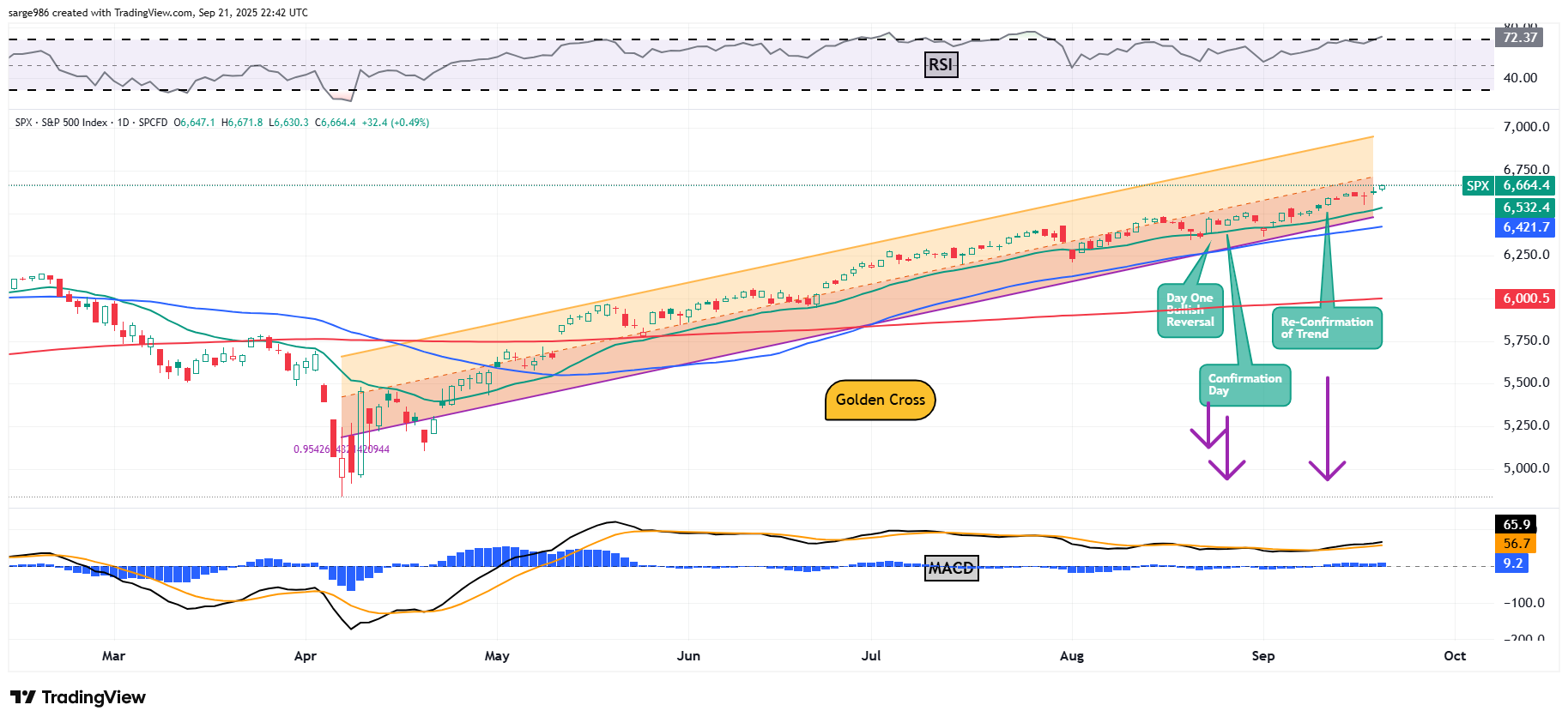
Readers will see that coming into the current week, The S&P 500's reading for Relative Strength continues to border on entering into technically overbought territory. The daily Moving Average Convergence Divergence for the index is postured very bullishly as well. All three components stand in positive territory. The histogram of the 9-day exponential moving average moved above zero on Sept. 11 and has remained positive since. That same day, the 12-day exponential moving average crossed above the 26-day exponential moving average. That is a powerfully bullish signal, especially when both lines are already above zero when it happens. That black line has remained above that gold line ever since.
Earnings
We are now less than a month away from the start of the third quarter earnings season. According to FactSet, for the third quarter, Wall Street is looking for earnings growth of 7.7%, up from 7.6% a week ago. The street also expects revenue growth of 6.3%, up from last week's 6.2%. Technology, Utilities and Materials are expected to be the outperformers with projected earning growth of 15% or more. Three sectors are predicted to suffer a year over year earnings contraction led by Energy. For the full calendar year of 2025, Wall Street still sees S&P 500 earnings growth at 10.7% on revenue growth of 6.1%.
Valuation
Still using data provided by FactSet, the S&P 500 ended last week trading at 22.6-times 12 months' forward-looking earnings, up from 22.5-times a week back. This stands well above the five year average of 19.9-times for the index as well as its 10-year average of 18.5-times. The S&P 500 also ended last week trading at 28.3-times trailing 12 months' earnings, up from 28.2-times. That also stands well above the five year (25 times) and 10 year (22.7 times) averages for the index. Nine of the 11 sectors are now trading above their five-year average valuations, led by Tech (29.8 times) and Consumer Discretionaries (29.6 times). Only the REITs (17.8 times), Health Care (16.6 times) and now the Utilities (18.1 times) remain undervalued relative to their five-year averages.
The GDP Game
Last week, the Atlanta Fed revised their GDPNow model for the third quarter up to growth of 3.3% (q/q, SAAR) from 3.1% the week prior. Among other regional central bank district branches running close to real-time GDP models, the New York Fed's estimate for Q3 growth now stands at 2.1%, up from 2.08%. The Cleveland Fed's model for the third quarter still stands at growth of 1.94%, while The St. Louis Fed model now stands at a paltry 0.05%, down from 0.16%. Obviously, this is a wide spread. There remains no consensus.
Fed Funds Futures
Fed Funds futures trading in Chicago are now pricing in a 93% probability for a quarter-percentage point rate cut on Oct. 29 and an 80% likelihood for another quarter point cut on Dec. 10. At present, there is only a half point worth of additional rate cuts fully priced in (78% chance) for all of calendar 2026. There is a rough 50/50-coin flip's probability for a third quarter point cut at some point in 2026.
On The Docket...
.... The Fed will be out in force this week. If there is a narrative out there that our central bankers feel that they need to push the opportunity will be there over the next few days. Today alone, there are five public appearances to be made by Fed officials on my radar. The headline speaker for the day will be new Fed Gov. Stephen Miran at noon from New York. Currently. I am taking as many as 18 scheduled appearances for the week. The highlight of the week will be a Tuesday afternoon speech by Fed Chair Jerome Powell. We'll also hear from Fed Gov Michelle Bowman on Tuesday, Thursday and Friday. Clearly, Bowman, who is influential, has something to say.
.... As far as the macroeconomic calendar is concerned, the week starts out slow and then heats up. On the home front (get it?), August new home sales and August existing home sales will cross the tape on Wednesday and Thursday respectively. The Census Bureau will release August durable goods on Thursday. The focus in that report will be on core capital goods. On Friday, we'll see August personal income & spending. Perhaps most importantly, we'll also see the August data for PCE and Core PCE prices, which is what the Fed is focusing on when they speak of consumer level inflation.
..... The earnings calendar is again lighter than light this week. Among better known firms that will report are Micron Technologies MU on Tuesday afternoon, followed by Cintas CTAS on Wednesday morning. On Thursday morning, we'll hear from Accenture ACN and Carmax KMX. Costco COST will go to the tape after Thursday's closing bell.
Economics
(All Times Eastern)
No significant domestic macroeconomic data scheduled for release.
The Fed
(All Times Eastern)
09:45 - Speaker: New York Fed Pres. John Williams.
10:00 - Speaker: St. Louis Fed Pres. Alberto Musalem.
12:00 p.m. - Speaker: Richmond Fed Pres. Tom Barkin.
12:00 - Speaker: Cleveland Fed Pres. Beth Hammack.
12:00 - Speaker: Reserve Board Gov. Stephen Miran.
Today's Earnings Highlights
(Consensus EPS Expectations)
No significant quarterly earnings scheduled.
At the time of publication, Guilfoyle was long MSFT, GOOGL equity.