Finally, It's (Inflation) Friday! CoreWeave's IPO, AppLovin's Slide
Let's tackle PCE expectations, check on CoreWeave's pricing and ... wowsers ... chart AppLovin's decline.
You've reached your free article limit
You've read 0 of 1 free Pro articles.
Another truly grueling work week grinds to an end. It may sound like I'm being over-dramatic and maybe I am, but really that hasn't been my style over the decades. It has felt, in recent weeks, like it takes more effort and more focus than ever to try and squeeze a living out of this marketplace. Good thing work ethic is something you and I have always had in ample supply. Smart kids are a dime a dozen at this level. Kids who can work their tails off and keep coming back for more? Those kids are special.
Today is February Inflation Friday if you are a central banker working at the Federal Reserve. While you and I and literally the entire planet focuses on consumer price index and core CPI when discussing consumer-level inflation, when our central bankers talk about their 2% inflation target, they are referring to the personal consumption expenditures price index and the core PCE price index. What's the difference? Well, for starters, the CPI (and the producer price index) are compiled by the Bureau of Labor Statistics, which is a federal agency within the Department of Labor. PCE data is compiled by the Bureau of Economic Analysis, which is a federal agency within the Department of Commerce. By definition, the CPI, which focuses on "out of pocket" spending, is reliant upon data that the BLS puts together itself and its weightings are updated every two years. PCE data is compiled by data put together by the BEA from the sellers' perspective.
To put that in perspective, the CPI measures what consumers purchase from businesses and PCE measures what businesses sell to consumers. They should, in theory, equal one another, but rarely do. This relationship is almost akin to the relationship between gross domestic product and gross domestic income. The difference is that GDP and GDI are both put together by the same agency (The BEA) and are designed to equal one another as a check upon the accuracy of one or the other. Just an FYI: They rarely equal each other as designed.
As to the relationship between CPI and PCE, not only do the weightings differ (example: CPI places more focus on shelter, while PCE focuses more on healthcare), but PCE is reweighted quarterly. The frequency of this re-weighting is likely the primary reason that PCE has become the Fed's "favorite" measure for consumer level inflation while the rest of us still focus on CPI when measuring prices.
That Said...
While most of us celebrated that headline consumer price index number slowed from 3% in January to 2.8% (on a year-over-year basis) in February and that core CPI slowed from 3.3% in January to 3.1% in February, expectations are not as rosy as far as the trajectory of inflation is concerned for the personal consumption index. I say that despite that the numbers are still lower for the PCE data.
This morning, consensus is for year-over-year PCE growth of 2.6% in February, up from 2.5% in January, while at the core, PCE is expected to print at growth of 2.7%, up from 2.6%. The numbers are lower, but if this data hits the tape as projected, the trajectory of consumer-level inflation will be seen by our policy makers as moving in the wrong direction. That's why someone likeAtlanta Fed Pres. Raphael Bostic said this week that he sees just a quarter-percentage point worth of rate cuts this year instead of a half-point worth, which is the median expectation of the Federal Open Market Committee.
Help Is on the Way
As I have mentioned repeatedly, I do expect consumer-level inflation to continue to slow, at least for this tail end of the first quarter. The Cleveland Fed, which runs a real-time inflation Nowcast model, currently projects March consumer price index and core CPI at 2.47% and 2.99% y/y. That same model is now projecting March PCE and core PCE to land at annual growth of 2.07% and 2.47% respectively. Numbers like that will not only get economists excited but may get traders and investors are-interested in what they are trying to accomplish. Unless, of course, their efforts are drowned out by massed algorithmic response to tariff-related headlines.
CoreWeave IPO Price Cools
The CoreWeave (CRWV) IPO was priced on Thursday night. Demand was not what had once been expected. Especially after earlier this week when the Financial Times reported that the cloud computing startup had breached some terms of a $7.6 billion loan last year, triggering a series of defaults, in which it had to ask its largest creditor, Blackstone BX to amend the terms of the loan and waive those defaults.
As a result, 37.5 million shares (down from an expected offering of 49 million shares) were priced at $40 per share (down from an expected range of $47 to $55). This will raise an expected $1.5 billion in what is still the largest domestic tech IPO since 2021. This also values the entire firm at something close to $19 billion based on total shares outstanding. The company, which is backed by Nvidia NVDA and counts Microsoft MSFT, Meta Platforms META, IBM IBM, Cohere and OpenAI among its high-profile clientele, was once valued preliminarily at more than $26 billion.
Not 'Lovin' It
AppLovin APP stock gave up a whopping 20.1% on Thursday after a short report was revealed by Muddy Waters Research. Muddy waters disclosed that it was short shares of APP in a post on "X" or the social media platform formerly known as Twitter.
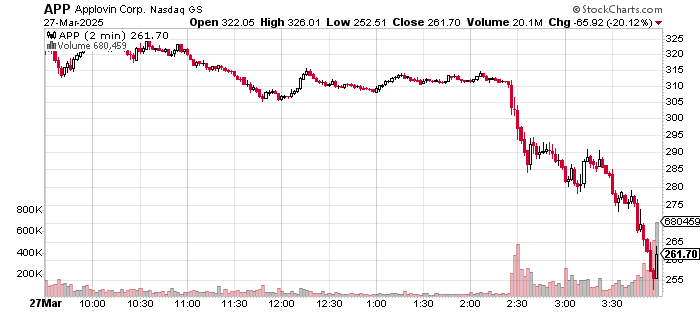
This report comes roughly a month after AppLovin was the target of short reports by both Fuzzy Panda and Culper Research, which came about a week after a short item on the name was published at The Bear Cave. This is a minute-by-minute chart of the action in APP stock on Thursday.
Marketplace
Equity markets were broadly lower on Thursday, but not really significantly lower. While the semiconductor, banking and auto stocks continued to get pounded, the broader indexes seemed to stabilize. The S&P 500 gave up 0.33% for the day as the Nasdaq Composite shed 0.53%. Defensive sectors outperformed as the Staples XLP gained 1.14%, while the bottom of the daily performance standings was littered with growthy type sectors and cyclicals.
Losers beat winners by a rough 4-to-3 margin at the NYSE and by about 5 to 4 at the Nasdaq, and trading volume did increase on a day-over-day basis across both NYSE-listings and the membership of the S&P 500. However, once again, advancing volume took a majority share across composite Nasdaq-listed activity while individual stocks skewed total trading volume.
Do not be surprised if the University of Michigan's revision to their March Consumer Sentiment survey, which will include both one and five-year out inflation expectations, ends up challenging the PCE data for macroeconomic market dominance when released at 10 a.m. ET this morning.
Have a nice weekend, gang. I'll be doing the I-95 shuffle again this weekend, headed back down to my adopted home state from my former home state. It's about an 18-hour drive, if all goes well.
Economics (All Times Eastern)
08:30 - Personal Income (February): Expecting 0.4% m/m, Last 0.9% m/m.
08:30 - Consumer Spending (February): Expecting 0.6% m/m, Last -0.2% m/m.
08:30 - PCE Price Index (February): Expecting 0.3% m/m, Last 0.3% m/m.
08:30 - Core PCE Price Index (February): Expecting 0.3% m/m, Last 0.3% m/m.
08:30 - PCE Price Index (February): Expecting 2.6% y/y, Last 2.5% y/y.
08:30 - Core PCE Price Index (February): Expecting 2.7% y/y, Last 2.6% y/y.
10:00 - U of M Consumer Sentiment (Mar-F): Flashed 57.9.
10:00 - U of M Consumer One-Year Inflation Expectations (Mar-F): Flashed 4.9%.
10:00 - U of M Consumer Five-Year Inflation Expectations (Mar-F): Flashed 3.9%.
1:00 p.m. - Baker Hughes Total Rig Count (Weekly): Last 593.
1:00 - Baker Hughes Oil Rig Count (Weekly): Last 486.
The Fed (All Times Eastern)
11:15 - Speaker: Reserve Board Gov. Michael Barr.
2:30 - Speaker: Atlanta Fed Pres. Raphael Bostic.
Today's Earnings Highlights (Consensus EPS Expectations)
No significant quarterly earnings scheduled.
At the time of publication, Guilfoyle was long NVDA, MSFT equity.