Fed Dissent, JP Morgan's 'Fragile' Bomb, GE Vernova Breaks Out?
Today is Fed Day and we've got everything you need to know right here; also, let's chart GE Vernova and check on what this JPM exec just said.
You've reached your free article limit
You've read 0 of 1 free Pro articles.
The day has come: This afternoon brings with it the financial event of the week. At 2 p.m. ET, the Federal Reserve Bank's Federal Open Market Committee will release its final official policy statement for 2025. According to futures markets trading in Chicago, there is currently an 88% probability that the group will reduce the target range for the Fed Funds rate by a quarter percentage point to a range spanning from 3.5% to 3.75%. This would be the third consecutive quarter percentage point rate cut for the group, should this come to pass.
There will not, however, likely be much of a consensus. After a government shutdown that ran all of October as well as much of November, our central bankers have been left at least partially in the dark on a number of labor market-related and inflation-related metrics. There are opposing views present throughout the committee on just how restrictive policy currently is, on just how hot consumer-level inflation actually is and on just how weak labor markets currently are.
Dissent has become a quite regular occurrence at recent FOMC policy meetings and more of the same is expected this afternoon. More than likely, when the statement announces today's quarter-point cut, as many as three dissents could be made public and not all will dissent for the same reason. Expect there to be at least one voter looking for a larger rate cut (Fed Gov Stephen Miran) and as many as two voters (possibly Kansas City Fed Pres. Jeffrey Schmid and St. Louis Fed Pres. Alberto Musalem) looking not to cut at all.
Alongside the statement, also at 2 p.m., the FOMC will release the group's updated quarterly projections. Included will be year-end projections for this year and the next three years. These predictions will cover gross domestic product, unemployment, inflation and the Fed Funds rate.
That last item will be put on full display with a public dot plot that the central bank would be wise to no longer publish. Meant as a tool of forward guidance, this dot plot has often served only to make our central bankers look foolish. The display can show how little these "academic economists" actually understand when it comes to the sometimes performative, but always interdependent relationships between interest rates, employment and economic activity.
Then Comes Powell
Thirty minutes after the FOMC releases all of this material, Fed Chair Jerome Powell will hold his fourth to last post-statement press conference. The financial media, who in the aggregate, have always seemed to have a rather warm relationship with Powell, will ask questions and he will answer. Here is where Powell is likely to signal just how dovish or hawkish the group actually was in its discussions.
While the press conference is often seen as quite important in how financial markets react to "Fed Day," one has to wonder if Powell's influence will start to wane as his time as the head of the central bank winds down. He will not be renominated as Fed Chair when his term expires in May. There will be FOMC policy meetings in January, March and late April. At that point the mantle of leadership will be handed off to someone else. Pres. Trump is indicating that he will still go through one round of interviews, possibly next week, with four finalists to take over the role of Fed Chair, but he has also implied recently that he has made his mind up. National Economic Council director Kevin Hassett, who is seen as dovish, is seen as the front-runner to succeed Powell as Chair. The interviews might simply be to define who else might the president nominate to serve on the Fed's Board of Governors should another spot or two open up. Powell's term on the Board does not expire until 2028.
JP Morgan and More 'Fragile' Economy
I am sure many readers noticed the 4.66% decline in value on Tuesday in the share price of JP Morgan Chase (JPM) . Being long the name, I sure did. Speaking from the Goldman Sachs 2025 Financial Services Conference, Marianne Lake, who is CEO of Consumer & Community Banking at JP Morgan, referred to the current economic environment as being "a little more fragile" as she warned that consumers are spending more than they earn and that cash buffers are in decline leaving individuals with a reduced capacity to withstand financial stress.
Lake also stated that JPM now sees full-year 2026 expenses at $105 billion vs. estimates for something closer to $101 billion. It appears that volume and growth-related expenses are driving costs higher along with strategic investment, which includes the integration of artificial intelligence into operations. Lake also said that bank deposits remain relatively flat year over year and quarter over quarter.
JPM stock has largely traded sideways since early September. Perhaps my idea to take my profits in Wells Fargo (WFC) and rotate into a larger position in JPM may have been a mistake. WFC stock had treated us well over time and has more or less continued to rise in price. During the same conference, Wells Fargo CEO Charlie Scharf, whom I see as the successor to Jamie Dimon as "America's banker," announced plans to grow his bank into a top five player in investment banking.
Wells Fargo has long been viewed as a plain vanilla, net interest margin-type Main Street bank. WFC is ranked as the No. 8 global investment bank this year by Dealogic, up from No. 9 in 2024. Scharf's plan to diversify better into a field dominated by the likes of JP Morgan, Goldman Sachs and Morgan Stanley (MS) might prove very timely, especially if Marianne Lake is correct about the current and ongoing struggles of the U.S. consumer class.
Shifting some of the bank's focus from Main Street to Wall Street might be necessary, especially as access to capital potentially dries up for private companies and as mergers and acquisitions appear poised to heat up further than they recently have.
Marketplace
Wall Street went into "snooze mode" on the Tuesday ahead of Fed Day. I would not expect a whole lot of thunder and lightning this morning, either. The yield on the U.S. Ten-Year Note moved a whopping one basis point higher on the day to 4.17%. On Tuesday afternoon, the Treasury Department ran a strong auction of $39 billion worth of new Ten-Year U.S. paper. Bid to cover was robust as foreign accounts took down 70.2% of the issuance leaving dealers with just an 8.8% slice of the pie.
As for equities, the S&P 500 gave up just 0.09% as the Nasdaq Composite gained a mere 0.13%. Small caps were up small as mid-caps sold off slightly as the action was clearly muted. Five of the level S&P sector SPDR exchange-traded funds closed in the green, led by Energy (XLE) and Technology (XLK) . The losers were led by Health Care (XLV) and the Industrials (XLI) . Not one fund among the eleven gained or lost even 1% on the session.
Winners beat losers by a five-to-four margin at the Nasdaq and by a rough seven-to-six margin at the NYSE. Advancing volume took a 60.3% share of composite Nasdaq-listed trade and a 52.8% share of composite NYSE-listed activity. However, aggregate trading volume contracted by 15.7% on a day-over-day basis across Nasdaq-listings and by 5.2% across NYSE-listings. Aggregate trade across the membership of the S&P 500 has now remained below the 50-day trading volume simple moving average for 10-consecutive sessions. In short, Wall Street took the day off.
GE Vernova Breakout?
Former Sarge-fave (missed out on this move) GE Vernova (GEV) is soaring overnight after the company doubled its quarterly dividend, boosted its share repurchase authorization (from $6 billion to $10 billion) and lifted earnings expectations at its Investor Day in New York. GE Vernova increased free cash flow guidance for this year to $3.5 billion - $4 billion from previously issued guidance of $3 billion - $3.5 billion.
The company also issued initial revenue guidance for 2026 of $41 billion to $42 billion, taking the mid-point above the $41.3 billion that Wall Street was looking for. The shares are up more than 9% since last night's closing bell. Take a look at the chart...
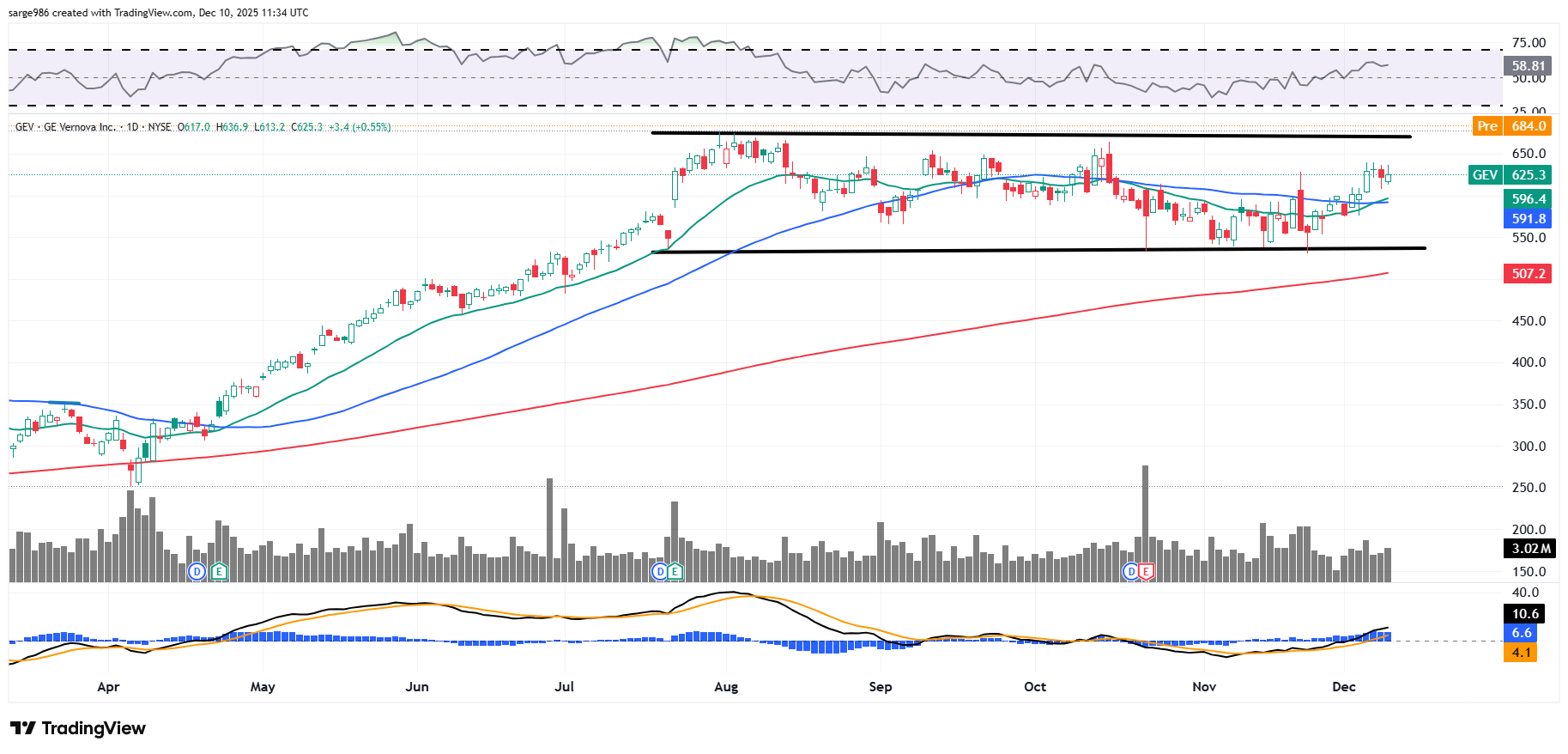
GEV is set to open much higher, creating a huge gap. The shares had been in a basing period of consolidation since early July with a $677 pivot. Those shares had, in recent days, retaken their 50-day simple moving average, experienced a swing traders' golden cross (21-day exponential moving average over the 50-day simple moving average) and seen a suddenly more bullish posture taken on by the stock's daily Moving Average Convergence Divergence. Should the stock hold that $677 level, a target price in the high $770's becomes very realistic.
Economics
(All Times Eastern)
07:00 - MBA 30 Year Mortgage Rate (Weekly): Last 6.32%.
07:00 - MBA Mortgage Applications (Weekly): Last -1.4% w/w.
08:30 - Employment Cost Index (Q3): Expecting 0.9% q/q, Last 0.9% q/q.
10:30 - Oil Inventories (Weekly): Last -470K.
10:30 - Gasoline Stocks (Weekly): Last +4.518M.
The Fed
(All Times Eastern)
2:00 p.m. - FOMC Policy Decision.
2:00 - FOMC Economic Projections.
2:30 - FOMC Press Conference.
Today's Earnings Highlights
(Consensus EPS Expectations)
Before the Open: (CHWY) (.30)
After the Close: (ADBE) (5.40), (NDSN) (2.93), (ORCL) (1.64), (PL) (-.04), (SNPS) (2.88)
At the time of publication, Guilfoyle was long JPM equity.