Fed Chair Favorite Could Accelerate Dollar's Free Fall
BlackRock's Rick Rieder is now favored to become the next Federal Reserve chair and that could impact your portfolio.
You've reached your free article limit
You've read 0 of 1 free Pro articles.
On Monday, the U.S. dollar traded at a four-month low. The greenback has been falling for some time, but that trend accelerated to a sharp plunge over the past week.
One reason for the dollar’s decline is speculation about the successor to Federal Reserve Chair Jerome Powell, whose term is scheduled to end in mid-May.
Over the past week, BlackRock executive Rick Rieder has surged into the lead as the likely nominee for Federal Reserve chair. Prediction market Polymarket shows the odds of Rieder’s ascent jumping from 16% on January 20 to 47% on January 27.
Rieder is considered a dove, and is likely to provide the interest rate reductions sought by President Trump, who wants to refinance the $38.6 trillion national debt at lower rates.
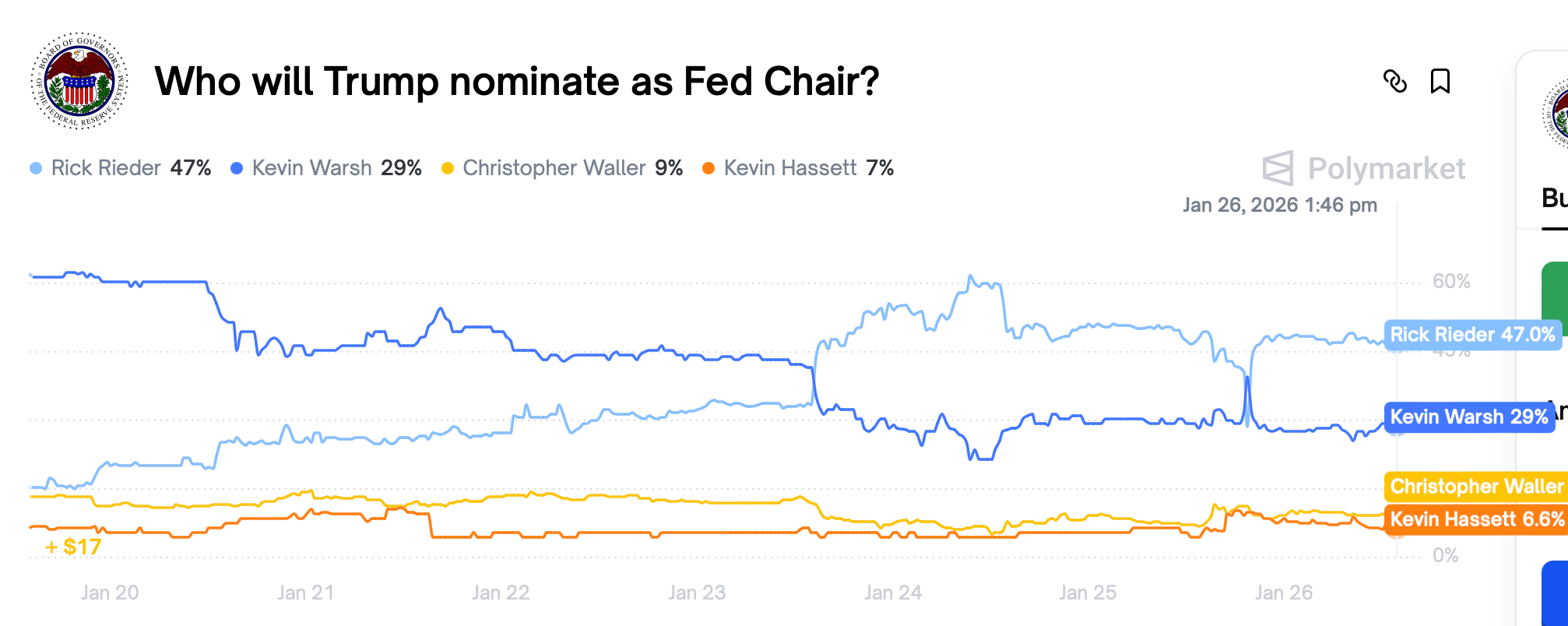
Meanwhile, the odds of a Fed led by Kevin Warsh, who is in my opinion the better candidate, have fallen from 53% last week to 29%. Warsh is more hawkish than Rieder, and is likely to be less aggressive in lowering the federal funds rate.
While Warsh would be a better candidate for those who are concerned about inflation, Rieder's ascent could be advantageous for the U.S. stock market.
A Buck Is a Buck
Movements in stocks are measured in terms of dollars. For example, "stock XYZ rose by $1 today."
However, changes in the dollar can’t be measured in dollars. That’s because $1 always has a face value of $1. A chart of the dollar, as measured in dollars, would be a flat line, always at $1.
This is not about the buying power of a dollar, just its face value. Since we can’t measure the value of a dollar in U.S. dollars, we measure it in terms of other currencies.
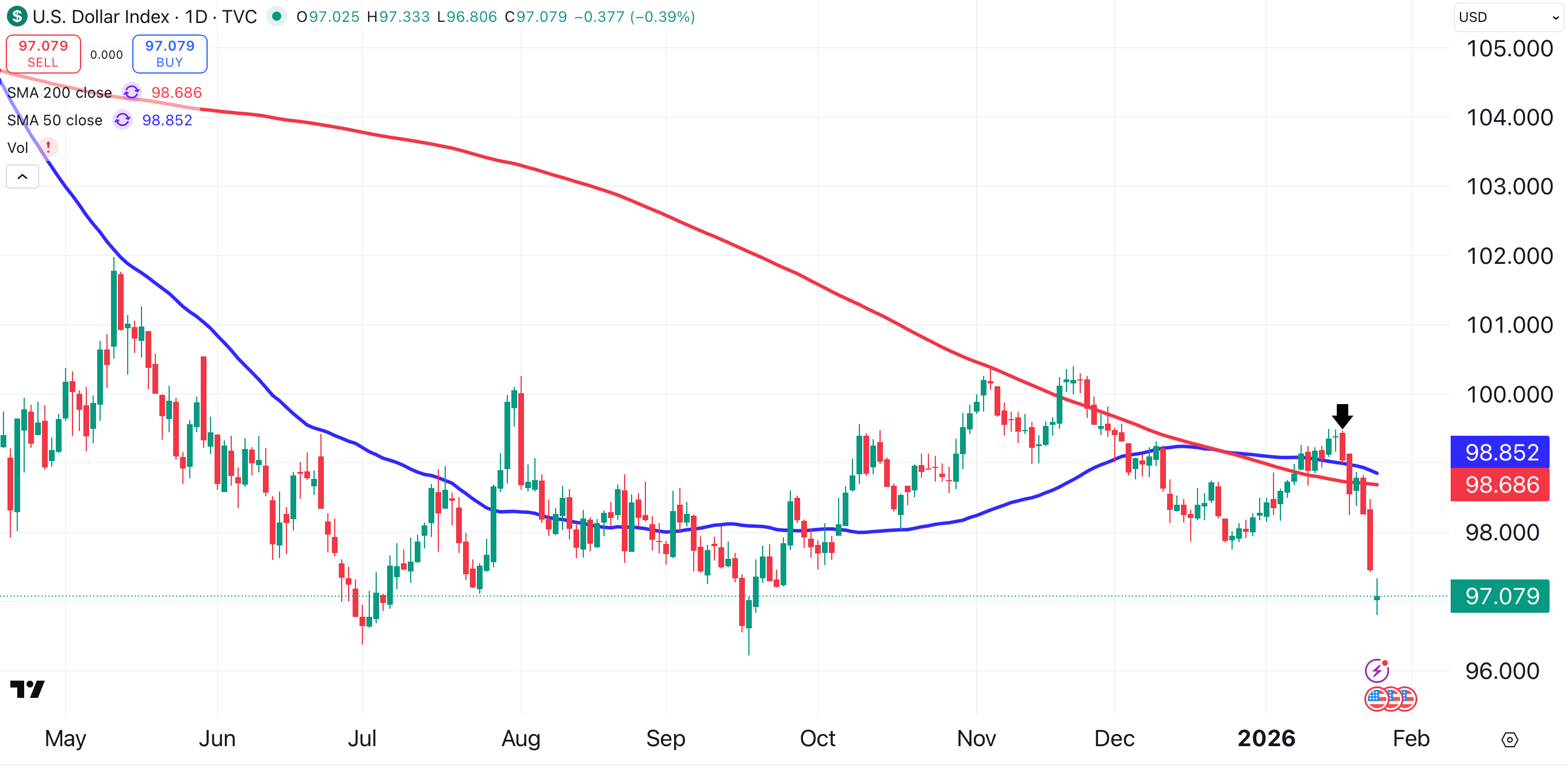
Here is the U.S. Dollar Index (DXY), showing the dollar falling rapidly against a basket of currencies. Note the acceleration of the decline over the past week (arrow).
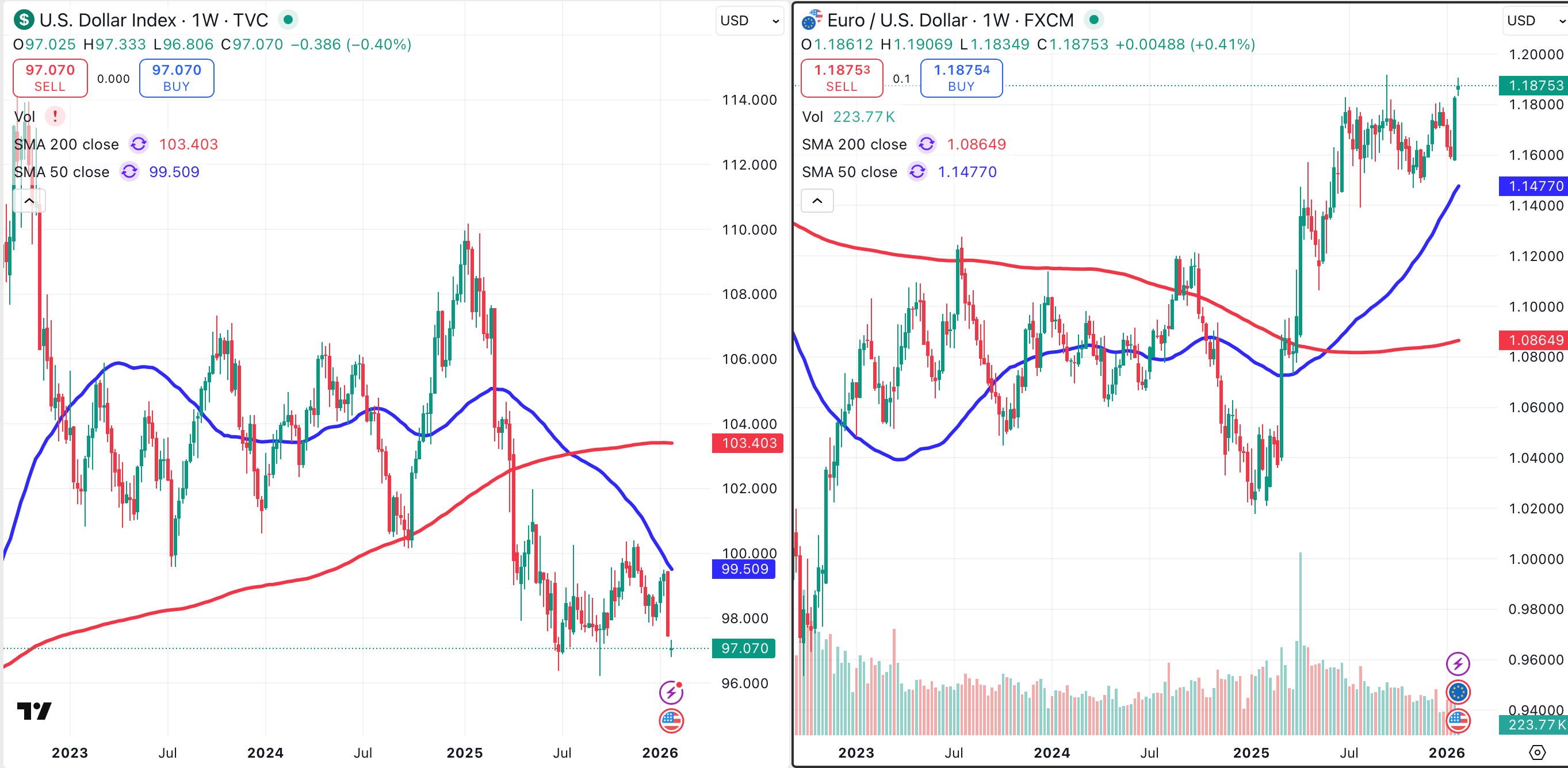
If we are measuring the dollar against other currencies (as in the above example), then a weaker dollar equates to stronger foreign currencies. This is clearly visible in the comparison between the dollar (left chart) and the euro (right chart).
Notice that as the dollar (left) falls, the euro (right) rises, and vice-versa. The two currencies have a strong negative correlation.
If Rieder becomes Fed chair, I’d anticipate aggressive rate cuts, which would further erode the dollar. As that happens, the euro would gain at the dollar's expense.
As the euro gains strength, everything valued in dollars becomes cheaper for folks in Europe. This includes U.S. stocks, which are, of course, valued in dollars. Therefore, a weaker dollar would stimulate European investment in U.S. markets, driving U.S. stock prices higher.
Careful What You Wish For
While this might sound great to investors, it’s really just another form of inflation.
Low interest rates at the earlier part of this decade created the worst bout of inflation in over 40 years. It also drove stocks and real estate prices to all-time highs.
Conversely, a Warsh chairmanship could be less beneficial for asset holders, but better for those concerned about inflation. While I still believe this makes Warsh the better choice, but the odds are no longer in his favor.
At the time of publication, Ponsi had no positions in any securities mentioned.