Eight Days of Up, the 'Dark' Traders, and Jobs Day Anxiety
Also, Meta and Microsoft win while Apple and Amazon lose overnight; and charting a crucial spot on the S&P.
You've reached your free article limit
You've read 0 of 1 free Pro articles.
Friday morning. Well, technically, as I put pen to pad, or fingers to keyboard, it's zero-dark thirty as Thursday night fades into Friday, but still, it's Friday morning. Or Fri-Yay morning. A chance to rest, to catch up on sleep for a couple of days, until we run the Sunday evening through Friday afternoon traders' marathon all over again next week.
They talk about the major exchanges going to something close to a 24-hour trading schedule at some point in the near future. My thought on that for the most part, is that the remaining human traders still in this game have been doing something close to that for a number of years already.
We no longer care where our trades are executed. Personally, I feel that a fairer model for price discovery would be achieved at a centralized point of sale that would reflect best bids and offers while grouping their size. I think it would also help if all trades were public and reported as such. In other words, get rid of dark pools.
One must surmise that every trade that occurs in the dark is being kept from the light for some reason and I really can't think of any reason to trade in the dark that benefits the public. How the large institutions were ever permitted to place a veil of opacity over a process that ethically should be as transparent as possible is beyond logic.
There was a reason, back when dinosaurs ruled the earth, that floor traders had to open their mouths in order to participate and a reason why when trading, they had to both announce their badge numbers and whom (not the ultimate customer, but the clearing house) they were representing. Those trades were then reported to the tape by the exchange where they had occurred and could be researched later on.
There is no upright reason in the world why trading, even during this algorithmic, electronic era, cannot be done in such a way where the public's interest is best served. There is no good reason why the large broker-dealers and investment banks would not want to support such a movement. Unless, of course, their intent is to protect large clients at the expense of retail investors. Yeah, no spit, Sherlock. Hey, by the way, today is April "Jobs" Day!
April Jobs
Of course, as investors, we track the economy as understanding and interpreting the data as well as determining its implications for both fiscal and monetary policy (and now cross-border trade) are key to both front-running and riding trend as well as managing tail risk. Crucial to macroeconomic health of course, are domestic labor markets. Coming in, investors and economists were more than moderately surprised by the weakness exhibited in Wednesday's ADP Employment Report for April private sector job creation. That print hit the tape at just 62,000 new hires, down from 147,000 in March and well below the consensus view of 114,000 jobs.
On top of that, Thursday's weekly print for initial state-level claims for unemployment benefits increased to 241,000 from 223,000 the week prior as continuing claims increased to 1.916 million from 1.833 million. The increase in initial claims might be explained away by the fact that this week's data covered the week of Passover and some public schools, especially in the heavily populated New York area, were closed. The fact is, though, that continuing claims lag initial claims for reporting purposes by a week, so this is not a reason that can explain that increase.
This was the largest number for initial claims since late February. That's an unwelcome fact, but not like something that came from left field. This was the largest week, however, for continuing claims since November of 2021. That's somewhat awful and should be cause for concern. The March unemployment rate of 4.2% touched a multi-year high, but that number was hit three times in 2024, so is still seen as under control.
The underemployment rate fell from 8% in February to 7.9% in March. While that seems like a move in the right direction, those were the worst two months for what economists refer to as "U-6 unemployment" since October of 2021. Meanwhile, the Bureau of Labor Statistics "JOLTs" tracker for national job openings, while known to be wildly volatile and not thought of as very accurate, has shown a now more than three-year trend reflecting decreased opportunity for laborers that has not yet let up.
Where's All This Headed?
If labor markets continue to gradually erode, or should said erosion accelerate? Likely toward the reduction of the central bank's target for short-term interest rates. Next week, on Wednesday afternoon, the Federal Open Market Committee will announce a decision on monetary policy. Futures markets trading in Chicago currently show a 93% probability for no change made to the Fed's target for its Fed Funds Rate.
That target now stands at 4.25% to 4.5%. which is where it has been since December. Readers may recall that the FOMC took that target down to that level down from 5.25% to 5.5% to its current level from last September through the December meeting. Why is this a big deal? Well, with the April strength in U.S. Treasury debt securities, yields have returned to the lower end of their 2025 range.
The Fed Funds Rate, which is the rate at which banks lend each other money overnight, is now inverted against the yields for the entire slope of the Treasury yield curve, with the exception of the Thirty-Year long bond. The Three-Month T-Bill remains inverted against everything through the Seven Year Note.
Remember a steeper yield curve, though it could mean higher medium to long term interest rates due to an out-of-control debt situation and / or inflation, is healthier for both the economy and the ability of the public to assess risk. Now, if medium to long-term rates are to be suppressed either due to decelerating inflation or decelerating economic growth, then the only way to restore the slope of that curve to a healthier condition would be to put downward pressure on the short end of the curve.
Yes, at this time, with growth wobbling, and with inflation down to 0.0% in March, and with the likelihood that any inflationary impact created by increased tariffs will pair off against reduced effective corporate tax rates, I am advocating for a lower Fed Funds Rate. Returning to those futures trading in the Windy City, there is now a 59% likelihood for a quarter-point rate cut at the June 18 meeting and a 60% probability being priced in for an entire percentage point worth of rate cuts in 2025. This morning's data will definitely impact these probabilities.
Marketplace
Despite weakness toward the end of the regular session, the headline U.S. equity indexes put in another solid performance on Thursday. The S&P 500 gained 0.63% for the session, which was the eight consecutive green candle day for that index. The Nasdaq Composite scored a gain of 1.52%, supported by both Meta Platforms META and Microsoft MSFT. After the closing bell, both Apple AAPL and Amazon AMZN reported and both are trading lower. That said, those two stocks are not holding equity index futures down as futures are headed into the jobs report trading above where they went out on Thursday evening.
Seven of the 11 S&P sector exchange-traded funds closed out Thursday in the green, with Technology XLK out in front as +1.47%. Health Care XLV was the big loser on the day at -2.73% as pharmaceutical giant Eli Lilly LLY was simply obliterated, giving back 11.7% on the CVS Health CVS, Novo Nordisk NVO news.
Winners beat losers by a rough 5-to-4 margin at both the NYSE and the Nasdaq Market Site. Advancing volume took a composite 59.8% share across Nasdaq-listed trade and squeaked by with a 50.25 composite share across NYSE-listed activity. Aggregate trade ebbed on a day-over-day basis, across NYSE-listed securities, across Nasdaq-listed securities and across the membership of the S&P 500.
Crucial Spot
Remember the S&P 500 breakout from that Ascending Triangle pattern that we talked about earlier in the week? We had discussed that this was a bullish set-up. On Thursday, the S&P 500 took back its 50-day simple moving average. Should the index be able to hold that line through the jobs numbers and into the weekend, this would force portfolio managers to increase long side equity exposure. You dig? This would move capital.
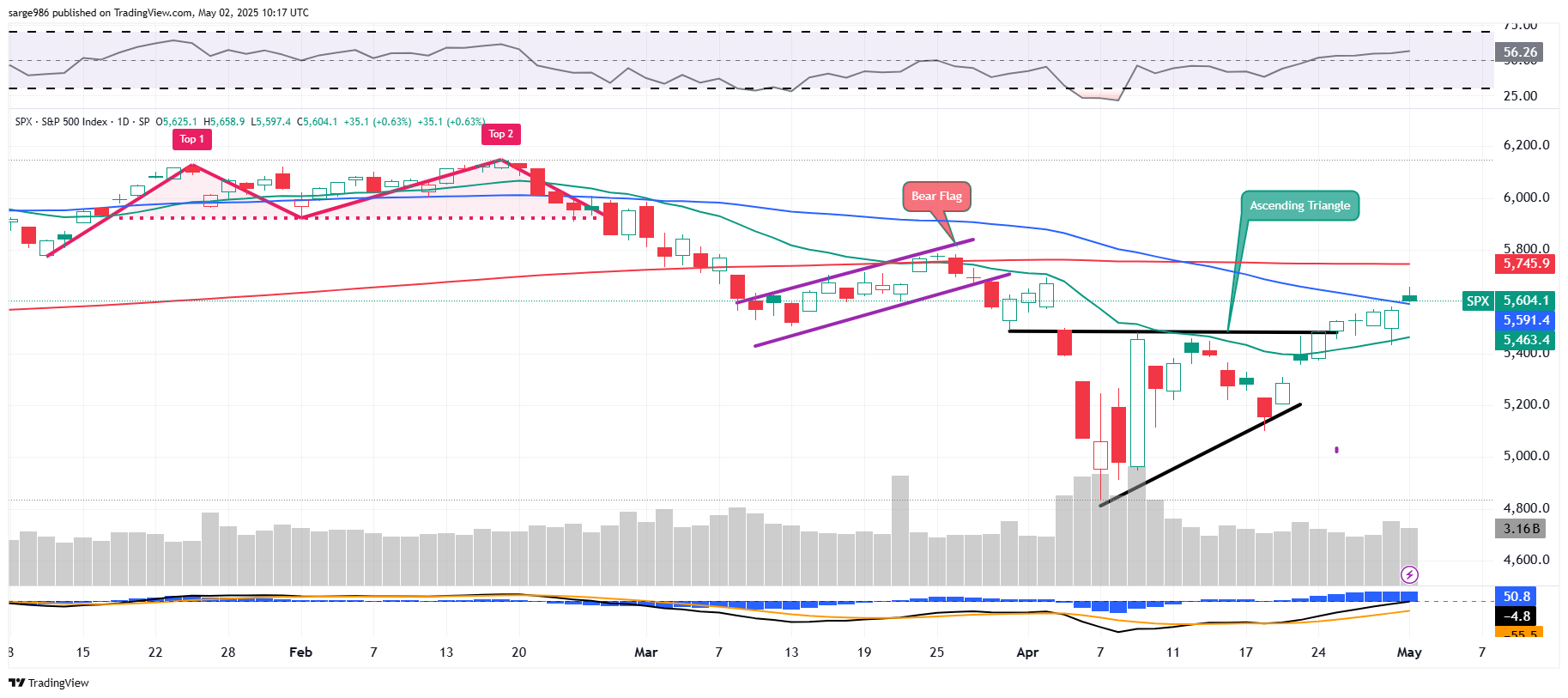
Readers will also see that Relative Strength is at its most robust level since mid-February and that the daily MACD for the S&P 500 is in a better place. While not yet fully bullish in its reflection, the histogram of the 9-day exponential moving average is positive and the 12-day EMA is well above the 26-day EMA. That is two of the four boxes we need checked.
The other two would be getting those two lines over the zero-bound. The 12-day line is getting close. By the way, a 2.5% gain from last night's close would put the S&P 500 in contact with its 200-day simple moving average, which is an even bigger deal for portfolio and risk managers than its 50-day SMA. Rock on, my friends.
April Employment Situation (08:30 ET)
Non-Farm Payrolls: Expecting 135K, Last 228K.
Unemployment Rate: Expecting 4.2%, Last 4.2%.
Underemployment Rate: Expecting 8.0%, Last 7.9%.
Participation Rate: Expecting 62.5%, Last 62.5%.
Average Hourly Earnings: Expecting 3.9% y/y, Last 3.8% y/y.
Average Weekly Hours: Expecting 34.2, last 34.2 hours.
Economics (All Times Eastern)
10:00 - Factory Orders (Mar): Expecting 2.6% m/m, Last 0.6% m/m.
1:00 p.m. - Baker Hughes Total Rig Count (Weekly): Last 587.
1:00 - Baker Hughes Oil Rig Count (Weekly): Last 483.
The Fed (All Times Eastern)
Fed Blackout Period.
Today's Earnings Highlights (Consensus EPS Expectations)
Before the Open: CVX (2.15), DD (.95), XOM (1.73), WEN (.20)
At the time of publication, Guilfoyle was long MSFT equity.