Don't Believe the Invasion Hype, Apple Gets Cored, Japan's Bond Bomb
Let's chart Apple, get a reality check on the supposed fears that the U.S. would attack Greenland, and look at the risk of the bond selloff in Japan.
You've reached your free article limit
You've read 0 of 1 free Pro articles.
Time. Tick, Tick.... As the creatures of the night make their nocturnal way around the property producing very little noise and doing the things that creatures do, U.S.-based equities and debt securities have appeared to make an attempt at finding a bottom. Could it be that easy? I have my doubts. Just one truly bloody day? Wouldn't that be groovy?
As Tuesday night melted into Wednesday morning, foreign stocks stabilized as U.S. Treasuries and equity index futures found a bid. All of the mid-major to major U.S. equity indexes suffered heavy losses on Tuesday as investors fled both risk assets and usual safe-haven type assets alike if those safe-haven assets could be packaged as part of a "Sell America" trade.
By that I mean that investors fled not only out of U.S. Treasuries, but also the U.S. dollar relative to reserve currency alternatives and into more global type safe havens such as precious metals. Gold and silver continue to trade near record levels overnight, not having surrendered sizable gains made on Tuesday.
Does that mean that there is some dip-buying of U.S. domiciled assets ahead of Pres. Trump's speech from Davos, Switzerland, this morning? It certainly does appear that there are some willing to take on that risk at this price. It does not mean that anyone is out of the woods.
Bloody Tuesday
There were two main catalysts for Tuesday's market-wide beatdown. The one that got all of the attention was Pres. Trump's threat to impose tariffs on eight NATO member nations unless they permit the U.S. to control or acquire Greenland from Denmark for national and global security purposes. The threat of economic harm is right out of the Donald Trump playbook.
The president often threatens sizable tariffs as an opener toward taking a negotiator stance that is meant to put potential opponents on the backfoot. Potential opponents, algorithmic traders and a very sensationalist media, go for it every single time. It's always the "end of the world" as if these folks have never negotiated anything meaningful in their lives. Maybe they haven't.
There are two possible outcomes: One, Denmark and NATO play hardball and the president then takes on a harsher stance. For now. Two, a "middle ground" offer is made to the U.S. that satisfies the president. While this could cause persistent volatility across financial markets, I do not see it as very realistic that U.S. shock troops (Marines, Airborne) would make a hostile approach on Greenland with the intent of installing occupying forces.
The second and perhaps even more crucial downside catalyst for global financial markets on Tuesday was the bond selloff in Japan. Concerns over Japan's fiscal situation had been simmering for quite some time. On Tuesday afternoon, those concerns boiled over. After decades of artificial control by the Bank of Japan over debt security price discovery (interest rates), Japanese financial markets are normalizing.
Where do Japanese sovereign bonds end up? It's been so long since there was anything resembling fair market pricing in those markets, that it's almost impossible to say at this time. We are talking about a more than $7.5 trillion market that if sharply diminished, will severely impact the asset side of the balance sheet for central banks and governments around the planet.
Marketplace
On Tuesday, while the U.S. Ten-Year Note backed up to a yield of 4.3% during the regular session, the Nasdaq Composite surrendered 2.39% to close down 1.24% 2026 to date. The S&P 500 gave up 2.06% to close down 0.71% year to date. Spreading out our view a bit, we see that the Dow Transports lost 2.12% on Tuesday as the Russell 2000 (small caps), Philly Semiconductors, and KBW Banks all gave back 1.21%, 1.68% and 1.7% respectively. What was up? The volatility index popped, ending the day above 20 after trading through the Friday session with a 15 handle.
Breadth
As one might have expected, market breadth on Tuesday was similar to what one might run into when hanging out with a pal who just ate a sardine, garlic and mayo sandwich. Ten of the 11 S&P sector SPDR ETFs closed out the day in the red with only the Staples (XLP) spotting any shade of green at all. Defensive sectors took three of the top slots on the daily performance tables with four of these funds showing losses of greater than 2%.
Obviously, Discretionaries (XLC) and Technology (XLK) were hit the hardest as autos, hotels and semiconductors were slapped around pretty good. Losers beat winners at the NYSE by a seven-to-two margin and at the Nasdaq by roughly eight to three. Advancing volume took a 37.6% share of composite Nasdaq-listed trade (not that bad considering) and a 28.7% share of composite NYSE-listed activity.
Here's the catch. Aggregate trade expanded by 7.7% across NYSE-listings on a day over day basis but contracted by 0.5% across Nasdaq-listings. Does that negate the impact of Tuesday's technical damage? Not entirely, but it does mean that US markets did not suffer a true "Day One" bearish reversal of trend.
That does not mean we're safe from having some real trouble to point out. Check this out...
The Chart
We see the S&P 500's breakdown from the "rising wedge" pattern of bearish reversal quite clearly in this chart.
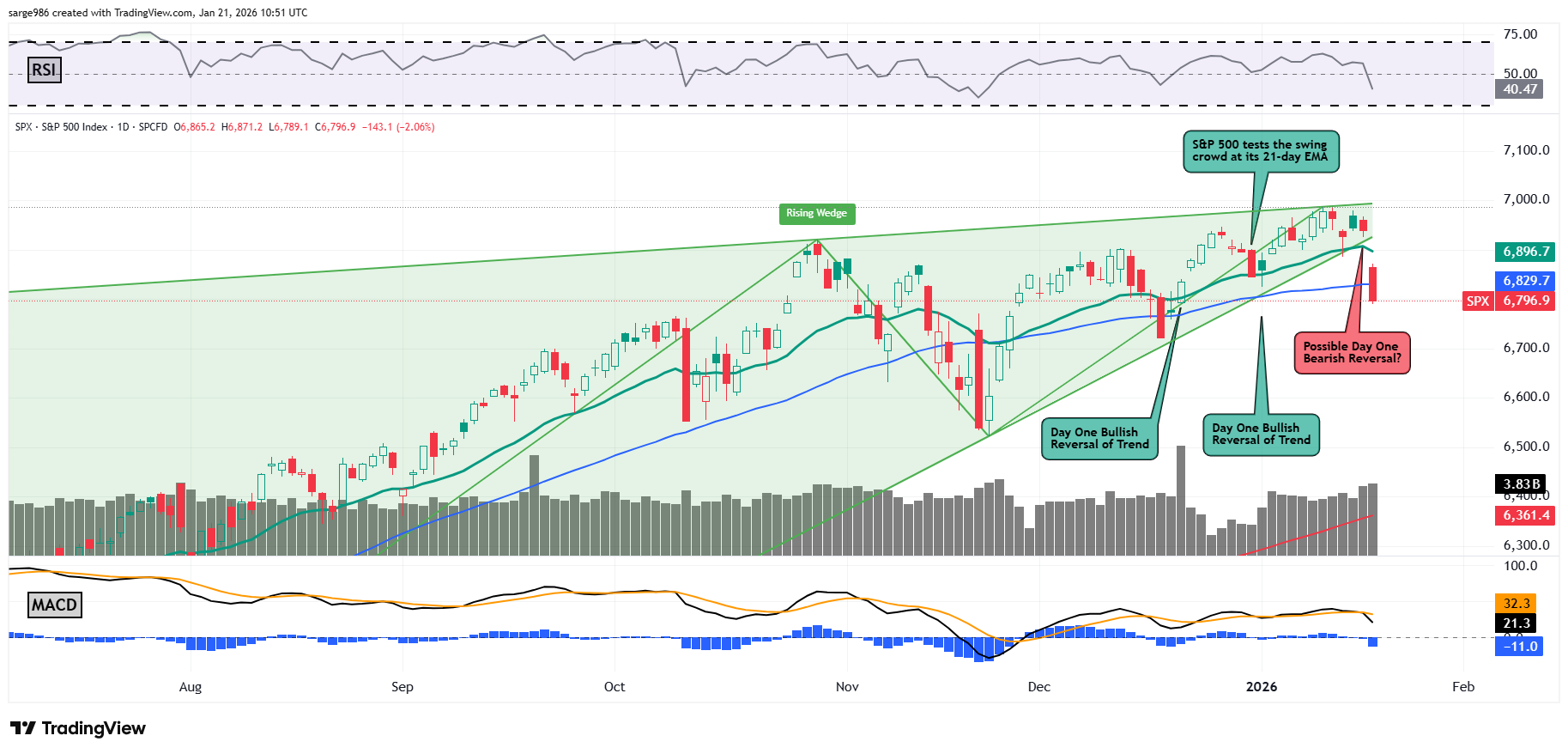
There were possible bearish "Day Ones" on both Friday and Tuesday, but neither neatly fit our traditional definition of what actually constitutes a "Day One."
More importantly, the index gave up its 50-day simple moving average during the session. This resulted in some reduction in professional long-side exposure in member names and came just after the swing crowd had thrown in the towel. The Nasdaq Composite also surrendered that thin blue line on Tuesday.
In addition, Relative Strength has moved below the "neural" line as the daily moving average convergence divergence for the S&P 500 has moved from a bullish posture to a bearish posture all in one day. Silver lining? A level, such as the 50-day simple moving average is not lost with just a piercing. Contact must be lost. That said, U.S. equity markets will need a semi-significant rally on Wednesday just to maintain contact. Thirdly, any rally that does not erase Tuesday's losses will be seen as a "pause" and a "pause in between selloffs that reverse a trend is, my friends, quite deadly.
Word Is...
Prime Minister Jens-Frederik Nielsen of Greenland said that the island's population and authorities need to start preparing for a possible military invasion while Denmark deployed more troops to Greenland and will run year-long military exercises. Oh, and the Canadian military has been modeling its response to a U.S. invasion. I don't know who's more alarmist, these guys or the media.
Get over yourselves. We're not invading anyone. If we did, you'd find out after we were in control, but we're not. Does anything really think that the U.S. government or this administration in particular would risk suffering potentially significant numbers of casualties to U.S. forces invading neighboring countries less than a year out from the midterm elections? No, we're looking for a deal.
Apple, Cored...
It may not happen today or this week, but with a head & shoulders pattern like that, can there be any doubt that Apple (AAPL) shares are headed for a rendezvous with their 200-day simple moving average.
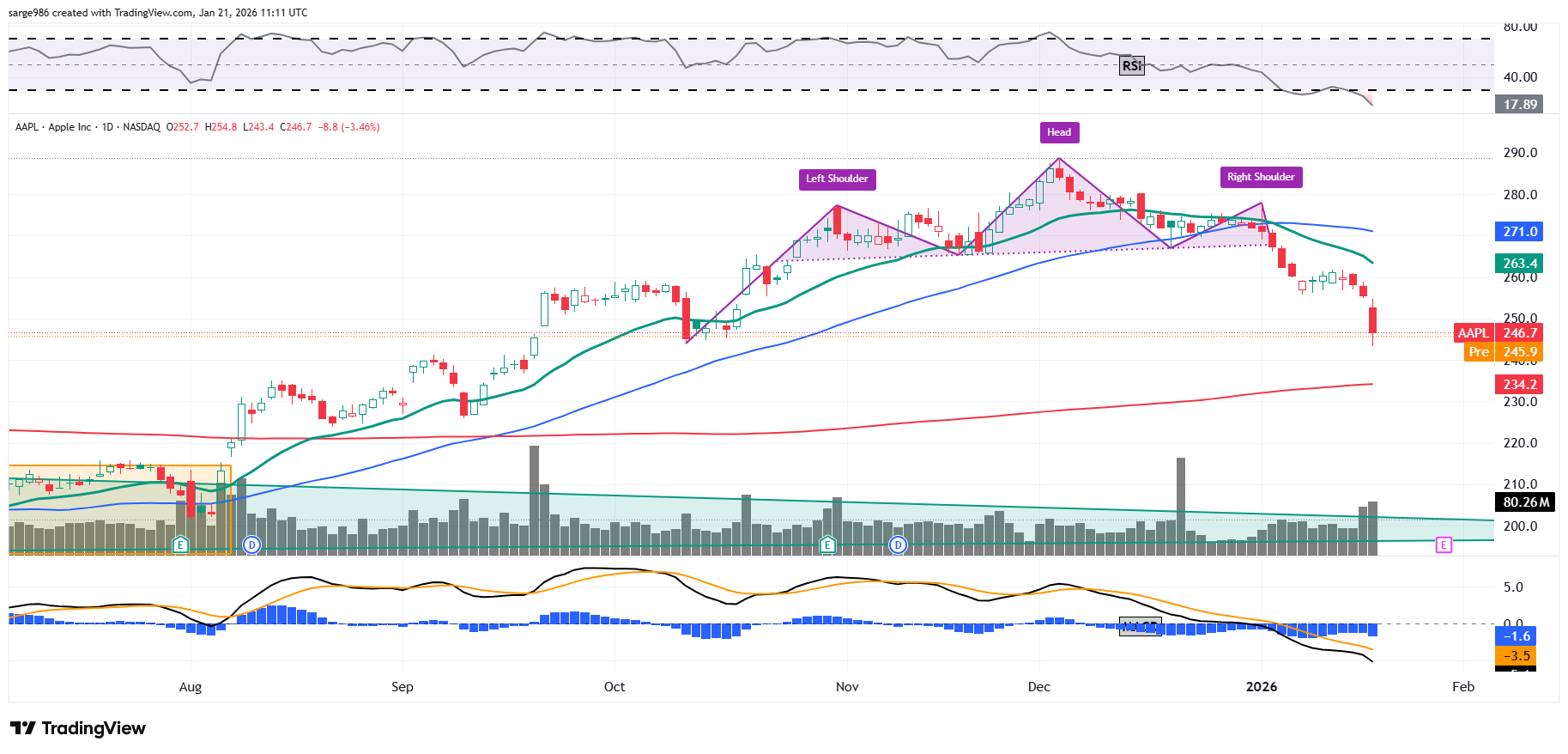
If that thin red line does not halt the meltdown in this stock, things could get really ugly.
Economics
(All Times Eastern)
07:00 - MBA 30 Year Mortgage Rate (Weekly): Last 6.18%.
07:00 - MBA Mortgage Applications (Weekly): Last 28.5% w/w.
08:55 - Redbook (Weekly): Last 5.7% y/y.
08:30 - Pending Home Sales (Dec): Expecting -2.6% m/m, Last 3.3% m/m.
08:30 - Construction Spending (Sep): Expecting 0.2% m/m, Last 0.2% m/m.
08:30 - Construction Spending (Sep): Last?
1:00 p.m. - Twenty-Year Bond: $13B.
The Fed
(All Times Eastern)
Fed Blackout Period.
Today's Earnings Highlights (Consensus EPS Expectations)
Before the Open: (HAL) (.55), (JNJ) (2.47), (TRV) (8.76)
After the Close: (CACI) (6.49), (KMI) (.37)
At the time of publication, Guilfoyle was long HAL equity.