Defense Contractors on Defensive, Hope in Jobs, a Needed Selloff
Trump goes on the offensive on military contractors, we get some hot and cold news on the economy, and my chart read of the market.
You've reached your free article limit
You've read 0 of 1 free Pro articles.
Double ... Dribble ... What was that? A slam dunk followed up by an alley-oop? I don't quite know how to explain what happened to defense stocks on Wednesday. First, Pres. Trump took to social media. In what was a very lengthy post, the president praised U.S. defense contractors as a group and then he let them have it. The president wrote, "Defense Contractors are currently issuing massive Dividends to their Shareholders and massive Stock Buybacks, at the expense and detriment of investing in Plants and Equipment. This situation will no longer be allowed or tolerated!"
He was not done. Not even close. Pres. Trump added, "Executive Pay Packages in the Defense Industry are exorbitant and unjustifiable given how slowly these Companies are delivering vital Equipment to our Military, and our Allies. Salaries, Stock Options, and every other form of Compensation are far too high for these Executives. Defense Companies are not producing our Great Military Equipment rapidly enough and once produced, not maintaining it properly or quickly."
The president stated that until U.S. defense contractors build "new and modern" production plants executive pay should not be allowed to exceed $5M, which would be a sharp reduction in compensation for these business leaders. Finally, the president was emphatic... "MILITARY EQUIPMENT IS NOT BEING MADE FAST ENOUGH!"
Executive Order
Pres. Trump then signed an executive order that presses on large defense contractors to spend less on shareholder returns and boost capital expenditures on industrial infrastructure, weapons development and weapons production.
Slam Dunk
These major contractors, which include General Dynamics (GD) , Lockheed Martin (LMT) , Northrop Grumman (NOC) , Boeing (BA) and RTX (RTX) and all of the smaller drone makers, had all been in rally mode up until this happened. The selloff began and the selloff was sharp. The Dow Jones U.S. Defense Index closed down 3.56% for the session while the Dow Jones U.S. Aerospace Index gave up 1.29%. Incredibly, the composition of these two industry equity indexes seems rather arbitrary to me, but you get the point.
The president took back to social media and singled out RTX, which is the old Raytheon, as "the least responsive to the needs of the Department of War, the slowest in increasing their volume, and the most aggressive spending on their Shareholders rather than the needs and demands of the United States Military."
RTX, which has admittedly been a staple holding of the Sarge-folio, is the name behind the Patriot Missile System, the Javelin and TOW anti-tank missiles, Sidewinder air to air missiles, is involved with hypersonic weapons, the Iron Dome / Skyhunter artillery destroyer, Stormbreaker laser guided bombs and so much more. RTX also contributes a number of components to the F-35 program.
Disengaging from RTX would be extremely difficult. That said, for an old American serviceman, it does not feel very good to see the name you bet on, singled out in this way. RTX closed lower by 2.45% for the regular session on Wednesday. It is important to point out that at no point on Wednesday was the pivot point that I gave readers on Tuesday, violated.
Alley-Oop
Just after the RTX post, the president then offered the defense & aerospace industry (see Dow Jones, one industry) more than a bone. Pres. Trump posted, "I have determined that, for the Good of our Country, especially in these very troubled and dangerous times, our Military Budget for the year 2027 should not be $1 Trillion Dollars, but rather $1.5 Trillion Dollars."
Just an FYI, spending on national security was authorized at $901B for the current fiscal year. The president mentioned his tariffs... "If it weren't for the tremendous numbers being produced by Tariffs from other Countries, many of which, in the past, have 'ripped off' the United States at levels never seen before, I would stay at the $1 Trillion Dollar number."
While I am usually all for aggressive defense spending, as an economist, I don't see the benefit of putting the tariff-driven revenue to work as if it were found money. I am not crazy about the idea of $2,000 rebate checks, either. Tariffs have taken the proverbial boot off of the nation's proverbial fiscal neck. That much is true. The Congressional Budget Office has estimated that the president's tariffs will generate as much as $3.4 trillion over 10 years, or $340 billion per year. To be honest, a net number would have to be worked out to allow for the negative economic impacts of said tariffs.
Increasing defense spending by more in dollar terms than the tariffs could possibly generate might not make sense and would detract from other initiatives. It could be and probably is that the president is merely pushing for increased defense spending and as has been his way, is opening negotiations in an aggressive way to put his political opponents on the backfoot.
Regardless, all of those defense contractors have rallied overnight on this news and are now trading at levels above where they peaked on Wednesday ahead of the selloff. RTX closed at $185.73 on Wednesday after peaking at $193.79 after 2 p.m. ET. I see RTX trading close to $195 at zero dark-thirty on Thursday morning.
The Economy and Jobs
Very interesting. There was some "not so hot" data. The ADP Employment Report showed private sector job creation of 41,000 seasonally adjusted positions for December. Wall Street was looking for about 50,000 jobs, readers will recall that I was at 46,000. The November JOLTS (job openings and labor turnover) report showed a lot less job openings than economists were looking for. I do not make JOLTS projections as I think they are both dated and close to meaningless.
Then there was some surprisingly strong data. The ISM Non-manufacturing Index of Service Sector PMI, printed at an impressive 54.4 for December. December was the strongest month for the U.S. service sector since October of 2024 and the third strongest since early 2023. New orders (the most important component of the survey) soared to 57.9 and have now printed in a state of expansion for seven consecutive months.
Perhaps most impressively, employment moved sharply into expansion at 52.0 from 48.9. December was the first month of employment growth for the U.S. service sector since May. Inflation continues to slow as well. Service sector prices, while still admittedly red hot, showed some disinflation for s second straight month.
My Thoughts
The jobs numbers that markets will react to (I won't call them the real numbers, because way too often, they are not even close) are due this Friday. That said, I want to remind readers of my views for 2026 on jobs and growth. As I have often mentioned, I see the possibility or even probability for impressive levels of economic activity for 2026 and beyond as generative and especially agentic artificial intelligence improve and take on more responsibility for decision making.
This could and likely will, even in what may be a statistically strong economy, pressure both demand for labor and wage growth in a broad way. Current fiscal policy objectives favor economic growth and though still behind, monetary policy appears to be moving slowly in the right direction. The regulatory environment is also about to improve, from an economic perspective, quite dramatically.
This environment will broaden the distribution of possible outcomes for investors like us. This is an environment where risk takers will likely get paid, but also be more subject to surprise, potentially, at times, negative surprise. Bottom line. Don't fight AI. Make AI an ally. Adapting more quickly than Joe on your left and Jane on your right will increase workplace longevity for those dependent upon an employer. Investing in AI beneficiaries will protect to some degree against the loss of, or decreased wage driven income. No, kids, it's not going to be easy. You could sit around and whine about it, or you could ball up two fists and come out swinging.
The Selloff We Needed
I know, there was a mild mid-day reversal. I know, stocks closed near their lows. I know, equity index futures outside of defense have not performed well overnight. The fact is that Wednesday provided investors with the selloff we needed.
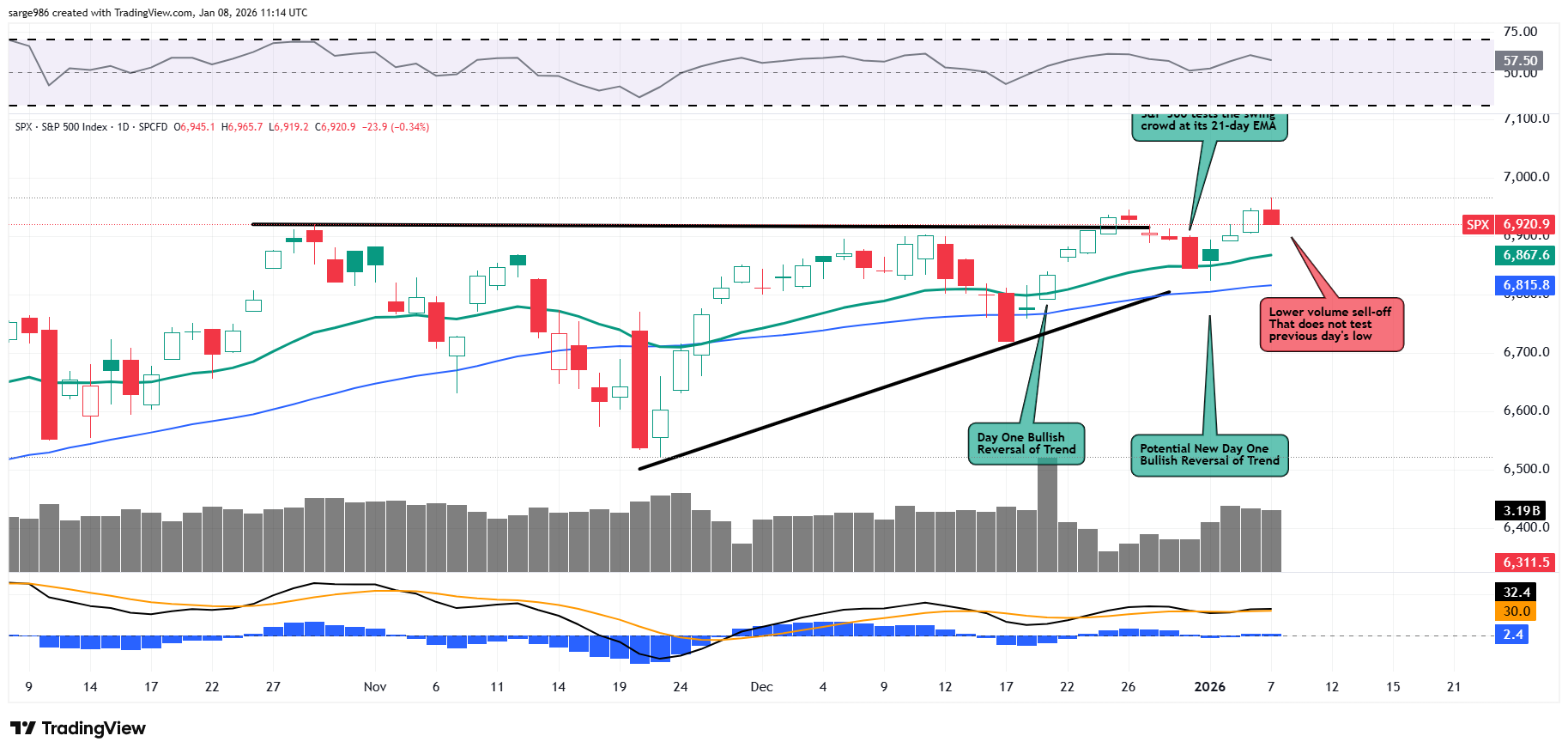
Readers will see that the S&P 500, having out in a "day one" bullish reversal last Friday, had not yet put in the necessary pause needed to confirm that new uptrend. Now we have the pause we craved. Even better, trading volumes were lower, which means that the pros were not that heavily involved in taking off any equity exposure.
Those "pros" still could, but consider this. Relative strength is "strong." The daily moving average convergence divergence is still set up nicely. Advancing volume took a 55.8% share of composite Nasdaq-listed trade on Wednesday. As far as selloffs go, that was pretty wimpy. Not even a potential "day one" bearish reversal. Am I nervous? Only God and something bad happening to my family makes me nervous. With stocks, I see what happens and I play by my rules, which makes the game so much easier than worrying.
Economics
(All Times Eastern)
07:30 - Challenger Job Cuts (Dec): Last 71.321K.
08:30 - Initial Jobless Claims (Weekly): Expecting 210K, Last 199K.
08:30 - Continuing Claims (Weekly): Last 1.866M.
08:30 - Non-Farm Productivity (Q3-adv): Expecting 3.4% q/q, Last 3.3% q/q (SAAR).
08:30 - Unit Labor Costs (Q3-adv): Expecting 0.8% q/q, Last 1.0% q/q (SAAR).
10:00 - Wholesale Inventories (Oct): Expecting 0.2% m/m, Last 0.5% m/m.
10:30 - Natural Gas Inventories (Weekly): Last -166B cf.
3:00 p.m. - Consumer Credit (Nov): Last $9.18B.
The Fed
(All Times Eastern)
No public appearances scheduled.
Today's Earnings Highlights (Consensus EPS Expectations)
Before the Open: (AYI) (4.55), (RPM) (1.41), (SNX) (3.73)
At the time of publication, Guilfoyle was long RTX equity.