Corn Price Nears Inflection Point After Bumper Crop Setback
Once the market works out the reality of corn's bumper crop, the price rebound could be impressive.
You've reached your free article limit
You've read 0 of 1 free Pro articles.
Farming is a tough business; when things are going well, the pay per unit of production is lower than it is in a difficult growing year. In some cases, 2025 included, the price they are set to receive for their efforts is below the cost of production. Most working Americans don’t know what it feels like to work long, hard, hot and dirty hours with the prospect of possibly not turning a profit; farmers do.
For these reasons, there are government-subsidized insurance programs to prevent farmers from throwing in their trucker hats en masse, leaving us without food security. Additionally, the 2014 Farm Bill pays farmers when the market price of a covered commodity (row crops such as soybeans, wheat, cotton and rice) falls below the statutory reference price set by Congress.
There have also been supplemental ad hoc disaster assistance programs. In late 2024, the relief act provided $10 billion in economic assistance to farmers for low crop prices. This program paid farmers a set amount per acre of cash crop grain planted.
Lastly, there are programs in place to allow farmers to take low-interest loans using their crops as collateral to reduce the harvest price pressure seen at the end of most cycles (the loans provide operational capital while farmers wait for higher prices to market their production). Each of these programs is aimed at reducing the risk of the farming business to manageable levels.
As is always the case, well-intended government programs often lead to unintended consequences. For instance, the government-provided backstop encourages farmers to focus on cash crops covered by the subsidy programs. Not surprisingly, this leads to an overproduction of such crops and a recipe for perpetually low prices. As a result, programs intended to provide farmer security can work against the farmer in the form of lower commodity prices.
Further, those peripheral to the industry stand to profit indirectly from government farmer aid programs. This includes high-tech farm equipment and aggressive scientific development to increase yields per acre. These aspects also increase the odds of a continuous supply glut. In short, technology is deflationary. As time goes on, we get better at producing row crops because that is how the system is designed to work.
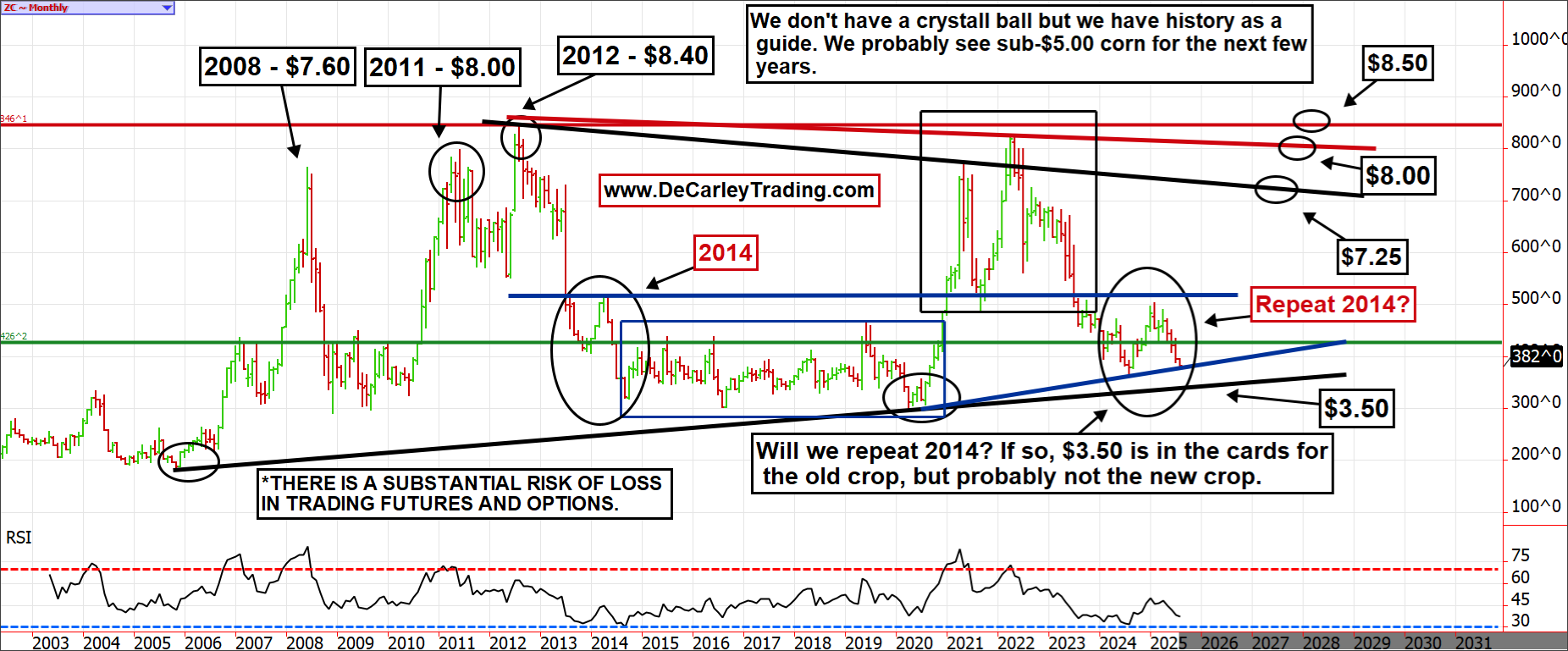
With all of this in mind, grain speculators are better off being perma-bears than perma-bulls; yet there is a time and place for everything.
Old crop corn futures (the September contract representing this year’s harvest) are likely to test a multi-decade support line near $3.50/$3.60. But the new crop contract (December corn representing next year’s crop) probably has a floor just under $4.00. Wherever that floor might be, once the market works out the reality of a bumper crop and the harvest low supply glut, the rebound could be impressive. Not as impressive as in 2021 or 2022, but a 50-cent-to-$1 increase is relatively likely. Even better, a relatively low volatility environment allows traders to speculate on higher corn prices with surprisingly low risk and incredible leverage.
For instance, it is possible to purchase a December corn futures contract for just over $4.00 while also buying a December corn $4.00 put for less than 13 cents. The total risk of such a position would be roughly 16 cents or $800 before considering transaction costs. Even if corn goes to zero, or below, as we saw oil do five years ago, the risk is capped at the amount spent on the put option plus the difference between the strike price and the futures price.
The profit potential, unlike the risk, is theoretically unlimited. This strategy allows the trader to benefit from price appreciation on 5,000 bushels of corn, or about $20,000 worth of corn, with a margin requirement and risk of less than $1,000. If corn rallies 50 cents, the put option purchased as insurance will lose most of its value, but the futures contract will be up about $2,500, leaving a net profit of about $1,850. A $1 rally in corn might see a profit of over $4,000. We wouldn’t count on this occurring, but 50 cents is probable, and a dollar is possible.