Consumers & CFOs Down. CrowdStrike Up.
Let's look at some depressing numbers about consumer confidence and CFOs' expectations for a recession, as well as my strategy for CrowdStrike.
You've reached your free article limit
You've read 0 of 1 free Pro articles.
Woke up this morning, what did I see?
A big black cloud hanging over me
I switched on the radio and nearly dropped dead
The news was so bad that I fell out of bed
There was a gas strike, oil strike, lorry strike, bread strike
Got to be a Superman to survive
Gas bills, rent bills, tax bills, phone bills
I'm such a wreck but I'm staying alive
Superman, Superman
Wish I could be like Superman
Superman, Superman
I want to fly like Superman
- "Superman" Ray Davies (The Kinks), 1979
The Consumer
The Conference Board on Tuesday morning released its most recent survey for Consumer Confidence, and the results were not pretty. The headline number dropped to 92.9 from 100.1 in February. This was the weakest headline print for this monthly series since January of 2021. Within the report, the component for future expectations dropped to 65.2 from 74.8 in February. Sit down for this: That was the weakest print for future expectations since March of 2013. That's 12 years. In addition, the median expectation for inflation increased to 5.1% from 4.7%. Additionally, only 37.4% of those surveyed expect the stock market to rise over the next 12 months.
The University of Michigan will on Friday revise the March results for its consumer sentiment survey. Readers may recall that two weeks ago, in the preliminary release of that survey, headline consumer sentiment dropped to 57.9 from 67.8 in February. That would be the weakest print for that release since April of 2023.
Perhaps most alarming is the one-year out inflation expectations portion of this survey. Expectations in the preliminary release for March increased to 4.9% from 4.3% in February, 3.3% in January and 2.8% in December. Now, I have told readers that I saw inflation as measured by consumer price index decelerating further in March after starting to decelerate in February. So far, that does seem to be playing out accurately. That said, one way to lose control over inflation is for expectations to become unanchored. If the good people believe that inflation is going to accelerate again, then inflation is going to accelerate again. It's a sort of emotions/sentiment-based thing. We, if united, can control it, but we most certainly will not.
The CFOs Said What?
CNBC reported on Tuesday the results of the network's most recent quarterly CFO Council Survey. The survey of corporate chief financial officers shows that 60% of respondents expect the U.S. economy to fall into recession during the second half of this year. On top of that, an additional 15% expect a recession to befall the U.S. economy by 2026.
There is good news. Sort of. Though that 60% is up from 7% for 2025, three months ago, 25% of CFOs across the nation apparently see no recession at all and 90% of all responding CFOs expect any recession, if it does occur, to be either moderate or mild. For what it's worth, over the course of my civilian career, I have held titles with the word "economist" in them at three Wall Street firms as well as having traded and managed money. At this time, I do not see a full-blown recession in 2025.
I still define recession as two consecutive quarters of economic contraction, despite the changes made to the definition in 2022 for political purposes. I do believe that as federal spending is reined in that the US economy will either fall into a state of contraction or come close to it. I do not see this slower period of growth lasting six months. The thing to remember is that I am not a fortune teller and financial austerity at both the corporate and household levels is contagious. That means that once these things start, they can be hard to control through policy.
Marketplace
The headline equity indexes still managed to put together a positive session on Tuesday. This made for three-day winning streaks for both the S&P 500 and the Nasdaq Composite. Those two indexes were up 0.16% and 0.46% respectively for the Tuesday session. The cold, hard truth, though, is that the internals were not all that great. The Dow Transports, small and mid-cap indexes, and Philly Semiconductors, all showed losses for the day as capital flows started to move back into Treasuries.
The yields for both the U.S. Ten-Year and Two-Year Notes experienced drops of three basis points apiece to 4.31% and 4.02% in that order. The U.S. Dollar Index more or less traded sideways for the session as did gold, Bitcoin and crude oil. Interestingly, copper prices soared on Tuesday.
Usually indicative of an economy that is either already in, or about to head into, a state of accelerating growth, copper prices are up a rough 31% in 2025. That's an indicator contrary to almost everything else we are seeing and reading right now. This may be as much a function of expected tariffs on imported copper as anything else and a lack of adequate refining capacity as the needs for electric power grow exponentially, but let's keep our eyes on this development.
Breadth
For the day on Tuesday, six of the 11 S&P sector SPDR exchange-traded funds shaded into the green, led by Communication Services XLC, which at 1.27% was the only one of these funds to gain more than 1%. Interestingly, despite all of the semi-apocalyptic economic surveys, all four defensive sectors finished in places eight through 11 on the daily performance tables as three of those funds surrendered more than 1%. The Utilities XLU were the day's biggest losers.
Despite the headline wins, losers beat the winners by a 5-to-4 margin at the NYSE and by about 5-to-3 at the Nasdaq. Advancing volume took just a 46.2% share of NYSE-listed trade and a 42.4% share of composite Nasdaq-listed activity. Readers should be cognizant that on a day-over-day basis, aggregate trade contracted by 1.1% for NYSE-domiciled securities and by 4.6% for Nasdaq-domiciled names. This does render Tuesday less meaningful in terms of how technicians interpret the day's activity.
To the Moon?
On Tuesday, analyst Gray Powell of BTIG, who is rated at five stars (out of five) at TipRanks, upgraded his rating on Sarge-fave CrowdStrike Holdings CRWD from "Neutral," which is a hold-equivalent, to "Buy," while setting a target price of $431. The stock closed at $384.95 on Tuesday, up 3.3% for the session. Last week, Keith Weiss of Morgan Stanley, another five-star analyst, assumed coverage of CRWD with an "Overweight" rating (buy-equivalent) and a $429 target price. The TipRanks service rates Powell at 735th and Weiss at 126th out of the 9,444 sell-side analysts tracked by the firm.
In his accompanying note, Powell wrote "With the July 19, 2024, IT outage now eight months in the rear-view mirror, we think CrowdStrike has much better visibility on forecasts. As we run through ARR (annual recurring revenue) recapture scenarios, we see potential for growth to re-accelerate in second half (fiscal) 2026 and upside to street forecasts in fiscal 2027." Readers should know that the current quarter is CrowdStrike's fiscal first quarter 2026.
My readers know that I am a huge believer in the durability of demand for cybersecurity software services for the long-term. I have written for years now that CrowdStrike was probably "best in class" as far as cyber and cloud security is concerned. CrowdStrike is currently the third heaviest weighted allocation on my most active portfolio and competes directly with Palo Alto Networks PANW, SentinelOne S, Microsoft MSFT and Zscaler ZS. In addition to CRWD, I am also long S and MSFT.
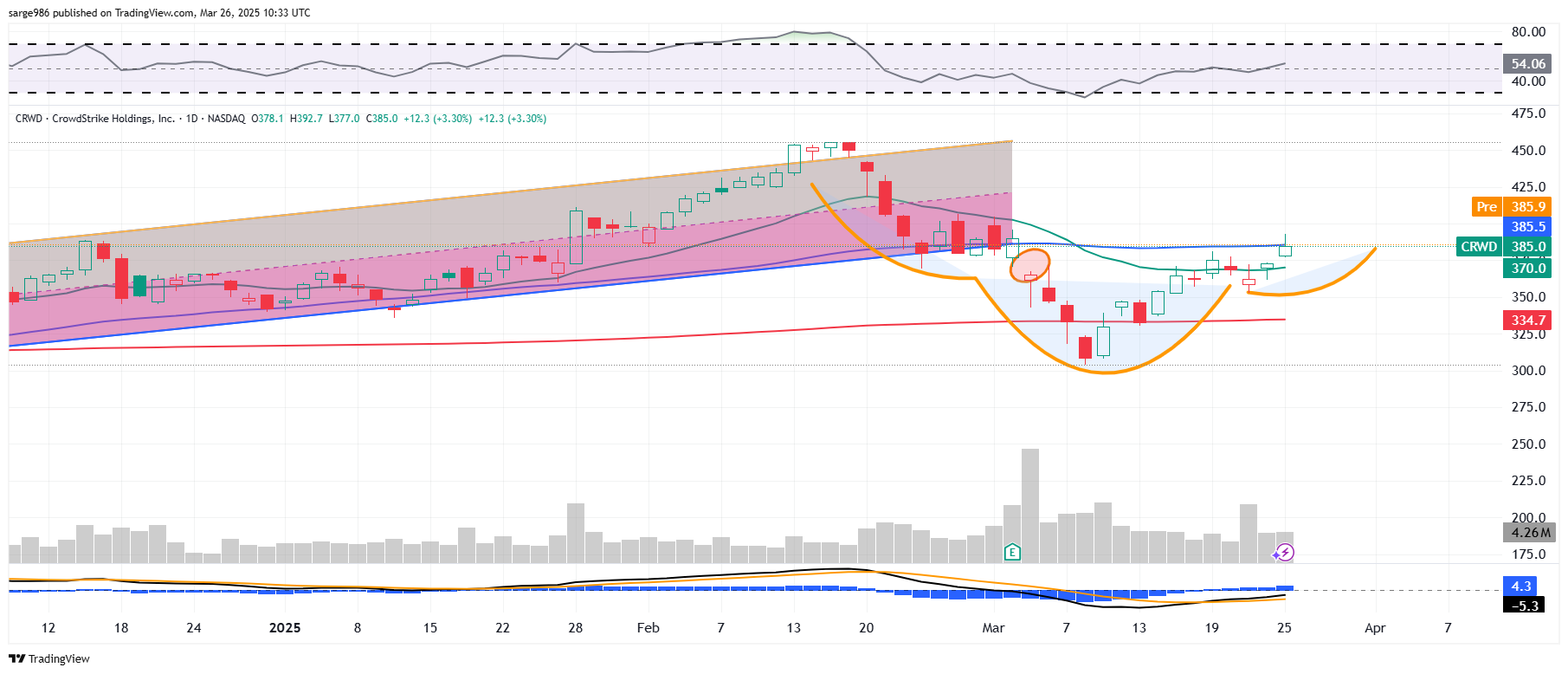
I wrote to you on March 5 and told you that if CRWD tested its 200-day simple moving average from above that I would be adding to my long position, which is what I did. Readers can now see that after losing that line on March 10, the stock has regained not just the 200-day simple moving average, but also the 21-day exponential moving average and closed on Tuesday pressed up against its 50-day simple moving average. This is what has forced portfolio managers to increase their exposure to the name.
Readers will also note that Relative Strength (above the chart) is improving, as the daily Moving Average Convergence Divergence indicator (below the chart), while still not postured bullishly, has greatly improved over the past week.
My Plan for CrowdStrike:
Target Price: $443
Pivot: 50-day SMA (currently $385.50)
Add: Down to the 200-day SMA (currently $334.70)
Panic: On a second loss of that 200-day SMA in less than a month.
Economics (All Times Eastern)
07:00 - MBA 30 Year Mortgage Rate (Weekly): Last 6.72%.
07:00 - MBA Mortgage Applications (Weekly): Last -6.2% w/w.
08:30 - Durable Goods Orders (Feb): Expecting -0.7% m/m, Last 3.1% m/m.
08:30 - ex-Transportation (Feb): Expecting 0.4% m/m, Last 0.0% m/m.
08:30 - ex-Defense (Feb): Expecting -1.6% m/m, Last 3.5% m/m.
08:30 - Core Capital Goods (Feb): Expecting 0.2% m/m, Last 0.8% m/m.
10:30 - Oil Inventories (Weekly): Last +1.745M.
10:30 - Gasoline Stocks (Weekly): Last -527K.
The Fed (All Times Eastern)
09:00 - Speaker: Minneapolis Fed Pres. Neel Kashkari.
09:10 - Speaker: St. Louis Fed Pres. Alberto Musalem.
Today's Earnings Highlights (Consensus EPS Expectations)
Before the Open: CHWY (.20), CTAS (1.05), DLTR (2.20), PAYX (1.48)
After the Close: JEF (1.20), VRNT (1.27)
At the time of publication, Guilfoyle was long CRWD, S, MSFT equity.