China’s Influence Rises as Beijing Becomes Unusual U.S. Ally on Iran
The Chinese government is playing a crucial behind-the-scenes role as guarantor of the U.S.-Iran ceasefire, and investors are moving past last year’s tariff fears as a result.
You've reached your free article limit
You've read 0 of 1 free Pro articles.
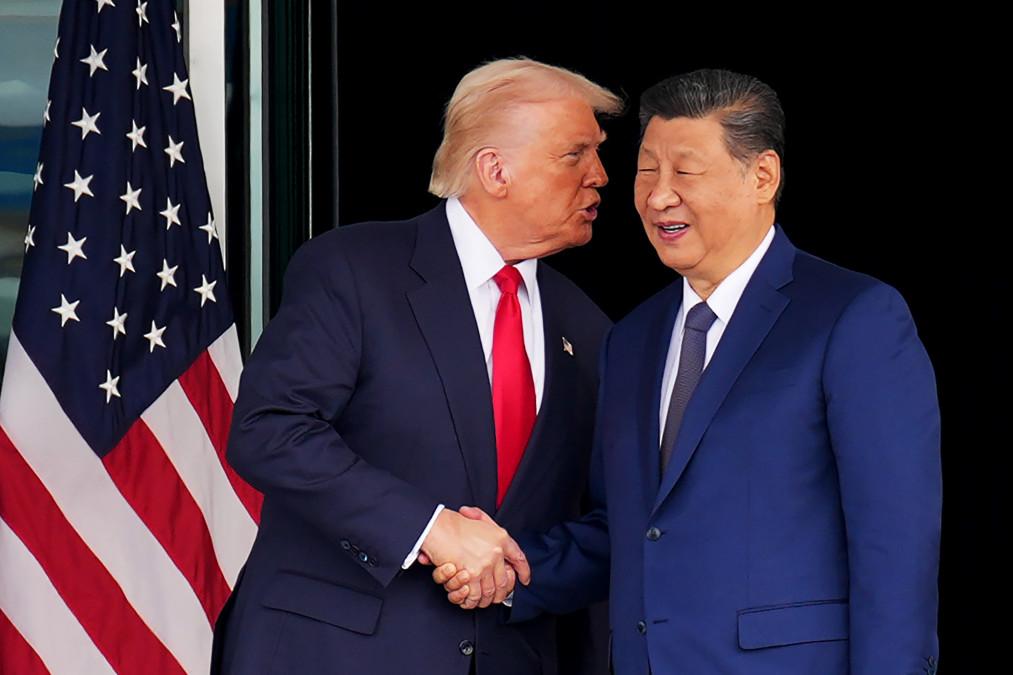 U.S. Donald Trump Meets With China's President Xi In South Korea
After the most bullish day of trading of the year for Asian markets on Wednesday, investors are today looking past the initial enthusiasm over the U.S.-Iran ceasefire and considering the longer-term implications of the fallout from the war.
TheStreet
One of the upshots is a renewed sense of optimism inside China. Its geopolitical position has been reinforced by U.S. aggression, leaving China as a uniquely positioned peacemaker not only in the Middle East but also with Russia and North Korea.
The Iran ceasefire was brokered in part by China, according to U.S. President Donald Trump, working behind the scenes with Pakistan ostensibly as the go-between linking Washington and Tehran.
Trump Tells AFP China Played Key Role
Trump said that China had played a key role in bringing Iran to the negotiating table, in a phone call with the Agence France-Presse (AFP) news agency.
“I hear yes,” he told AFP, when asked whether Beijing was involved in getting its “comprehensive strategic partner” Iran to agree to talks.
Trump has also credited Pakistan’s role, indicating that U.S. Vice President J.D. Vance will lead a delegation to attend peace talks in the Pakistani capital, Islamabad.
Iran has denied Trump’s previous claims that the Tehran government is negotiating with their American counterparts. Washington has a 15-demand plan that includes opening the Strait of Hormuz, with Iran holding out a 10-demand plan of its own, including continued Iranian control of the strait.
Continued Behind-the-Scenes Influence
China hasn’t confirmed its behind-the-scenes role but is the only Iranian ally with the clout to pressure Iran to strike a deal. China is both Iran’s largest trading partner and largest buyer of its oil. The Chinese foreign ministry welcomes the ceasefire and has “consistently advocated for an immediate ceasefire and cessation of hostilities,” spokeswoman Mao Ning says.
Trump has postponed a trip to Beijing due to the war with Iran, with his China trip now slated for May 14-15. That gives him a self-imposed deadline to conclude the war. Chinse President Xi Jinping will have a valuable bargaining chip during those talks if he can point to his assistance in mediating talks with Iran.
Besides having greater economic clout over Iran than Pakistan, China is also able to negotiate with Israel, a nation without diplomatic ties to Pakistan. So China is acting as a “guarantor” of the talks even if it nominally remains neutral.
India Watching Pakistan’s Rise With Concern
India, meanwhile, is watching on with concern. Pakistan’s role as mediator increases the country’s influence, at a time that India’s government has been working hard to isolate its neighbor and nuclear rival, painting Pakistan as a sponsor of terrorist groups.
India's external-affairs minister, Subrahmanyam Jaishankar, lashed out that India will not be a "dalal" nation like Pakistan, using a disparaging Hindi word for "broker" or middleman. The Indian political opposition had questioned why India is remaining silent while Pakistan plays a prominent intermediary role.
India also maintains close ties with Israel. Indian Prime Minister Narendra Modi was hosted in Tel Aviv by Israeli Prime Minister Benjamin Netanyahu two days before the attacks on Iran began.
China’s Electric-Vehicle Exports Soar
One noteworthy company-specific impact has been a boom in demand for electric vehicles (EVs), with China the primary source of production, batteries and vehicles made for export.
China’s EV exports hit a record 349,000 vehicles in March, according to data released Thursday by the China Passenger Car Association. That’s up 140% in a year.
BYD (BYDDY) (HK:1211) is leading the way with 120,083 export vehicles. Geely Automobile Holdings (GELYY) (HK:0175) and Chery Automobile (HK:9973) account for the rest of the top three.
While BYD shares are up 7.0% in 2026, and Chery up a similar 6.9%, Geely stock has soared 34.0% after it posted record sales for Q1 and saw sales move ahead of BYD for the first two months of the year.
The shares of the Chinese EV makers are highly volatile, trading on monthly sales figures. That’s given an intense price war within China, where EVs make up more than half of all vehicles sales, at 51.5% for March. The 848,000 New Energy Vehicles (including EVs and hybrids) sold within China for March was up 82.6% from the prior month but down 14.4% year on year.
BYD’s sales are down within China, with March representing a seventh straight month of decline. But sales in Europe are soaring off a small base. Given the incentives and discounts in its domestic market, BYD can turn a larger profit margin off a China-made car sold in Europe than if it sells the same vehicle within China.
Asian Shares Soar Then Dip on Oil
Asian shares continue to trade based on the price of energy. Oil prices are back up, with Brent crude trading at $98.90 as I write, and rising. It had fallen to a bottom of $90.69 Wednesday, its lowest levels in a month, sending Asia’s oil-importing markets surging.
Wednesday’s oil dip sent South Korea’s world-leading stock market surging to close up 6.9% on the day, triggering a five-minute “sidecar” immediately after trading began, to pause program-driven trading. In Tokyo, the broad-market Topix rallied 3.3% and the exporter-heavy Nikkei 225 added 5.4% by the close. Hong Kong’s Hang Seng index ran up 3.1% in its best showing of the year so far.
All those markets are modestly in the red on Thursday, with the Kospi giving back 1.6%, the Topix down 0.9%, the Nikkei 225 off 0.7% and the Hang Seng down 0.5%.
The main immediate impact of the Middle East conflict has been the disruption in energy supplies to Asia, the bulk of which pass through the Strait of Hormuz, as I’ve explained in my recent columns since the war began. That places inflationary pressure on Asian economies.
The Philippines has declared a national energy emergency as a result. South Korea has launched a nationwide energy-saving campaign and is considering restriction driving to certain days, and even oil-producing countries such as Indonesia are capping fuel purchases at 50 liters per day and encouraging work-from-home measures.
Iran briefly agreed to reopen the Strait of Hormuz as part of a two-week U.S. ceasefire deal that it at best described as “fragile.” Iran immediately closed the strait when Israel launched attacks in Lebanon, on the Iran-backed militant group Hezbollah.
Even if ships do begin passing through the Strait of Hormuz in significant numbers, Iran will surely seek to control and tax the flow, charging a fee of up to $2 million per passage. One-fifth of global oil and gas shipments would normally flow through the strait, with around 1,400 vessels currently backed up in the Persian Gulf and Gulf of Oman on either side.
Change of Tone Within China
There has been a marked shift in tone in China, with greater optimism about the outlook, according to Jim Walker, the chief economist at Hong Kong-based Aletheia Capital.
He noted a distinct change in mood on a recent trip to the mainland. “In contrast to our visit to Beijing a year ago, most of our contacts didn’t seem to have a care in the world,” Walker notes.
Twelve months ago, all the talk was about the trade war with the United States, and the impact of higher tariffs on the economy. The death spiral in the domestic property industry was also a key concern, putting pressure on the finances of local governments and raising the prospect of negative surprises to economic growth.
Now, the situation surrounding Taiwan appears peaceful, China has introduced a new five-year plan targeting growth through 2030, and the property industry appears to be recovering.
What’s more, China has moved from trade-war opponent to an unusual U.S. ally on Iran. The “Iran War is rarely mentioned except to say that China has advantages compared to other countries,” Walker points out in a note to clients.
At the time of publication, McMillan was long BYD.