China Struggles, Nvidia Pauses H200 Chips, Econ Data Moves Markets Again
Let's check on China's slowdown, reports that Nvidia's halting production of AI chip, how macro data is back & Warsh nomination.
You've reached your free article limit
You've read 0 of 1 free Pro articles.
Was it all just a dream? Was this all just some sideways trading action? Nothing profound to be discerned from the risk asset-focused process of price discovery this week? Maybe. Maybe not. Jobs Day still lies to our front. The concern over the war with Iran, at least from a financial markets' perspective, does appear to be dissipating. On Wednesday, it mattered more to markets that the ADP Employment Report on February private sector job creation was not overtly weak. In fact, that report was slightly stronger than expected.
On Wednesday, it mattered more that the ISM Non-Manufacturing (Service) Sector Index (PMI) for February appeared to hit the tape much stronger than expected. In February, New orders for the service sector across the country not only printed in a state of expansion for a ninth consecutive month but accelerated sharply from January levels. Within that report, Employment accelerated as did order backlogs, as did inventory building. Only thing that decelerated? Prices. Not kidding.
Of course, it did not hurt that the New York Times reported that someone in Iran had made indirect contact with U.S. intelligence looking for a way to slow hostilities. Whether that is true or anything comes of it, mortgage refinance applications across the U.S. have increased for four straight weeks and are now running at their strongest pace in four years. There is no denying that at least on Wednesday, markets reacted positively to stronger-looking macroeconomic data than to anything related to the war.
Meanwhile, Back at the Ranch...
Beijing signaled to the world that the planet's second-largest economy is now entering into a period of reduced economic activity. The Chinese government set its 2026 target for GDP growth at 4.5%, which would be the slowest target set by Beijing in a rough 30 years or so. The mainland Chinese economy is, of course, dealing with slower household spending, slower investment, and a tough real estate market. That economy will now also have to deal with the denial of its access to inexpensive and illegal energy commodities now that the U.S. has taken Venezuela and Iran off of the playing board.
Speaking of China
Elite U.S. chip designer Nvidia (NVDA) has apparently halted production of its H200 AI chips that had been designed for the Chinese market due to the persistent roadblocks thrown up by both U.S. and Chinese regulators. Nvidia did not include future sales to Chinese customers in its forward-looking sales projections made in late February. This news likely also negatively impacts Nvidia's top AI-capable chip designing competitor, Advanced Micro Devices (AMD) .
Nvidia has decided to move on and deal with the world it can do business with, where, by the way, there is still a shortage of supply and immense demand for cutting edge chips. Nvidia is now re-allocating its manufacturing capacity at Taiwan Semiconductor (TSM) to ramp up production of its upcoming Vera Rubin generation hardware.
New Sheriff in Town
On Wednesday, Pres. Trump officially nominated Kevin Warsh to succeed Jerome Powell as Chairperson of the Federal Reserve Bank in May when Powell's term as "top dog" comes to an end. Warsh still needs Senate confirmation to ascend to that position. This does not necessarily mean that Jerome Powell's influence on monetary policy will disappear completely.
Powell's term as Fed Chair ends May 15. His term as a member of the Fed's Board of Governors does not end until Jan. 31, 2028. Though it would be unusual for a former Fed Chair to hang around in a lesser capacity after leaving office, the relationship between Pres. Trump and Powell has deteriorated to the point where Powell could stick around just to make a point.
Anyone Else Notice South Korea?
The KOSPI Index in South Korea closed up 9.6% this morning after having traded as much as 12% higher during the session.
Nothing Else Matters
Trust, I seek and I find in you
Every day for us something new
Open mind for a different view
And nothing else matters
- Hetfield, Ulrich (Metallica), 1991
Marketplace
As U.S. equities have appeared to recover, the same U.S. Treasury debt securities that protected our portfolios during the early stages of the war-inspired volatility, have continued to selloff. On Wednesday, the U.S. Ten-Year Note paid as much as 4.1% and that yield has moved higher, to 4.12% overnight. Nearly an entire month of lower yields has been lifted.
The S&P 500 gained 0.78% on Wednesday and peaked at a higher level than it did on Friday. The Nasdaq Composite added 1.29% on Wednesday and apexed considerably higher than it did last Friday. Yes, the week is now positive over three sessions. Looking at all of the mid-major to major U.S. equity indexes, there was no red on the screen. The Philadelphia Semiconductors led the recovery, gaining 1.93%, led not surprisingly, by SanDisk (SNDK) , as well as Advanced Micro Devices and Intel (INTC) . The small caps did well too, as the Russell 2000 tacked on 1,09%.
Breadth
Market breadth was strong on Wednesday. Eight of the 11 S&P sector SPDR exchange-traded funds ended the day in the green, led by the discretionaries (XLC) and tech (XLK) . The staples (XLP) led the losers as the cyclicals and growth both outperformed the defensives.
Winners beat losers by a nine-to-five margin at the NYSE and by 11 to five at the Nasdaq. Advancing volume took a 65.6% share of composite NYSE-listed trade on Wednesday and a commanding 73.2% share of composite Nasdaq-listed activity. Here's where a potential problem comes up.
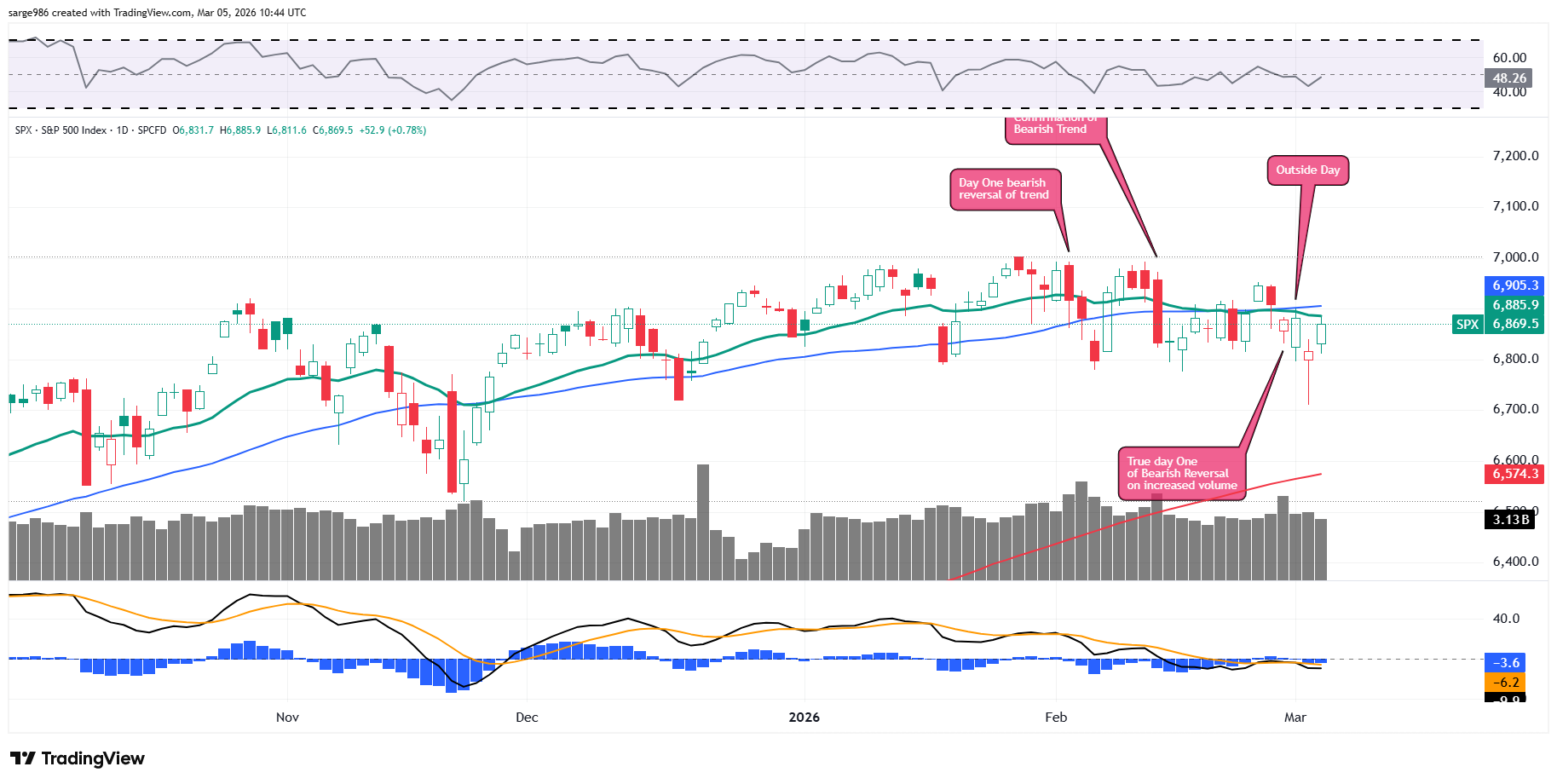
Aggregate trading volume expanded across Nasdaq-listed names, by an impressive 12.5% day over day. But aggregate trade across NYSE-listed securities contracted by an almost disturbing 18.5% from Tuesday's levels. Aggregate trade also contracted rather sharply across the membership of the S&P 500.
Readers will see that the S&P 500 re-engaged with its 21-day exponential moving average on Wednesday but was met with resistance at that line. The index never made it to its 50-day simple moving average. Is that meaningful? It could be. As a long-term bull, I would like to see that line at least kissed on Thursday ahead of the jobs data on Friday. Equity index futures have been volatile overnight but are trading close to flat as I approach the submission of this piece. This should be an interesting Thursday.
Economics
(All Times Eastern)
08:30 - Initial Jobless Claims (Weekly): Expecting 215K, Last 212K.
08:30 - Continuing Claims (Weekly): Last 1.833M.
08:30 - Export Prices (Jan): Expecting 0.4% m/m, Last 0.3% m/m.
08:30 - Import Prices (Jan): Expecting 0.2% m/m, Last 0.1% m/m.
08:30 - Non-Farm Productivity (Q4-adv): Expecting 4.4% q/q, Last 4.9% q/q, SAAR.
08:30 - Unit Labor Costs (Q4-adv): Expecting -0.3% q/q, Last -1.9% q/q, SAAR.
10:30 - Natural Gas Inventories (Weekly): Last -52B cf.
The Fed
(All Times Eastern)
No public appearances scheduled.
Today's Earnings Highlights
(Consensus EPS Expectations)
Before the Open: (BURL) (4.74), (KR) (1.20)
After the Close: (COST) (4.54), (MRVL) (.79)
At the time of publication, Guilfoyle was long NVDA, AMD, TSM, INTC equity.