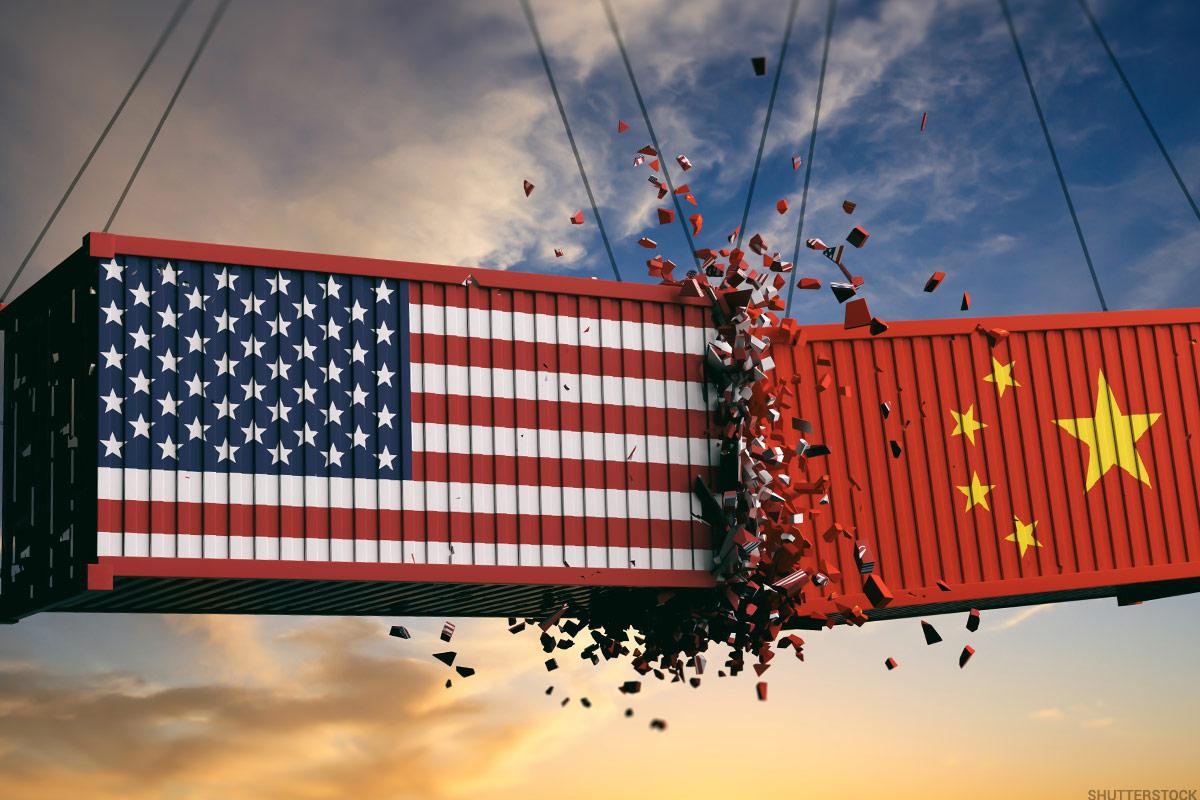
China Markets Call Trump’s Bluff on Trade
The imposition of new tariffs on Chinese imports hasn’t hurt Hong Kong stocks, while U.S. stocks have been hit instead, suggesting that investors see Sino-U.S. tensions easing.
You've reached your free article limit
You've read 0 of 1 free Pro articles.
The markets are calling Donald Trump’s bluff.
Hong Kong and China shares are little changed Tuesday, despite the impact of an additional 10% tariffs on Chinese goods exported to the United States.
The Hang Seng index is down 0.3% Tuesday, after the Hong Kong benchmark gained the same percent on Monday. Granted, after a selloff on Friday, Hong Kong stocks are down 3.2% since the U.S. president declared he would impose an additional levy on Chinese imports.
But it’s hardly a market meltdown, and Hong Kong stocks remain 21.6% higher than their low for the year. That came on January 13, one week before Trump’s inauguration, since when China-focused businesses in Hong Kong have continued to run up.
The Hang Seng Tech Index, which has led the rally, ended Tuesday little changed, technically a 0.22 point loss that registers as 0.0%. It remains 31.1% higher so far in 2025. So the China rally is proving resilient, despite moves intended to hit the Chinese economy. You can trade that tech index via the KraneShares Hang Seng Tech Index ETF KTEC, where I've now bought a small position.
What gives with the ongoing Hang Seng strength? In part, it’s because Trump is erratic, and his tariff strategy isn’t clear. “It’s 10 plus 10” for China, he had to clarify in the Oval Office, since he had already imposed an added 10% on imports from China.
And let’s not forget that China, the world’s second-largest economy and biggest threat to U.S. dominance on the world stage, is still getting off lighter than Mexico and Canada, U.S. neighbors and allies that now face imposed charges of 25% as of Tuesday.
As China’s annual National People’s Congress begins Wednesday, the domestic outlook appears a little more settled. Chinese President Xi Jinping held a symposium for business leaders two weeks back, an unusual step designed to demonstrate Xi’s keenness to stimulate the private sector. Notably, Alibaba Group Holding BABA (HK:9988) figurehead Jack Ma, the first and most-prominent victim of a government crackdown on Big Tech, was brought back into the fold.
Wednesday should see Premier Li Qiang deliver the government’s work report, and announce the growth target for China’s economy, which it remarkably always hits. That’s likely to remain at “around 5.0%,” a mark that China hit for 2024 thanks in part to a strong Q4. Many experts and even members of the government cast doubt on the carefully massaged gross domestic product figures, but they do at least provide a general direction. Last year was the slowest non-pandemic year since 1990.
China-focused investors may be encouraged that Trump intends to use tariffs to strike deals. There’s been little of the international diplomacy deployed by Trump’s predecessor, Joe Biden, who successfully attempted to cut off the supply of high-end chips to China.
That’s not an express purpose of Trump’s blanket tariffs, which somewhat bizarrely he justifies on the basis of illegal shipments of fentanyl. I’m not sure why a U.S. toy importer is supposed to pay a price for the trade in synthetic heroin, operated by international crime syndicates. But there it is.
Many China watchers expect Trump to use tariffs to press the Beijing leadership to the negotiating table on a trade deal. The “Phase One” deal agreed during Trump’s first term involved China purchasing more of farm goods in particular, although partly thanks to the pandemic, China essentially bought no extra U.S. goods at all.
Trump raised the topic of talking with Xi a month ago. But the two leaders have yet to speak by phone since Xi called to congratulate Trump on his election victory, before he took office.
China has responded Tuesday with tariffs of its own, an additional 15% import tax on U.S. chicken, wheat, corn and cotton, and an extra 10% on U.S. soybeans, sorghum, pork, beef, aquatic products, fruits, vegetables and dairy, as of March 10.
Beijing is hitting back hardest in a way that hurts Trump’s voter base in rural “red states.” China is the biggest market for U.S. farm exports. The additional levies affect around 15% of U.S. exports to China, or US$21 billion in trade, according to calculations by Reuters.
China also added 15 companies to its export control list. The Ministry of Commerce will restrict any “dual-use” items that could be used for military purposes to the likes of defense contractor Leidos Holdings LDOS and satellite operator Aerkomm AKOM, as well as General Dynamics GD land-systems subsidiary, as well as other nonlisted contractors such as naval engineering specialist Gibbs & Cox. It also added 10 companies to its “unreliable entity” list, companies it says are selling weapons to Taiwan.
It is U.S. stocks that have suffered with the imposition of new tariffs, with the Nasdaq down 2.6% on Monday and the S&P 500 off 1.8%. That makes sense since it’s U.S. consumers who ultimately pay the price. Costs will also rise for any U.S. manufacturers that import parts from any of the three nations hit with extra duties. The U.S. dollar also weakened as talk began to swirl about a “Trumpcession.”
The Chinese yuan has been steady Tuesday, up 0.2% against the greenback thanks to the decline in the dollar.
Chinese electric vehicle makers are seeing their shares sell off. But they sell very few if any cars into the U.S. market, where they already face an import duty of 100% of the sales price. Imposed under the Biden administration, that doubling of the price has been in place since September.
The main EV influence is that market leader BYD BYDDY (HK:1211) is looking to raise HK$40.7 billion (US$5.2 billion) through a primary placement of its H shares in Hong Kong. It started book building on Monday evening at a price ranging from HK$333 to HK$345 per share, which is a discount of 5.1% to 8.4% over its closing price on Monday.
BYD shares are down 6.8% Tuesday, leading the Hang Seng losses but seeing the shares close at HK$339, exactly in the middle of that range. Its chief rivals also lost ground, with Nio NIO (HK:9866) down 4.6%, Li Auto LI (HK:2015) down 3.2%, and XPeng XPEV (HK:9868) down 3.0%. I own small stakes in BYD, Li Auto and XPeng.
BYD is, however, coming off a record share-price high. Likewise, smartphone maker Xiaomi XIACY (HK:1810) set an all-time high last week as the company unveiled its own electric vehicle, the sleek-looking SU7 Ultra, which starts at C¥215,900 (US$29,750). It has set an ambitious target of selling 10,000 cars this year, but says initial orders already exceed that. Xiaomi corrected 0.8% Tuesday but is up 48.7% so far this year.
The kind of domestic-focused companies that I highlighted in my last column have been gaining in China recently fared well again on Tuesday, ahead of likely moves out of Beijing to spur consumption.
Jewelry chain Chow Tai Fook CJEWY (HK:1929) led the Hang Seng gainers, up 5.3%, with brewers China Resources Beer CRHKY (HK:0291) and Budweiser Brewing Co. APAC BDWBY (HK:1876) also both up 4.5%.
I’ll be watching to see how Hong Kong’s China plays fare as China holds its congress, normally over the course of two weeks. Most of the talking points and all the policy has been agreed beforehand so it is the messaging out of the meetings that’s important.
There’s speculation whether Trump is attempting a “Nixon 2.0” or “reverse Nixon” by buddying up to Russia, potentially leaving China out in the cold. That would be the reverse of Nixon’s ping-pong diplomacy that isolated Moscow.
But so far, my money will be on Trump maintaining warm relations with both President Xi and his Russian counterpart, Vladimir Putin. These tariffs look designed to prompt a “Phase Two” China trade deal, meaning any geopolitical pressure on Hong Kong stocks should continue to ease.
At the time of publication, McMillan is long KTEC, BYD, Li Auto and XPeng.