China Celebrates 'Anti-Fascist' Victory, Assembles Trade Bloc of U.S. Rivals
Tuesday marks an important anniversary in Asia, so China is both looking to control that narrative, and cast itself as the free-trade leader of the future.
You've reached your free article limit
You've read 0 of 1 free Pro articles.
Tuesday is “VJ Day,” with September 2 marking the date that Japan’s surrender took effect to end World War II. So there are 80th anniversary observations around Asia to mark the official end of the conflict.
September 2, 1945, is also the date of the founding of the Democratic Republic of Vietnam, the day that Ho Chi Minh proclaimed independence from France. No other nations recognized the Communist government at first, and war soon broke out with France. But the date is now recognized as Vietnam’s National Day, its equivalent of July 4, a public holiday honoring the founding of the modern nation.
So it is with one eye on the past and one eye looking to the future that Chinese President Xi Jinping has invited some two dozen world leaders to the Chinese port city of Tianjin. The immediate occasion is the annual summit of the Shanghai Cooperation Organization (SCO), a 10-member grouping essentially of China, Russia, Iran and the “Stans” in central Asia, alongside India and Pakistan for good measure.
Xi, Modi, Putin Huddle
The SCO isn’t normally incredibly significant, but China is the current president of the body. So Xi is making the most of the event, with 16 other countries taking part as “observer states” or “dialogue partners,” taking in much of the Middle East, central Asia and south Asia.
China will also hold a major military parade Wednesday, ostensibly to honor the World War II anniversary. But it is escaping nobody’s attention that the event in Tianjin has brought together pretty much all of the major U.S. rivals in the region.
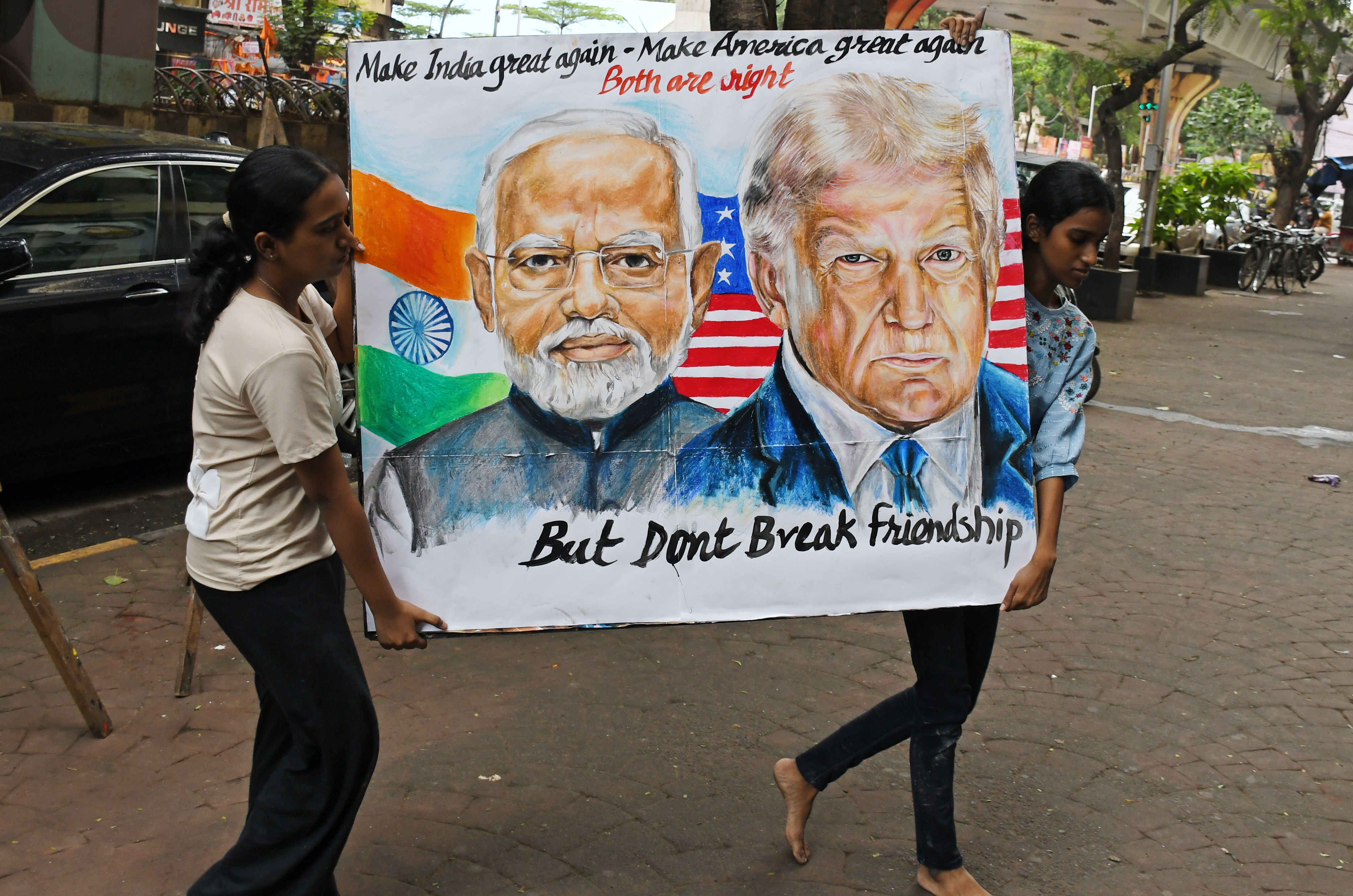
The images Monday of Indian Prime Minister Narendra Modi clasping hands with Xi and Russian President Vladimir Putin, in a smiling, laughing huddle, capture the quintessence of this particular event. In light of U.S. President Donald Trump’s higher tariffs on shipments into the United States, here is a body of nations that are being punished with some of the highest U.S. tariff rates, meeting in a spirit of bonhomie and collaboration.
There are already results out of the two-day SCO summit, which concluded Monday. Russian oil giant Gazprom says Tuesday it has inked a deal to build the long-awaited Power of Siberia 2 gas pipeline to China, via Mongolia, which Gazprom CEO Alexey Miller says could supply up to 50 billion cubic meters per year, for 30 years.
Gas Deal After India Punished
It will also escape nobody that India has just been hit with a 50% tariff rate on imports into the United States, half of that rate a punitive import tax because India is buying Russian oil, according to Trump. It remains to be seen if these tariffs are enforceable — a court has ruled that most of Trump’s tariffs are illegal. The court says Trump’s declaration of various kinds of “national emergency” to justify these tariffs oversteps the mark, since tariffs aren’t even mentioned in the relevant law, and since Congress must normally approve new taxes. But the court is allowing the extra trade duties to remain for the time being.
China’s gas purchases double-dares Trump. China, the original object of Trump’s trade ire, has been stringing negotiations along, and is currently subject to a tariff of “only” 30%, well below the 50% faced by both India and Brazil. It’s clear Trump would like to celebrate a “win” with a China trade deal.
China and now India both appear willing to stand up to Trump — literally while holding hands with Russia. The U.S. leader says India has offered to cut its own tariffs to “nothing,” but it’s not clear when that happened, what exactly that involves, or if the offer still stands. “They have now offered to cut their Tariffs to nothing, but it’s getting late,” Trump writes on social media. “They should have done so years ago.”
The Tianjin summit will have given these rivals to the Western world order an opportunity to confer. The members issued their “first-ever statement supporting the multilateral trading system,” according to the Chinese news service Xinhua, “underscoring the SCO’s unwavering resolve to safeguard the stability of the global trade order.”
'Bullying Behavior'
Xi, in his opening address, pointedly denounced “bullying behavior” in the world order, and encouraged attendee nations to “adhere to fairness and justice” as well as to “oppose a Cold War mentality.” He recognized the 80th anniversary of the “victory of the World Anti-Fascist War” as well as the founding of the United Nations.
The joint communiqué out of the summit strongly condemned “the military aggression launched by Israel and the United States against Iran,” but glossed over and made no mention of Russia’s invasion of Ukraine.
Also at the summit, the member states agreed to form a new development bank to invest into infrastructure and socioeconomic development in SCO nations. That’s a victory for China, which first pushed for such an institution as far back as 2010.
Though no further details were given, such a development bank would stand alongside the China-backed Asian Infrastructure Investment Bank as a non-U.S. dollar-backed entity. It would also offset similar entities such as the U.S.-backed World Bank and the Asian Development Bank, heavily supported by both the United States and Japan.
Vietnam, China Stocks Riding High
We’ll see if there are further partnerships between the attending nations. Xi also met with Vietnamese Prime Minister Pham Minh Chinh on Sunday, the Communist neighbors (and frequent rivals) agreeing to intensify their “strategic cooperation.”
It is coincidental timing, but the gathering in China comes at a time that both mainland and Vietnamese stocks are rallying.
The CSI 300 index of the largest stocks listed in Shanghai and Shenzhen is up double digits in the last month, posting a 10.7% gain as of Tuesday’s close, giving it a 17.5% gain in 2025. That’s as mainland stocks play catchup with their counterparts in Hong Kong, where the Hang Seng is up 29.9% in 2025, but only 3.1% in the last month.
There are signs, as Reuters notes in this interesting analysis, that global investors are rotating out of U.S. stocks and into China. September is frequently a poor month for U.S. stock performance, so hedge funds have reduced their leverage and U.S. holdings. The retail traders that make up 40% of the U.S. stock market continue to drive shares higher, a retail bid dubbed “powerful but fragile,” should those trades unwind.
The VNI Index tracking stocks in Ho Chi Minh City wasn’t trading Tuesday, and is also out of action Wednesday. But Vietnamese stocks have been setting record highs in August. It is up 34.5% year to date, making it Asia’s top-performing index, narrowly outstripping the 32.2% gain in South Korea’s Kospi.