Chaos: France's PM Resigns, Japan's Right Turn, U.S. Still Shut Down
Now we look forward to earnings amid lack of economic data; also, let's chart the market.
You've reached your free article limit
You've read 0 of 1 free Pro articles.
Monday morning. Arise my faithful pals and face the day. For the day is a gift as are all days spent on this side of the dirt. Rock on, my legions. Victory awaits those who dare, and you and I have never been shy.
U.S. equity index futures are trading higher as the zero-dark hours pass. Despite the ongoing government shutdown and the likelihood of having less macroeconomic data to look at. Earnings? What are those? It's been weeks. There will be a few earnings released this Thursday. Then the large banks will step to the plate next week.
I always look forward to a restful break as earnings season winds down. Then once we're about a week or two into the period between seasons, I can't wait for it to start all over again. I need the juice. I need the adrenaline boost. Probably like many of you, I need the chaos and the welcome mayhem of earnings season to spark the occasionally dormant, but sometimes creative side of my brain.
One thing my brain does not need is the chaos surrounding governments and some economics right now... and it's not just the U.S. I'm talking about. France has had yet another brand-new prime minister resign early on Monday morning. Sebastien Lecornu, an ally of Pres. Emmanuel Macron, has stepped down from the job just three weeks into his tenure as he has apparently been unable to unite a fractured French parliament enough to pass a budget for 2026. Sound familiar? Lecornu had just named a new cabinet that was to meet later today. What now? I guess France will find out. In the meantime, I see France's benchmark equity index, the CAC 40 down almost 2%, while French 10-year sovereign paper pays just under 3.6%, up from 3.51% on Friday.
Moving in the other direction, Japan's Nikkei 225 rallied 4.75% on the day as the nation' ruling Liberal Democratic Party elected staunch conservative Sanae Takaichi as leader over the weekend. This positions her to quite likely become Japan's next and first female prime minister. Yes, you read that right. Political party descriptions do not quite mean the same thing outside of the U.S. as they do domestically. The Liberal Democratic Party of Japan selected a staunch conservative as its leader.
Sanae Takaichi is seen as a former prime minister Shinzo Abe ally and would likely be expected to rely more heavily on debt and easier monetary policy. The yen is trading lower against the dollar this morning, while the probability for a next rate hike at the Bank of Japan has declined. Though Takaichi's relationship with U.S. Pres. Trump is unknown, there are some similarities between the two. She has led with a "Japan First" platform and is known to be a China and North Korea hawk. That could actually cause friction from the perspective of trade relations between the two nations.
Roadhouse Blues
Well, I woke up this mornin'
And I got myself a ....
Well, I woke up this mornin'
And I got myself a ....
The future's uncertain
And the end is always near
Let it roll, baby roll
Let it roll, baby roll
Let it roll, baby roll
Let it roll
All night long
- Gillan, Glover, Paice, Airey, Ezrin, Morse (The Doors), 1970
On a Roll?
Of all of the mid-major to major equity indexes that I follow, only the KBW Banks ended last week in the red. Everyone else had a positive week. The S&P 500 has closed in the green now for six consecutive days, four of the past five (and 7 of 9, Star Trek reference unintended) weeks and five consecutive months. I think that qualifies as a roll.
According to the research team at Bank of America, after hitting yet another all-time intraday high on Friday, the S&P 500 closed up 14.18% year to date. B of A's team shows in a piece released over the weekend that when the S&P 500 had closed the month of September up 10% or more for the year, which has now happened 14 times, that only once has the index posted a negative return over the final three months of the year.
That one negative year was 2012. Remember the fiscal cliff? The S&P 500 was up 15% through nine months that year and gave 1% back over the final three months. On average over those prior 13 instances, the S&P 500 has been up 17.5% through nine months and has added another 6.8% over the final three months. For the full year, those 13 years have averaged a return of 25%. I can dig it.
I Don't Know...
Who needs to hear this, but the U.S. Dollar Index bottomed in mid-September, and really started to perk up later in the month. The same goes for Treasury yields. The government shutdown may throw a monkey wrench into the gears but this does indicate that the stronger macroeconomic data posted of late, could truly slow down just how dovish the Fed can be beyond year's end.
These probabilities are explained below in the "Fed Funds Futures" section show exactly how futures traders are looking at this economic environment. We are very likely moving into a reflation phase for equities. Yes, even though equities did not deflate. I do not take lightly the possibility or even probability of a hiccup at some point in October. In fact I expect at least one major attempt by the gods of thunder and algorithmic trading to try to shake us out of our positions this month.
That said, there is no doubt that until the government shutdown, economic activity had been accelerating to the upside. Labor markets have stalled, but have not cracked. A lack of government spending will force a bruise upon performance. That is expected now. How long and deep that bruise is we do not know.
Understand though, that all of the deregulation and tax cuts that have not been realized are still out there. I will not be anywhere close to surprised to see not just increasing organic economic activity through Q4 2025 and into Q1 2026. This will mean choppier waters for fixed income investors and unfortunately also for mortgage seekers, but an improving picture for both equities and most industrial commodities awaits.
Gold and Bitcoin will likely hit stall speed here for a little bit. That could provide for the underexposed an opportunity to add in those areas should there be some giveback ahead of some economic trouble (which would be good for alternate investment) that potentially hits in mid-2026.
The Week That Was...
What the mid-major to major U.S. equity indexes did last week, as the government shut down, the flow of economic data slowed and assets continued to rally...
- The S&P 500 gained just 0.01% on Friday but 1.09% for the week.
- The Nasdaq Composite gave up 0.28% on Friday but gained 1.32% for the week.
- The Nasdaq 100 gave up 0.43% on Friday but gained 1.15% for the week.
- The Russell 2000 rallied 0.97% on Friday but still lost 0.59% for the week.
- The S&P Smallcap 600 gained 0.72% on Friday and 1.72% for the week.
- The S&P Midcap 400 added 0.31% on Friday and 0.65% for the week.
- The Dow Transports rallied for 0.58% on Friday and 0.7% for the week.
- The Philly Semis surrendered 0.64% on Friday but soared 4.42% for the week.
- The KBW Bank Index gained 0.64% on Friday but lost 2.17% for the week.
There were more winners than losers last week. That said, the position of where the defensive sectors were on the performance tables both on Friday and more broadly for the week, tells a potentially different tale than do colorless statistics.
On Friday, eight of the 11 S&P sector SPDR ETFs closed out the session in the green, led by the Utilities (XLU) and Health Care (XLV) . The Discretionaries (XLY) closed in eleventh, but the two growth sectors placed ninth and tenth for the day.
For the week, seven of the eleven S&P sector SPDR ETFs traded higher with Health Care up 6.88% thanks to 10.86% and 8.83% positive moves in the Dow Jones U.S. Pharmaceuticals Index and Dow Jones U.S. Biotechnology Index respectively. The Utilities placed second for the week with Technology (XLK) in Third. Energy (XLE) finished in 11th for the five-day period.
For that week, the defensives finished in first, second, sixth and seventh, while the cyclicals placed fourth, fifth, eighth, ninth and 11th. Could that be a warning concerning forward-looking economic activity? It could. This could also be a rotation that is simply a reaction to the government shutdown that unwinds once Washington gets its act in gear. That's kind of what I'm thinking.
The Chart...
Readers will see that last week, on Monday, the S&P 500 provided the pause necessary to confirm the bearish reversal of trend that the index appeared to experience on Sept, 25. Instead, the very next day, on Tuesday, Sept. 30, a continuance of the upward trend was instead confirmed by volume. Stocks rallied for the rest of the week. This is the second reconfirmation of the bullish trend that the S&P 500 has put to the tape since the initial confirmation of trend for this late summer / autumn rally on Aug. 26.
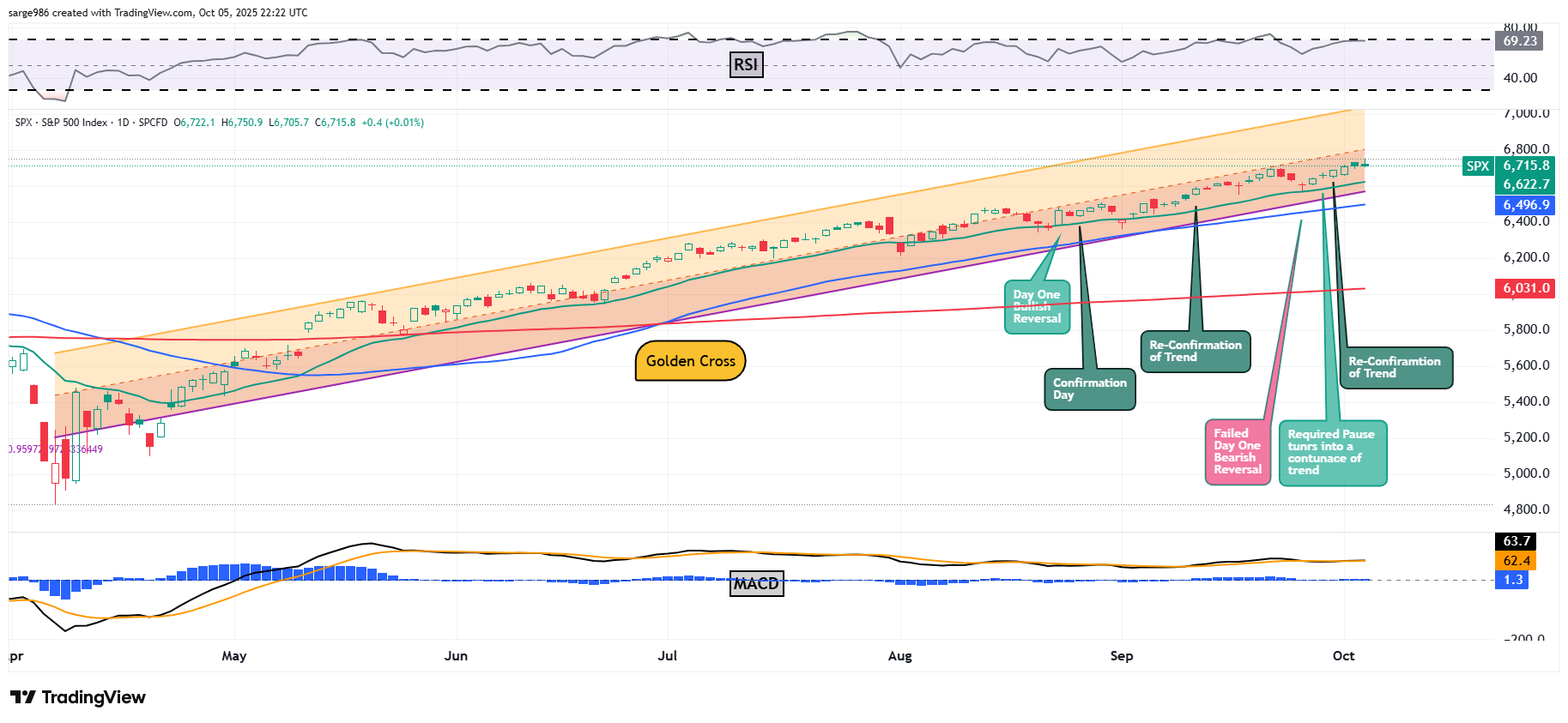
Friday was not a true third re-confirmation as the S&P 500 was essentially flat and the Nasdaq Composite traded lower for the session, but market breadth was excellent for that day. On Friday, winners beat losers by a rough 3-to-2 margin at both the NYSE and the Nasdaq. Advancing volume took a 67.9% share of composite NYSE-listed trade and a 68.2% share of composite Nasdaq-listed activity. Trading volume increased significantly on a day over day basis across the listings of both the New York's key equity exchanges and also across the membership of the S&P 500.
Readers will note that while all three components of the daily Moving Average Convergence Divergence (below the chart) are above zero which is short to medium-term bullish, the 12-day exponential moving average is riding just barely above the 26-day EMA, A cross below the 26-day line by the 12-day line would be a bearish signal. Relative Strength (above the chart) is quite robust, but still short of actually entering a condition of being technically overbought.
Earnings
Though the large banks will start reporting next week, which is the week that many folks will recognize as the start of third quarter earnings season, we will have a few names run ahead of the banks late this week. According to FactSet, for the third quarter, the street is looking for earnings growth of 8%, up from 7.9% a week ago. The street also expects to see revenue growth of 6.3%, which is where that number has stood for several weeks.
Technology, and Utilities are expected to be the outperformers with projected earning growth of 17% or more. Three sectors are predicted to suffer a year over year earnings contraction led to the downside by Energy. For the full calendar year of 2025, Wall Street sees S&P 500 earnings growth at 10.9% (up from 10.8 last week) on revenue growth of 6.1%, which is flat from a week ago.
Valuation
Still using data provided by FactSet, the S&P 500 ended last week trading at 22.8 times 12 months' forward looking earnings, up from 22.5 times a week ago. This stands well above the five year average of 19.9 times for the index as well as its ten year average of 18.6 times. The S&P 500 also ended last week trading at 28.8 times trailing 12 months' earnings, up sharply from 28.3 times the week prior. That also stands well above the five year (25 times) and ten year (22.7 times) averages for the index.
Ten of the 11 sectors are now trading above their five-year average valuations, led by Tech (30.7 times) and Consumer Discretionaries (29.3 times). Only the REITs (17.8 times), remain undervalued relative to their five-year averages. Health Care now trades at 17.3 times forward looking earnings, after last week's rally versus a five-year average of 17.1 times.
The GDP Game
Last week, the Atlanta Fed revised their GDPNow model for the third quarter down to growth of 3.8% (q/q, SAAR) from 3.9% the week prior. Among other regional central bank district branches running close to real-time GDP models, the New York Fed's estimate for Q3 growth now stands at 2.35%, down sharply from 2.55%. The Cleveland Fed's model for the third quarter remained unrevised at growth of 1.99%. The St. Louis Fed model now stands at a paltry 0.18%, down from last week's 0.22%.
There remains nothing close to a Fed consensus on just how healthy economic activity was during the third quarter. It will be interesting, at least to me, to see if these regional Fed districts stop updating their models without a ton of underlying macroeconomic data to rely on... or if they instead rely more on alternative private sector modeling.
Fed Funds Futures
Fed Funds futures trading in Chicago are now pricing in a 95% probability for a quarter-point rate cut on Oct. 29 and an 84% likelihood for another quarter point cut on Dec. 10. Those probabilities are down from 89% and 65% a week ago. At present, there are still only 50-basis points worth of additional rate cuts fully priced in (63% chance) for all of calendar 2026. I thought that the lack of expected change in 2026 was somewhat odd given how much more dovish this market has become looking out towards the last two policy meetings of 2025 since the government shut down.
On The Docket...
Last week, I wrote to you that the Fed could be out in force. This week, potentially without a whole lot of macroeconomic data to look at and with few earnings on the way, their public presence, in the aggregate, will be even more pronounced.
... Today (Monday), the Fed will get the week off to a slow start. Kansas City Fed Pres. Jeffrey Schmid who does hold policy voting rights this year, will speak this evening. I see at least fifteen public appearances by Fed officials over the four day that follow. The headline event, of course, will be Fed Chair Powell's appearance before the opening bell on Thursday morning. Among other high-profile or influential Fed speakers, I have Fed Gov. Michelle Bowman on my radar three separate times this week as is Fed Gov. Michael Barr. Fed Gov. Stephen Miran is also set to speak twice just on Tuesday alone.
.... As far as the macroeconomic calendar is concerned, we still have last week's September Jobs Report to look at when it is finally released. This would be a quiet week economically, even without the shutdown. That said, Treasury auctions are considered essential, so there will be auctions of both U.S. Ten-year Notes and U.S. Thirty-Year Bonds this Wednesday and Thursday respectively.
..... The earnings calendar is super light this week. All traders and investors really have to look forward to this week is hearing from Constellation Brands (STZ) tonight, followed by McCormick (MKC) on Tuesday morning. After that, on Thursday, Delta Air Lines (DAL) , PepsiCo (PEP) and Levi Strauss (LEVI) will report. That's all we have.
(Tentative) Economics
(All Times Eastern)
No major domestic macroeconomic data-points are scheduled for release.
The Fed
(All Times Eastern)
5 p.m. - Speaker: Kansas City Fed Pres. Jeffrey Schmid.
Today's Earnings Highlights
(Consensus EPS Expectations)
After the Close: (STZ) (3.41)
At the time of publication, Guilfoyle had no position in any security mentioned.