Ceasefire Chaos, Fed Craziness, Semiconductor Boom
Should we call this period the 'fog of peace' as disagreements on deal emerge? Also, what the FOMC doesn't get about inflation and Lattice, Lam Research and SanDisk surge.
You've reached your free article limit
You've read 0 of 1 free Pro articles.
 Market_Recon_TSP1_KL
Alastor, or The Spirit of Solitude
(excerpt)
The day was fair and sunny: sea and sky
Drank its inspiring radiance, and the wind
Swept strongly from the shore, blackening the waves.
Following his eager soul, the wanderer
Leaped in the boat; he spread his cloak aloft
On the bare mast, and took his lonely seat,
And felt the boat speed o'er the tranquil sea
Like a torn cloud before the hurricane
- Percy Bysshe Shelley (1816)
The Fog of Peace?
Or should we call it "the fog of uncertainty?" Financial markets acted well, in fact they acted very well in response to the news that the U.S., Iran and Israel had agreed to a two-week ceasefire that, in theory, would put an end to the almost six-week long period of hostility western Asia. Cracks in the pavement appeared immediately. It seems whoever is in charge in Iran these days had thought that the ongoing battle between the Israeli military and Hezbollah had been included in the ceasefire deal. Israel just as apparently, had not agreed to that.
The President of the United States had mentioned a 10-point plan proposed by Iranian leadership as a workable basis for any deal. Some news outlets failed to mention that this 10-point plan had been revised twice by Iranian leadership before the U.S. agreed to talk and that the version originally released was very different from the version that got the ball rolling. This caused a great deal of confusion, globally.
Then there was the fact that Iranian forces just kept on firing missiles launching drones at their neighbors while failing to fully open the Strait of Hormuz. Iran had agreed to open the Strait but believed that they would be due a hefty toll on a per vessel basis, which was apparently to be shared with Oman. The plan that the U.S. found workable, had the U.S. very involved in the re-opening of the Strait and also in control of any toll. Then again, much of this is rumor or hearsay, as really nothing, not even the cessation of violence, has really been agreed to by the combatants.
We know that a U.S. delegation, led by Vice Pres. JD Vance will head to Islamabad, Pakistan for talks with Iran scheduled to begin this Saturday. We know that the U.S. thinks that Iran has agreed to surrender all of its enriched uranium and its ability to pursue the ability to create more. We do not know that Iran or whoever is in charge in Iran has really agreed to this key sticking point.
When Pres. Trump launched this war in late February, he said it would take six weeks. It is now six weeks later. He said that regime change was not really a priority, but he also said that Iran must not be allowed to have the ability to control nuclear weapons. That's where we are. Not truly regime change, though the entire top few tiers of government in Iran have been eliminated. The Iranian military and economy have been destroyed, but does Iran still have the ability to get aggressive from a nuclear perspective? That is the first all-important question. Can Iran be permitted to continue to pose a kinetic threat to commercial vessels in the Strait of Hormuz? That hurts the global economy, and the economies of eastern Asia to be specific. That is question number two.
What Now?
Let's see what we know:
- It does appear that Iran has slowed its aggressive posture against its neighbors as the peace talks approach. There is some belief that given the lack of effective internal communication after the U.S. bombing campaign, that Iranian leadership had been unable to inform some units that a ceasefire had been agreed to.
- The Strait of Hormuz has not been safely re-opened.
- U.S. military forces will remain in theater and are being added to, should Iran fail to live up to its part of this ceasefire or any deal ultimately agreed to.
- Iran's ambassador to Pakistan deleted a post to social media that informed that his nation's delegation would arrive in Pakistan on Thursday night ahead of Saturday's talks. No explanation was offered.
Marketplace
Prices for front month WTI crude futures fell from trading with a $116 handle (per barrel) late Tuesday to bottoming with a $92 handle on Wednesday. I currently see those futures trading above $97. The U.S. Ten-Year Note paid more than 4.37% late Tuesday and as little as 4.23% on Wednesday morning. I now see U.S. Ten-Year paper yielding a rough 4.29%. Stocks soared in the U.S. on Wednesday. U.S. equity index futures are under some pressure as we traverse through the zero-dark hours on Thursday morning.
On Wednesday, the S&P 500 sported a gain of 2.51% as the Nasdaq Composite ran 2.8%. Smaller-cap type stocks did well as the Russell 2000 added 2.97%. Some of the industry-specific indexes outperformed the broader large-cap indexes. The Dow Transports gained 3.23% led by the airlines and the truckers. The Dow Jones U.S. Banks popped for 3.54% and the Philadelphia Semiconductors simply soared, gaining 6.34%. That group was led by Lattice (LSCC) , Lam Research (LRCX) and SanDisk (SNDK) .
Related: The Powerful Ceasefire Rally Has Significant Flaws: What to Do Now
Breadth
Ten of the 11 S&P sector SPDR ETFs closed out the day on Wednesday in the green, led by the industrials (XLI) , materials (XLB) and technology (XLK) . Only energy (XLE) , for good reason, closed in the red and did so spectacularly. Cyclicals outperformed growth for the session and growth outperformed defensives.
Winners beat losers by about 21 to four at the NYSE and by a rough three to one at the Nasdaq. Advancing volume took a 72.7% share of composite NYSE-listed volume and a convincing 77.5% share of composite Nasdaq-listed activity. Here's where it gets interesting. Aggregate trade was actually lower, by 3.6% on a day-over-day basis across Nasdaq-listings. Aggregate trade, however, was up an incredible 29.6% day-over-day across NYSE-listings and up similarly across the membership of the S&P 500.
Therefore, I do believe, despite the reduced activity across the Nasdaq, that Wednesday was a Day of Confirmation of the bullish change in trend that began on Tuesday, March 31st. Some call this a "follow-through" day. Of course, the entire financial marketplace remains subject to an enormous level of headline risk, but technically... the trend had changed, the necessary pause occurred and the bullish shift has been confirmed.
The Chart
Readers will see that the S&P 500 easily took back its 200-day simple moving average and even closed above its 50-day SMA on Wednesday. Holding the 200-day line forces managers to increase long-side exposure. Holding both of those lines would force something resembling a squeeze. Do not be surprised if the index makes an attempt to fill that gap and maybe even test the 200-day line from above ahead of Saturday's meeting.
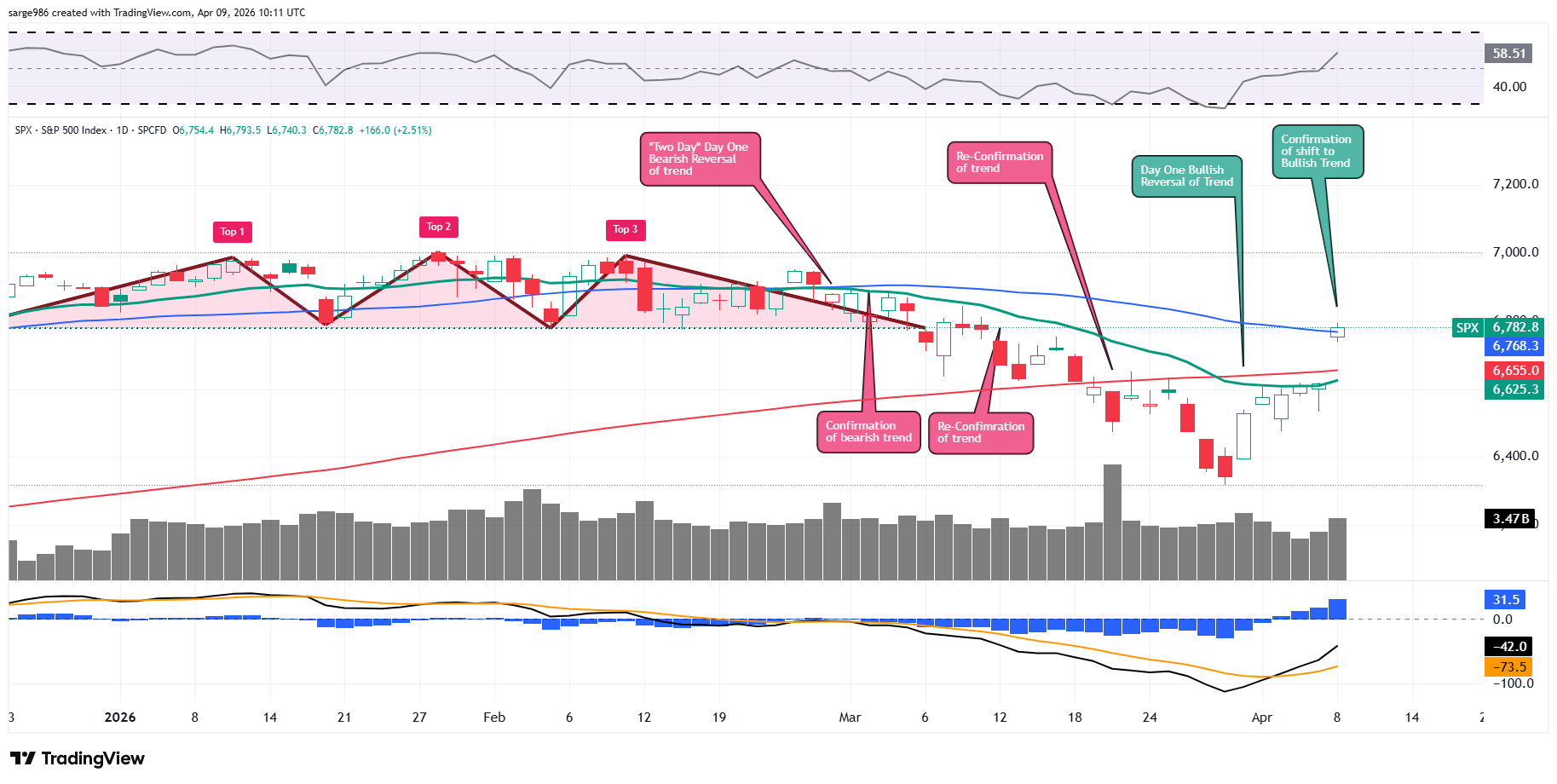
The indicators are strong. Relative Strength is quite robust without approaching technically overbought territory. Below the chart, the posture of the daily moving average convergence divergence is rapidly improving. The histogram of the 9-day exponential moving average has been positive for four days now. The 12-day EMA crossed over the 26-day EMA on April 1 and has widened that expanse since. These two lines, however, remain below the zero-bound.Crossing above zero, for those two lines, would amplify the bullish signal.
Sit Down Fed, This Isn't Complicated
The Fed Minutes, on Wednesday afternoon, showed that a growing number of FOMC committee members are worried that the war in Iran might further stoke consumer-level inflation and that the central bank may have to consider raising interest rates. I can't believe that I have to explain this to economists with doctorates, yet again, but I know that several members of the FOMC read my stuff every morning, so here goes.
Gang, you cannot impact the rate of inflation when that inflation is caused by scarcity or a shock to supply, by increasing interest rates. Wake the heck up. Interest rates are intentionally manipulated to either enhance or diminish aggregate demand. By increasing rates during a period of scarcity, elastic demand for discretionary items wanes and economic activity withers. You will put the nation in recession. Congrats. Additionally, inelastic demand for staples will remain constant and for those items higher interest rates will only force the rate of inflation to accelerate. I hope this helps. As always, I am here when you dingbats realize that you need me or someone like me and I will always answer my nation's call.
Economically...
Tomorrow's March consumer price index data is much more important than this morning's February personal consumption expenditure data. This morning's initial jobless claims remain a focus. Keep an eye on the U.S. Treasury's auction this afternoon of 30-Year Bonds after Wednesday's sloppy auction of $39 billion worth of new ten-Year Notes. On Wednesday, foreign participation in U.S. Treasury markets dropped below recent averages as did the bid-to-cover. This could be a sign of a safe haven unwind if the world believes that there will be a lasting peace in the Persian Gulf area.
Economics
(All Times Eastern)
08:30 - Initial Jobless Claims (Weekly): Expecting 205,000, Last 202,000.
08:30 - Continuing Claims (Weekly): Last 1.841 million.
08:30 - Personal Income (Feb): Expecting 0.3% m/m, Last 0.4% m/m.
08:30 - Consumer Spending (Feb): Expecting 0.5% m/m, Last 0.4% m/m.
08:30 - PCE Price Index (Feb): Expecting 0.4% m/m, Last 0.3% m/m.
08:30 - Core PCE Price Index (Feb): Expecting 0.4% m/m, Last 0.4% m/m.
08:30 - PCE Price Index (Feb): Expecting 2.8% y/y, Last 2.8% y/y.
08:30 - Core PCE Price Index (Feb): Expecting 3.0% y/y, Last 3.1% y/y.
08:30 - GDP Growth Rate (Q-4 F): Flashed 0.7% q/q, SAAR.
10:00 - Wholesale Inventories (Feb): Expecting 0.1% m/m, Last -0.5% m/m.
10:30 - Natural Gas Inventories (Weekly): Last +36B cf.
13:00 - Thirty-Year Bond Auction: $22B.
The Fed
(All Times Eastern)
No public appearances scheduled.
Today's Earnings Highlights (Consensus EPS Expectations)
No significant quarterly earnings scheduled.
At the time of publication, Guilfoyle had no position in any security mentioned.