Let's Chart Whether This Rally's Got Momentum and a Possible Palantir Target
We've got several obstacles ahead for continued green but this chart is telling me something interesting; also, let's see the path of a possible target for one of my favorite stocks.
You've reached your free article limit
You've read 0 of 1 free Pro articles.
Monday's rally was probably stronger than anyone anticipated. That was sweet. No doubt. Where to now? The president's "Liberation Day" is still more than a week away. Optimism that what will be revealed that day might be narrower than initially implied is what lit the spark that became the catalyst on Monday. Overnight, U.S. equity index futures have started to give back some of Monday's gains.
Still, there remains an elevated level of uncertainty over tariffs as the president signed an executive order on Monday stating that countries around the globe would face blanket tariffs of 25% for purchasing energy-based commodities such as crude oil and natural gas from Venezuela. Though the U.S. itself as well as Spain, and India, would all be impacted by this move if not for sanctions-exempted licenses that have been granted to Chevron CVX, Repsol REPYY and Reliance Industries respectively, those licenses are winding down. Chevron is expected to be done in Venezuela by now late May after gaining an extension.
Make no mistake. The target here is really China, which received a rough 503,000 barrels per day of Venezuelan oil in February. That's about 40% of Venezuela's total oil exports. Beijing has maintained strong ties with Venezuelan leader Nicolas Maduro and this, while not crippling China, will increase the costs of supplying that nation with crude and refined oil products.
Another Fly in the Ointment
Atlanta Fed Pres. Raphael Bostic, who is not really known as a hawk nor a dove, interviewed at Bloomberg TV on Monday afternoon. Despite that Bostic sees GDP growth slowing to 1.8% (year over year) in 2025, down from his expectation for growth of 2.1% as recently as December, he sees the U.S. unemployment rate at year's end at 4.2% to 4.3%. Bostic calls this "still quite strong by historical standards." He also sees uncertainty over tariffs as an upside threat to consumer-level inflation.
The real kick in the pants came when Bostic cut his view for the number of quarter-point rate cuts in 2025 to one from two, despite his expectation for a deceleration in the pace of economic activity. Bostic said specifically: “I moved to one mainly because I think we’re going to see inflation be very bumpy and not move dramatically and in a clear way to the (Federal Reserve's) 2% target. Because that’s being pushed back, I think the appropriate path for policy is also going to have to be pushed back.”
Readers will recall that the FOMC's quarterly economic projections made just last week showed a median forecast for a total of a half-percentage point worth of rate cuts this year, so this is hawkish commentary. The Fed's slowdown of its "quantitative tightening" program along with the idea that the U.S. might be headed for lower interest rates is what led to the equity market rally that started on Friday and carried through to Monday along with the above mentioned tariff related impact.
Bostic, though influential, by virtue of the FOMC's rotation of voting rights, will not vote on policy in 2025, so maybe that will be something of a saving grace for markets as Monday melts into Tuesday. Atlanta does not regain FOMC voting rights until 2027 after serving as an alternate in 2026.
Flash Gordon
S&P Global released their flash PMIs (purchasing managers' surveys) for the U.S. for March on Monday. There was good news and bad news. The bad news held more weight than the good news. The Service Sector Flash PMI printed at 53.5 for March, up from 51.6 in February. The Manufacturing Sector PMI hit the tape at 49.8 (in contractionary territory), down from 52.7 in February.
Why did U.S. manufacturing wane a bit in March from February? Straight from the report: Manufacturing "fell back into (a state of) decline after the front running of tariffs had temporarily boosted factory output in the first two months of the year." That's clearly a negative.
The good news from the service sector is unfortunately not as good as solid as it might be as S&P Global does not include either retail or wholesale trade in its monthly surveys. This leaves economists and investors in something of a state of limbo until the Institute for Supply Management releases the results of its similar service sector PMI that does include everything. Those results for March are not due until a week from this Thursday, on April 3.
Marketplace
To say markets for risk assets were strong as capital moved out of Treasury securities on Monday would be an understatement. As the yields for both the U.S. Ten-Year and Two-Year Notes moved up by eight basis points apiece to 4.33% and 4.04% respectively, Bitcoin, crude and stocks ran wild for the day. Gold was notably stable, not truly participating in the rally.
The S&P 500 tacked on 1.76% on Monday as the Nasdaq Composite popped for a gain of 2.27%. Smaller caps did even better. The Russell 2000 ran 2.55% as the S&P Mid Cap 400 gained 2.49%. Reaching further into the weeds, the Dow Transports gained 2.17%, the KBW Banks gained 2.44% and the Philadelphia Semiconductors surged 2.99% for the session.
Ten of the 11 S&P sector ETFs closed the day in the green. If that's not enough, eight of these funds gained at least 1% for the day led by the Discretionaries XLY at +3.75%. Only the Utilities XLU gave up any ground as defensive type sectors took the bottom three slots on the daily performance tables. Within the Discretionaries, the Dow Jones U.S. Automobile Index screamed 10.76% higher paced by Tesla's TSLA 11.93% run.
Breadth
Winners beat losers on Monday by just less than a 3-to-1 margin at the NYSE and at the Nasdaq by about 2 to 1. Advancing volume took a commanding share of trade across the listings of both the Nasdaq (77.9%) and the NYSE (76.6%), which is impressive, but let's keep in mind that Friday was a triple-witching expirations event. Therefore, trading volume literally had to drop off on Monday from Friday.
Aggregate trade contracted by 51.8% (more than halved) on a day-over-day basis across NYSE-listed names and by 23.2% day-over-day across Nasdaq-listed names. Aggregate trade across the S&P 500 on Monday fell 9% short of its 50-day trading volume simple moving average after topping that milestone by 89% on Friday.
Does this negate the conviction behind the rally on Monday? To some degree, of course it does. One has to remember that the volume on Friday was driven by widespread options and futures expirations and not by conviction either.
Charts
Let's look at an updated version of the chart I just showed you 24-hours ago. Readers will see that while volume halved, the S&P 500 gained both its 21-day exponential moving average and the 200-day simple moving average on Monday. This is potentially huge:
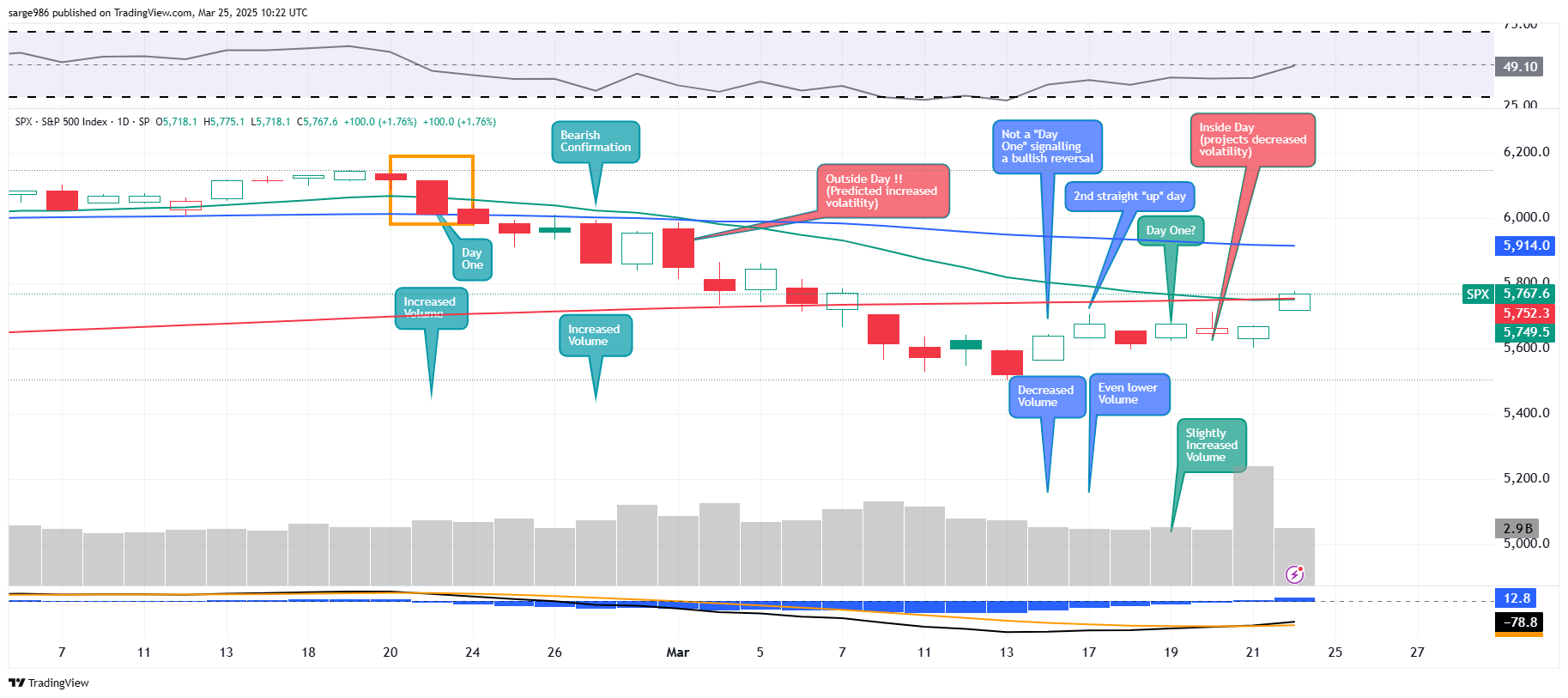
If these moving averages can be held on Tuesday morning, admittedly a big "if", then this rally could not just have legs, but build momentum. The 21-day exponential moving average will keep a percentage of swing traders invested and holding the simple 200-day line would keep portfolio managers invested at an increased level.
That group might look at a number of indicators and they may have differing styles, but this line is their holy grail. Not many of them will try to take short-term profits based on Monday's move if they think the 200-day line might hold. That said, should the 200-day line fail, risk managers will pressure portfolio managers up and down Wall Street (which is pretty much in Southern Florida these days) to reduce long-side exposure.
Give Peace a Chance?
Late Monday, those investors hoping for a peace dividend heard what they wanted to hear. Ukrainian Ambassador to the United States Oksana Markarova stated that Ukraine supports the idea of a full ceasefire unconditionally. On Bloomberg TV, she stated, "We embrace it wholeheartedly. We need Russia to agree to that."
U.S. and Russian diplomats talked for 12 hours in Saudi Arabia on Monday, after U.S. officials had met with their Ukrainian counterparts on Sunday. Even as talks have continued, large scale Russian drone attacks have continued on both Ukrainian energy infrastructure targets (which were supposed to be off-limits for now) and population centers.
U.S. Pres. Trump has recently bandied about the idea of bringing Ukraine's nuclear power plants under U.S. control in order to deter further Russian attacks.
Palantir Gap Almost Filled...
Readers will see that Palantir Technologies PLTR retook both its 21-day exponential moving average and 50-day simple moving average late last week. On Monday, the stock solidified its hold on that 50-day line. You may recall that last Monday, I wrote that the 50-day simple moving average was the upside pivot for PLTR. This unleashes, as long as this line indeed is held, the $110 target price that we have discussed here at TheStreet Pro.
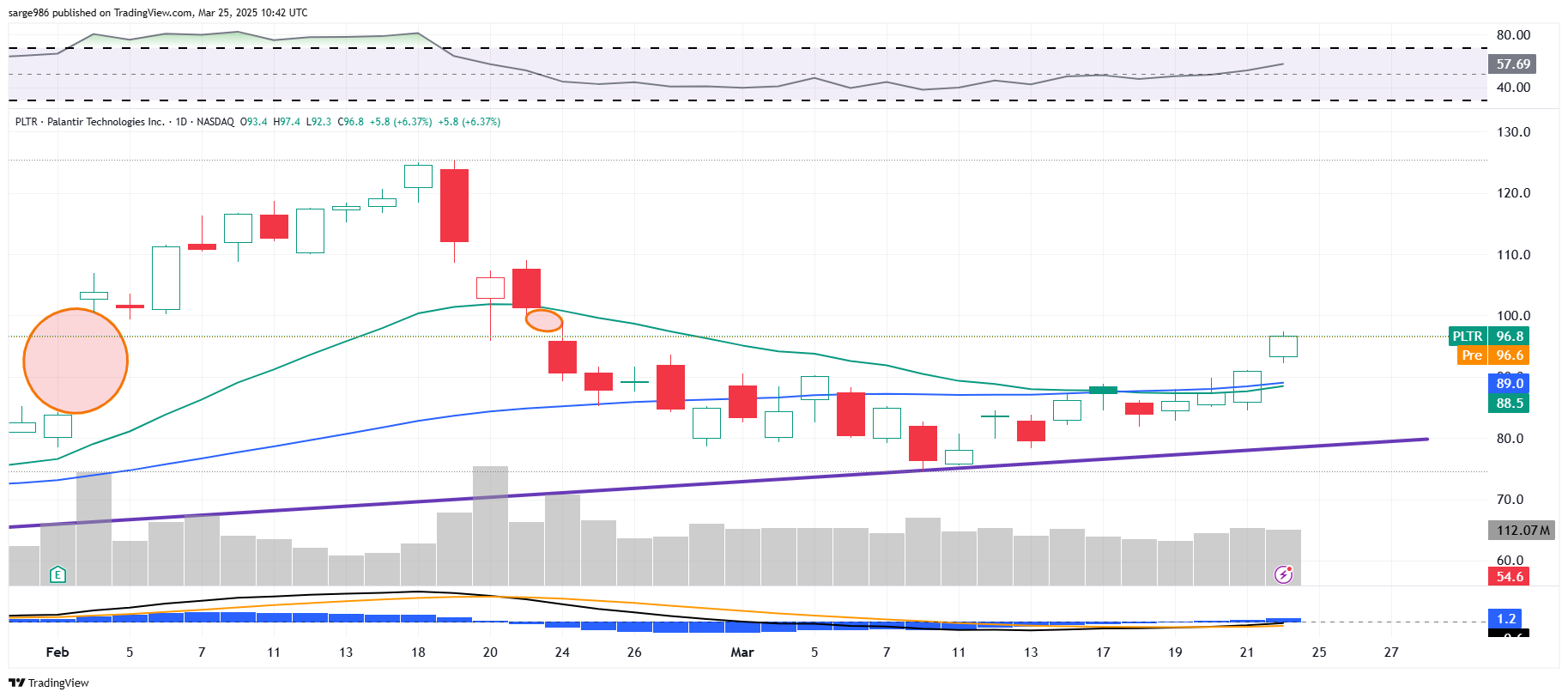
Note that the unfilled gap created on Feb. 24 needs a tick at $100 or greater to fill. Long-time traders know that while gaps do not have to fill, they usually do. So, we have that feather that we hopefully can stick in our caps.
Economics (All Times Eastern)
08:55 - Redbook (Weekly): Last 5.2% y/y.
09:00 - Case-Shiller HPI (Jan): Expecting 4.6% y/y, Last 0.44.5% y/y.
09:00 - FHFA HPI (Jan): Expecting 0.3% m/m, Last 0.4% m/m.
10:00 - CB Consumer Confidence (Mar): Expecting 94.1, Last 98.3.
10:00 - New Home Sales (Feb): Expecting 681K, Last 657K, SAAR.
10:00 - Richmond Fed Manufacturing Index (Mar): Expecting 8, Last 6.
4:30 p.m. - API Oil Inventories (Weekly): Last +4.593M.
The Fed (All Times Eastern)
07:40 - Speaker: Reserve Board Gov. Adriana Kugler.
08:05 - Speaker: New York Fed Pres. John Williams.
Today's Earnings Highlights (Consensus EPS Expectations)
Before the Open: MKC (.64)
After the Close: GME (.08)
At the time of publication, Guilfoyle was long PLTR equity.