By 'Not Being Political' the Fed Has Totally Botched Its Job
Jerome Powell seems so intent on defying influence from President Trump that he is hurting the market in a big way.
You've reached your free article limit
You've read 0 of 1 free Pro articles.
The Fed’s famous Dual Mandate is the stupidest thing ever put forward. It states the conflicting goals of facilitating maximum full employment while also promoting price stability.
I heard a great saying long ago, for which I cannot take credit. It said, implementing a dual mandate is like a football coach telling his team, “Go play your hearts out. Just be sure not to get the uniforms dirty.”
Federal Reserve Bank Chair Jerome Powell seems so intent on defying influence from President Trump that he is hurting the market in a big way. The predominantly left-leaning mainstream press cheer him like a rock star when he does that. That encourages him to delay rat cuts that would likely help stocks and the economy in general.
Softball questions following Powell’s press conference included asking, “What do you do all day at work?” and “What are your spare time activities?”
I would ask why the Fed wastes multi-millions each year on its Jackson Hole, Wyoming in-person (paid vacation?) conference. It is one on the most expensive venues in America to hold those meetings and one of the least accessible for travelers. There is nothing that takes place there that could not be accomplished on a Zoom meeting for a minimal cost.
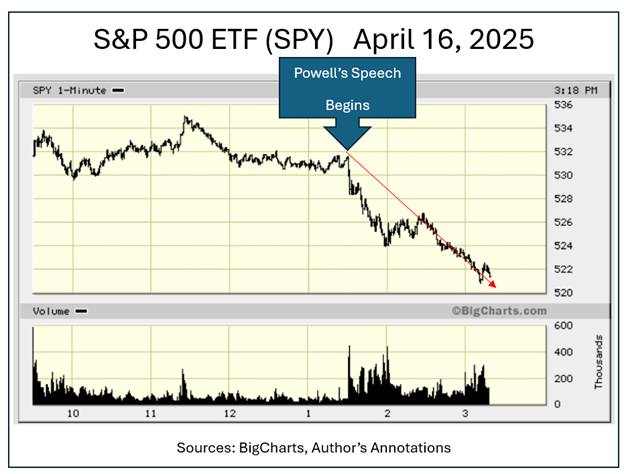
Chair Powell said on April 16 that he will wait until “proof” of a poor economy is evident before cutting rates. The tariff situation is making corporate managements crazy due to uncertainty about where things will sit when the dust settles.
From the moment Powell’s words spewed forth, the broader market plunged.
It is not like Powell, or his predecessor Janet Yellen, had sterling histories. Yellen did nothing but keep interest rates near zero for her entire term as Fed Chair. That led to huge real estate and stock market bubbles during the very extended ZIRP (zero interest rate policy) period.
Powell made a huge mistake during the 2021–2022 inflation spike to forty-year highs. He continued to call it “transitory” all the way up, thus missing his chance to raise rates until way too late.
Fed policy changes need to anticipate future economic trends. That is because it typically requires about six to 12 months after a change for the impact to be felt. That lag time means waiting for definitive data, such as knowing we are in a recession or seeing employment data worsening significantly, makes any actions by then “too late.”
America’s nearly $37 trillion national debt is now gobbling up over $1 trillion annually in debt service. That number is growing with every new Treasury bond auction as maturing lower coupon bonds are replaced with higher coupon bonds.
Raising rates further would make our nation’s cost of debt service almost impossible to live with. That aspect alone should have Powell saying they will not go up, barring a true emergency, which is nowhere in sight at this time.
Interest-rate cuts should have started months ago. Despite numerous signs pointing to a weakening economy, Powell’s fear of seeming political keeps him on the fence doing nothing.
The Federal Reserve bank was created in 1913. How has it done in terms of maintaining “price stability?”
The chart below offers all the evidence needed to assign the Fed a failing grade. The graphic only extends through 2020. Since then, the dollar has dropped to under 1% of its pre-Fed-creation buying power.
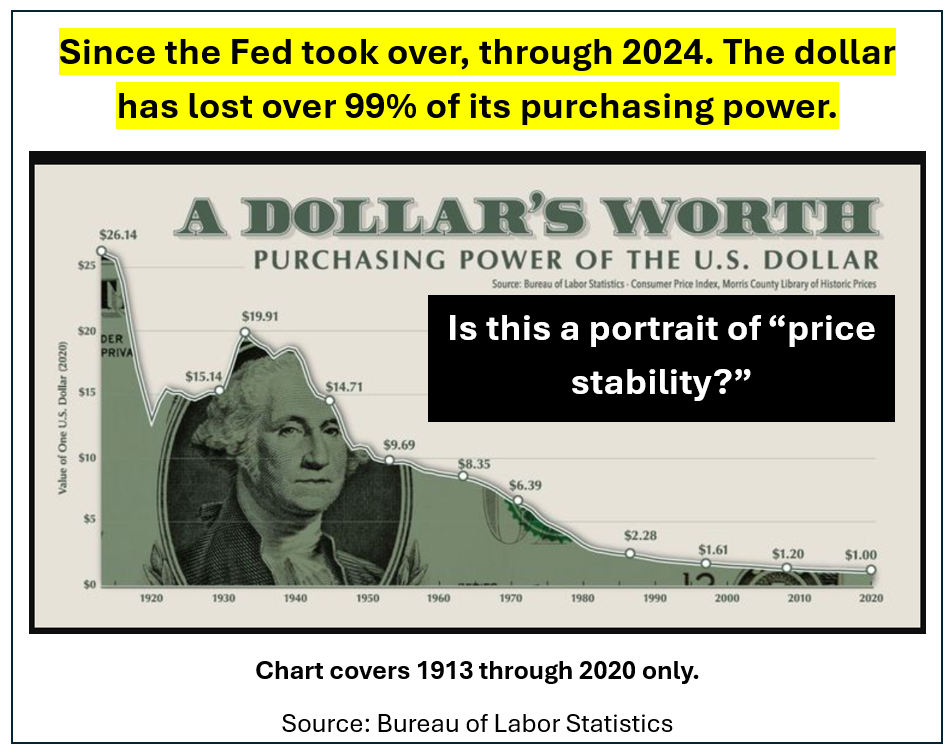
Even the Fed’s current 2% annual inflation target is a joke in terms of price stability. At that rate overall prices would double every 36 years. Be aware, too, that the Fed does not even target CPI. It “prefers” to measure the goal as 2% of PCE (personal consumption expenditures), which almost always looks tamer than CPI, the official consumer price index.
Back in the heyday of high inflation in the 1980–1990 period the Bureau of Labor Statistics recalculated how they figured inflation twice to fool the public into thinking it was less bad than before. Government inflation numbers are not to be trusted.
It has been done again more recently with the substitution theory. The BLS now assumes if rib-eye steaks get too expensive that consumers will simply trade down to cheaper cuts. Presto, no increase in the cost of living then.
Normal people see inflation in a meaningful way. They want to know the annual change in the cost of an identical basket of goods and services.
What Causes Inflation?
Prices rise when too much money is chasing a finite amount of goods and services. The large jump in prices during 2021 and 2022 were caused by the multiple stimulus checks and enhanced unemployment benefits putting “free money” in the public’s hands.
As they say, “Easy come, easy go. “
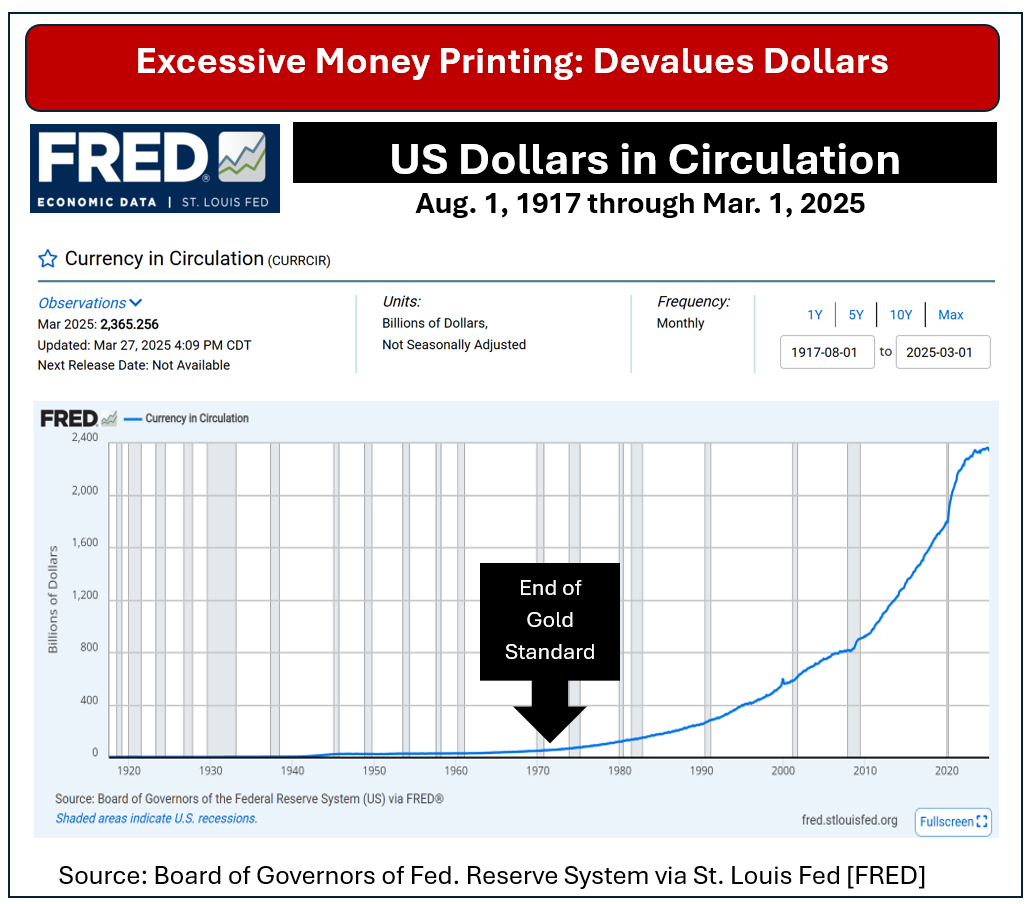
Until the end of the gold standard, by President Nixon in 1991, our Fed could only print as much money as was backed by precious metal holdings. That restrained deficit spending. Since then, however, politicians went crazy with new social programs and the Fed obliged by monetizing the debt.
The chart below documents the story. Since the gold standard went by the boards, money in circulation skyrocketed.
From 1980 through 2000 America’s national debt grew by almost six-fold.
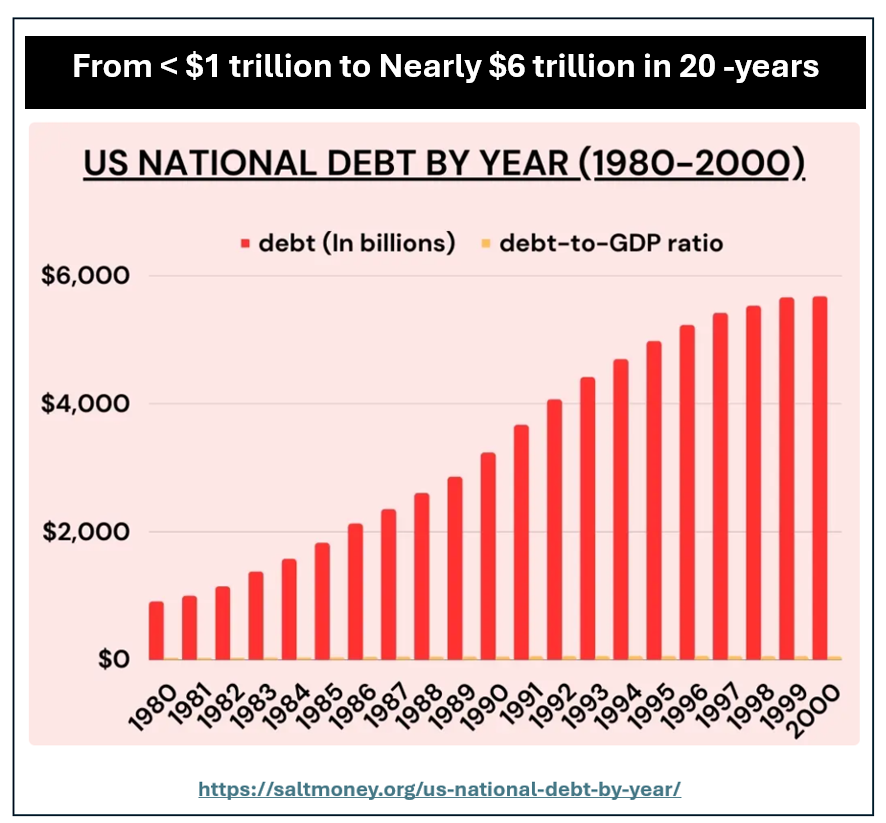
Since 2000 that figure surged from under $6 trillion to over $37 trillion. The five-year cumulative increase was over 500%.
All that debt, coupled with excessive money printing, calls for major changes in the way America is overseeing its finances.
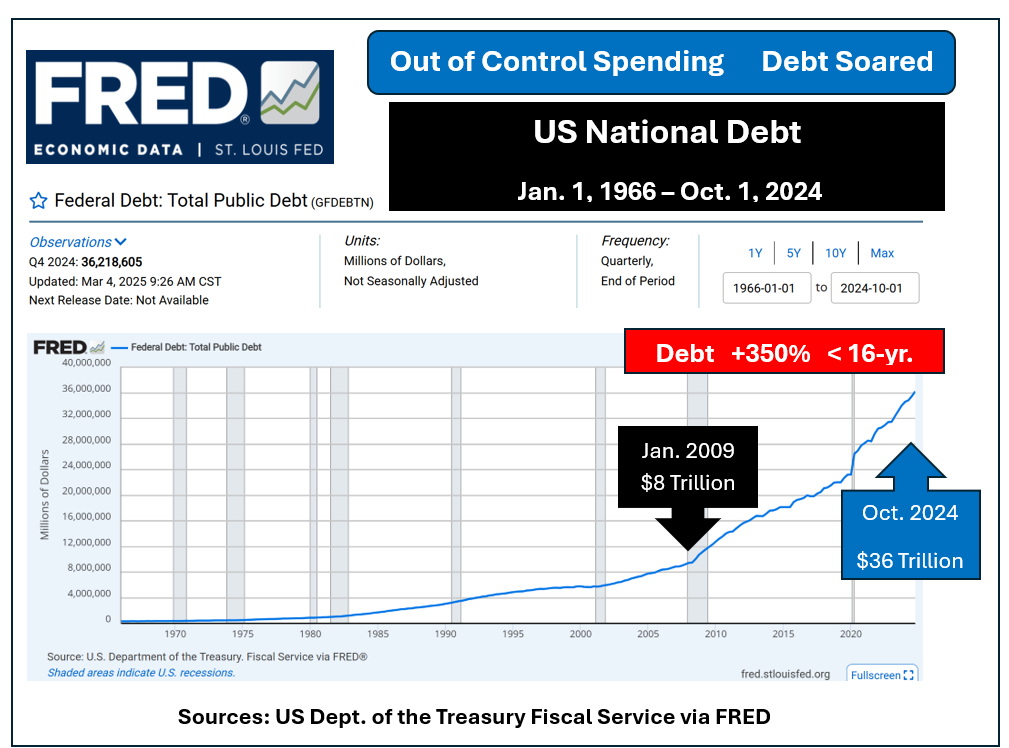
The Federal Reserve Bank has totally botched its job by allowing this to happen under the guise of “not being political.”
Our country would likely be better served by simply letting “the market” set rates than by pretending to improve things via faulty decision making.
Disclosure: I have no control over the Fed’s actions. Chair Powell has not asked for my opinions on anything.