Be Careful Betting on the TACO Trade
Be very cautious about believing things have "normalized."
You've reached your free article limit
You've read 0 of 1 free Pro articles.
The Trump administration went out in full force to calm markets about trade relationships between China and the U.S.. The latest effort (as of 9 p.m. ET on Sunday) being a social media post from the president’s account stating, among other things, “Don’t worry about China, it will all be fine!”
Maybe it is a TACO?
As I write this, stock futures have bounced, but have retraced less than half of Friday’s losses.
I think we have to be extremely cautious thinking that things have “normalized”
This time seemed different, in that it seemed like China threw the first punch. Basically every single step of the tariff wars have involved the administration leading with something to spark the next round of “negotiations.” China seemed to take the lead here with tightening up rules on its exports of not just processed/refined rare earths and critical minerals, but some goods containing those.
The control over the processed/refined rare earths and critical minerals is China’s “best card” in the negotiations. But, as the U.S., finally, takes some steps to promote its own efforts (investments in (LAC) , (MP) , (INTC) , etc.) and I think more to come (especially if we can get a sovereign wealth fund up and running), that will reduce China’s negotiating power over time. It isn’t just the investments, but what seems to be a focus (finally) on deregulation. So if China does want a “war,” one of their negotiating powers is likely to diminish over time.
Does China want our chips? If China wanted our chips, which are the best in the world, then we would hold clear power over them. But, I’m really wondering if they want to force their industry to grow even more rapidly than it is. Necessity is the mother of invention. By refusing our chips, China reduces earnings at some of our biggest companies. At the same time it might force the development of their industry, which they have been pushing hard on. It is aggressive and very risky. On the other hand, following the success of Huawei and BYD (not in chips, but suddenly a large auto manufacturer), it is conceivable that China could believe that with enough money and engineering power (no shortage there) that they can catch up. They seem better prepared than we are, on the electricity production side.
There are lots of stories circulating about how surprised the administration was by how badly stocks reacted on Friday. That would explain all the calming messages, but if China is driving this round, does that help enough?
It is always dangerous to say "this time is different,” but I think we have entered a new phase where China is prepared to be more aggressive and an instigator, which isn’t something we have faced.
I do think it is great for companies in any industry that produces things important to national security (like chips, pharma, biotech and commodities), especially the refining and processing of them.
A Sector Lower Than April’s Lows
With the recent credit events of Tricolor and First Brands, a lot of attention is being focused on risks in the rapidly growing private credit market. The questions is whether these are evidence of systemic problems or if they are idiosyncratic in nature? The answer may be a bit of both, as there were some specific factors hitting each one, but it certainly highlights potential risks many have discussed with the rise of private credit.
We are working on some of the details on these two companies, but also trying to estimate the potential macro impact.
For now, I’m relatively calm about the situation:
- While rapidly growing, it is still only a subset of the credit market
- A lot of the handwringing is because much of the lending is outside of the regulated entities, but that is a good thing, as problems in regulated entities is what can cause a large ripple effect, and that should not occur, even if private credit has a hiccup.
- There is still little evidence of leverage on leverage. There has been little indication of investors viewing private credit as incredibly safe. We have argued, and still argue, that bigger problems only happen when problems hit “safe” assets, as those are the types of assets that get leveraged, that permeate regulated entities, and have no expected losses allocated to them.
- The growth of the industry has been rapid, which, traditionally does mean some mistakes will have been made along the way – though I suspect that problems (if they mount) will be highly correlated to deal flow (or rather the lack thereof). Those firms with the best deal flow should have fewer problems, even as they’ve grown.
Having said that, it is difficult not to share this chart, as it is surprising (my gut is it is overdone, but it certainly deserves attention and some additional work, which we will be putting in).
BDC’s are leveraged entities that lend privately and seem to be viewed as a proxy for private credit (not a perfect proxy, but not a horrible way to think about them, especially in trying to figure out what might be the canary in the coal mine).
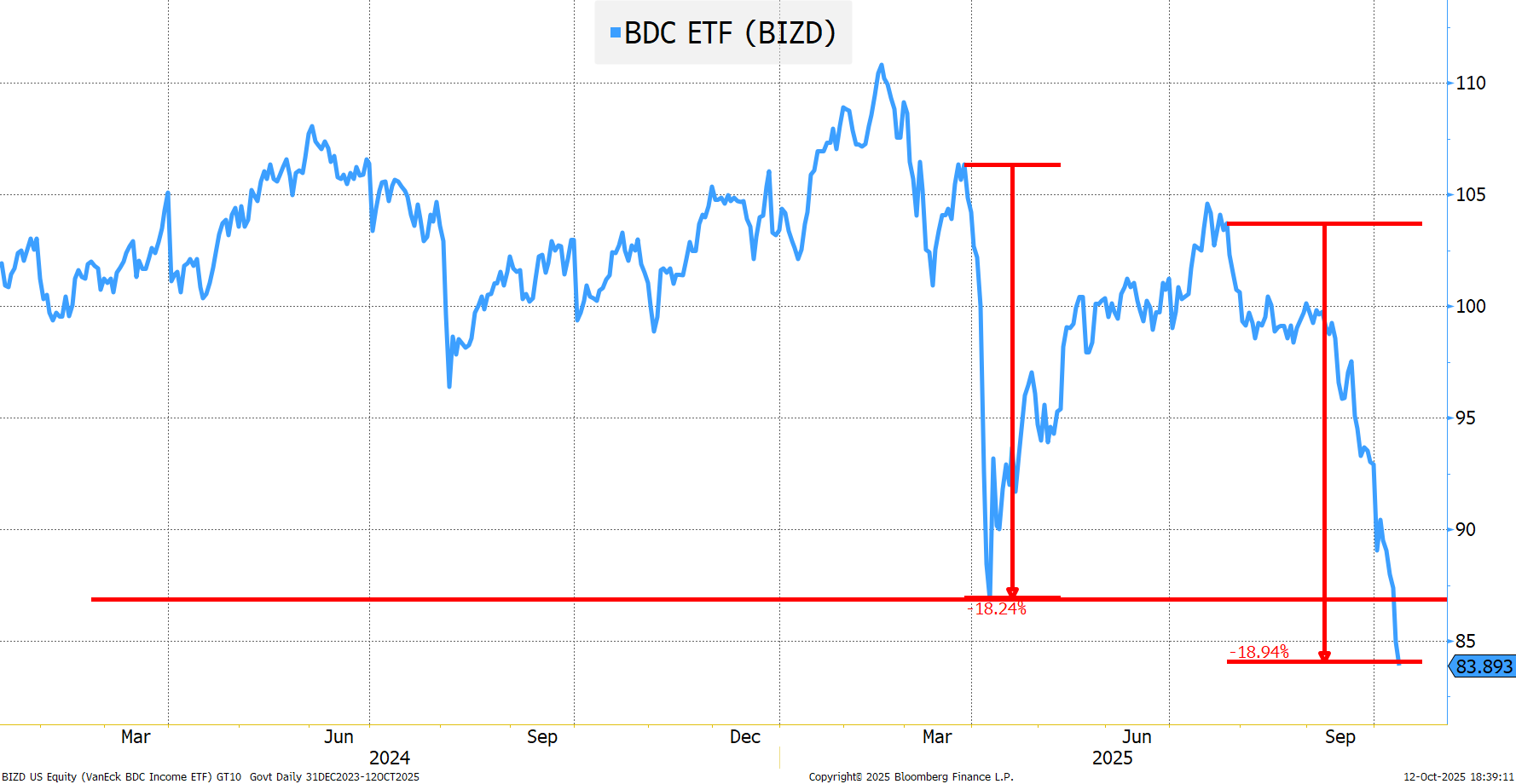
This ETF does have a dividend yield of 12%, paid quarterly, which may be playing a role in the performance, but I struggle to think of a sector that is below levels seen in April, so it bears attention.
Credit has been solid as a rock, and it should remain that way, with IG in great shape, but selling pressure in any sector is always worth watching. The risk to “public credit” might be that investors who cannot access liquidity in private credit decide to sell what they can, rather than what they would like to, in order to reduce overall credit exposure.
My current inclination is that the pressure in private credit (BDC’s as a proxy) is overdone, and in any case, the risk of pressure spreading to public markets is low.
Though if the trade war with China is ramping back up (and equity futures aren’t indicating that they are convinced that we have gone back to where we thought we were on Thursday), the risk increases.