As Asia Tiptoes Around Trade Chaos, Should U.S. Investors Worry?
While U.S. markets appear able to surmount every obstacle put in their path higher, Asian investors show more caution amid growing uncertainties.
You've reached your free article limit
You've read 0 of 1 free Pro articles.
Are we set for another leg down in U.S. stocks?
Both “buy on the dip” and the TACO trade trends are dominating discourse on U.S. markets. Friday’s selloff led into big gains on Monday, all underpinned by the ongoing gains in semiconductor stocks and “anything AI.”
But Asia-based investors are far more concerned about the resumed hostilities in the U.S.-China trade war, and the prospects for global growth. We have not seen support for markets, with red across the screen on Tuesday.
The Hang Seng index in Hong Kong fell for the seventh straight trading day, down 1.7% on Tuesday. That takes its losses since Oct. 2 to 6.8%.
Persistent Weakness
Stocks didn’t react quite as dramatically as we might have expected on Monday, the first opportunity for Asia-based investors to respond to U.S. Pres. Donald Trump’s threat to impose an added 100% tariff on imports from China, which led to Friday’s Wall Street selloff. But they haven’t rallied like U.S. equities did, either, with another significant leg downward today.
Mainland China’s equities remain relatively insulated compared with Hong Kong, where international buyers are free to trade in and out of markets without currency controls. So the CSI 300 of the largest listings in Shanghai and Shenzhen has not suffered to quite the same extent, down 1.2% on Tuesday.
But the pattern for mainland stocks is simply a toned-down version of what’s going on in Hong Kong. Since the resumption of trade last Thursday after the “Golden Week” holiday surrounding China’s national day, mainland stocks have sold off 3.6%.
What Will Puncture the AI Investment Bubble?
Chip stocks posted some of the most impressive gains in Monday’s rally, sending the PHLX Semiconductor Sector Index up 4.9% by the close. So we might have expected sequential gains in Asia’s semiconductor stocks, and the markets in South Korea and Taiwan.
The South Korean benchmark, the Kospi, has been Asia’s top performer this year, up 48.5% year to date. But it fell 0.6% today, with chip-producing heavyweights Samsung Electronics (KR:005930) off 1.8% and SK Hynix (HXSCL) (KR:000660) down 0.8%.
Even Taiwan’s Taiex closed down 0.5% today, despite a 6.8% spike higher on Wall Street for market heavyweight Taiwan Semiconductor Manufacturing Co. (TSM) (TW:2330). The Taipei listing for the company edged ahead just 0.7% for Tuesday.
I indicated coming into 2025 that TSMC is still my favorite single Asian equity, and it’s up another 33.8% following a very strong 2024. Yet a strong start to this month has now stalled.
Carrot and Stick
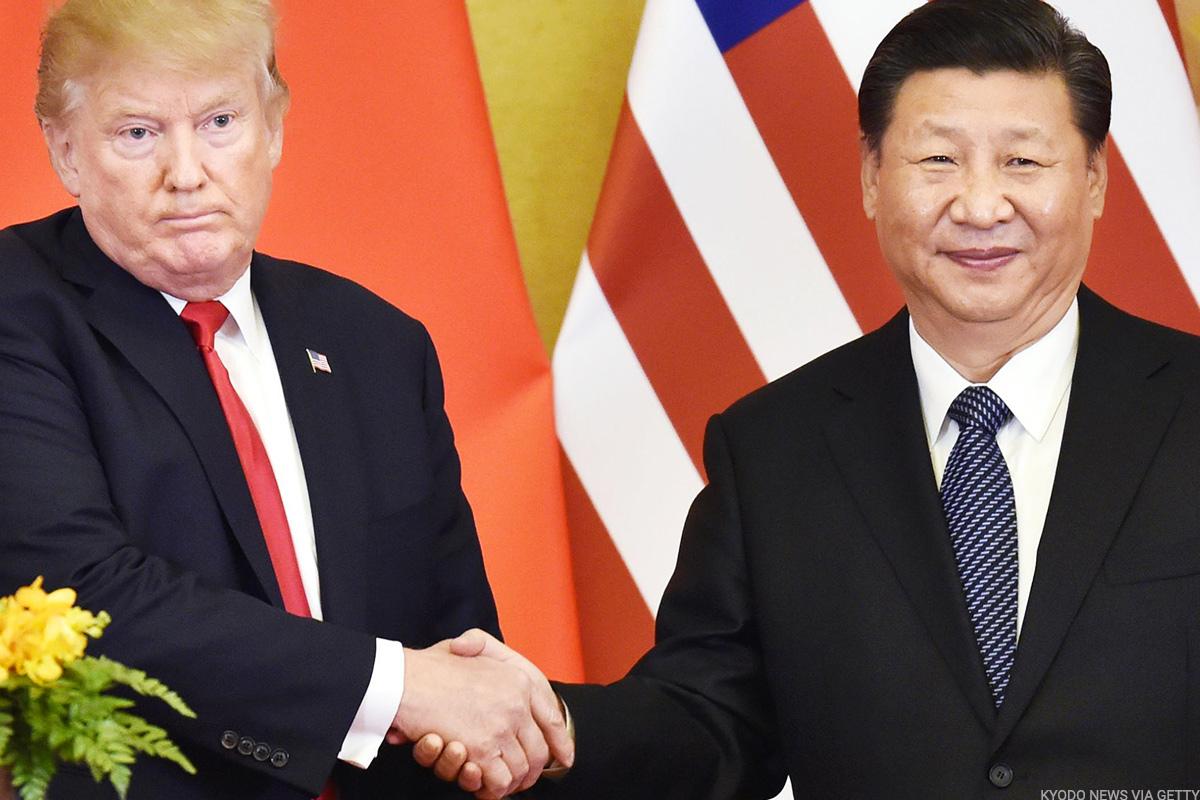
We are once again at the mercy of official pronouncements, with investors having to make sense of tough language from Trump on Friday that he immediately moderated over the weekend. In response to stricter Chinese controls on the 17 rare earths, Trump said he would impose another 100% tariffs on imports from China, with further controls on U.S.-made software. Trump also said he wasn’t sure there was a point in meeting Chinese President Xi Jinping at the APEC Summit in South Korea, which takes place Oct. 31-Nov. 1.
Today, we have heard from U.S. Treasury Sec. Scott Bessent, who both criticized China in an interview with the Financial Times, and then held out hope that the tariffs wouldn’t happen, and the Trump-Xi meeting is still on.
“The 100% tariff does not have to happen,” Bessent says. “The relationship, despite this announcement last week, is good. Lines of communication have reopened, so we’ll see where it goes.” He adds of the Xi-Trump conflab, “I believe that meeting will still be on.”
Asia-Specific Uncertainties
U.S. investors appear far more bullish and ready to jump onto any positives, even after days like last Friday. Asian investors are far more cautious, with added uncertainties within the region giving cause for pause.
In Japan, it is not clear at all whether newly elected Liberal Democratic Party leader Sanae Takaichi will have the necessary votes to become Japan’s next prime minister. Takaichi, a right-wing hardliner, won an internal vote to lead the LDP, but that party’s coalition partner, Komeito, on Friday quit the coalition, and said it would not support Takaichi in a vote due later this month.
The LDP now needs a new partner, since the party does not have a majority in either house of Japan’s parliament. Takaichi is reportedly meeting with each of the three other opposition parties on Wednesday.
The added uncertainty contributed to a 2.6% slide on Tuesday for the blue-chip, exporter-heavy Nikkei 225. The broad-market Topix fell 2.0%, in the heaviest selling since April.
Japanese markets had crested to all-time highs last week when Takaichi looked set to become Japan’s first female leader. She favors government stimulus and low interest rates that should be supportive of stocks.
With the leadership in Japan in the balance, and U.S.-China relations likely to remain testy until the potential meeting of Trump and Xi at the end of this month, there are a lot of uncertainties. With Asian investors taking risk off the table, I wonder what it will take to puncture the supreme confidence in equities that U.S. investors are showing.
At the time of publication, Alex Frew McMillan was long TSM.