AI Infection
While demand remains strong for chips, questions arise over Nvidia mega deal, valuations, future of AI funding.
You've reached your free article limit
You've read 0 of 1 free Pro articles.
Just like that, it would appear, things changed. What worked for stocks for years, now scares investors. Traders have gone extremely short-term. Investors have narrowed their books and lightened up on long positions at a speed that startles. It has not just been speed either, but the sheer breadth of this assault on tech stocks specifically, with damage done also to related industries, corporate debt securities, precious metals and cryptocurrencies. There has been a risk-asset bon fire. Private equity, heavily invested in the "AI trade," has taken on damage as well.
First, there was just a simple four paragraph announcement from AI startup Anthropic PBC. That company released a new tool that would reduce laborious workloads for junior attorneys on its Claude AI model that includes both the Claude Cowork and Claude Legal offerings. The shot across the bow was more than noticed by industries stretching far beyond the legal field.
Though this product may or may not ultimately be recognized as a game-changer, one thing is becoming clear: Disruptions are coming. To the software industry specifically. We have seen many AI-focused software companies such as Salesforce (CRM) and others struggle to maintain what had once been lofty valuations as industries such as client relationship management may not matter going forward nearly as much as cost or efficiency. I mean stocks mostly trade algorithm to algorithm now. In a field where developing human relationships once mattered greatly, there is now very little human interaction at all. There is now almost never a trade where both sides are human in origin.
Will an environment like that spread beyond the financial services industry once agentic artificial intelligence reliant upon generative AI starts impacting a wide swath of industries? What happened on Wall Street and will now very possibly start happening to junior and then mid-level attorneys will happen to salespersons, marketing personnel, accountants, bankers and the like. The current level of labor market anxiety still lies in the hypothetical, but that is only because the threat is very real.
Then Came This...
The other shoe then dropped. The Wall Street Journal dropped a report suggesting that Nvidia's (NVDA) deal to provide OpenAI, the owner of ChatGPT, with up to $100 billion in funding could be in trouble or could be delayed. Nvidia refuted the story, claiming that the elite-level chip designer had until the second half of this year to provide those funds. The story, though, rattled Wall Street, and concerns over just how incredibly expensive the development of artificial intelligence, that had already been there, raged on.
How to innovate if the funding slows? How to maintain margins if the funding does not slow? Valid concerns all, that are simply infecting everything related to what has been referred to as "the AI trade" from the Magnificent 7 hyperscalers to industry-specific software companies all to way to semiconductor providers.
Sure, there remains insatiable demand for AI-capable chips and for memory/ storage type chips. Heck, there's even an ongoing shortage of those chips even while concerns flare over just how clientele can keep paying for them or how the electrical power necessary to build data centers the size of city blocks can profitably scale out. Not everyone can pay those prices necessary. You all saw what happened to my Advanced Micro Devices (AMD) on Wednesday. Great numbers, great fundamentals, solid guidance, Sold. Down 17%.
Anyone else notice Alphabet's (GOOGL) plan to drop between $175 billion to $185 billion on capital expenditures in 2026? Of course you did. The stock dropped 2% on Wednesday and is down another 2.5% overnight despite earnings that blew away expectations and sales that topped consensus by almost 2.4 billion dollars. Think of that. That was the size of the beat. Just incredible.
Economics
What a confusing day, really, even for an old pro, who people think has his stuff together. We had all of the above downward pressure on the markets. We also had more strong economic data. The economy is seemingly red hot at the moment. The Atlanta Fed's GDPNow model is running at growth of 4.2% (q/q, SAAR) for the fourth quarter, coming on top of 4.4% growth for Q3 and 3.8% growth for Q2.
Outside of periods of fiscal stimulus, which is artificial and the pandemic snapback, we have not seen three consecutive quarters of this kind of increased economic activity since I was a considerably younger man. On Wednesday, it was the ISM Non-Manufacturing (Services) Survey that pleasantly surprised. The headline print for January crossed the tape in line with December when some slowing down in the current expansion had been projected.
New orders printed in a state of expansion for a second straight month as did Employment. Guess AI has not yet hit purchasing managers across the service sector. Of course, service sector prices also went higher for a 104th consecutive month. That's 8.7 years for those keeping score, which is unreal.
Marketplace
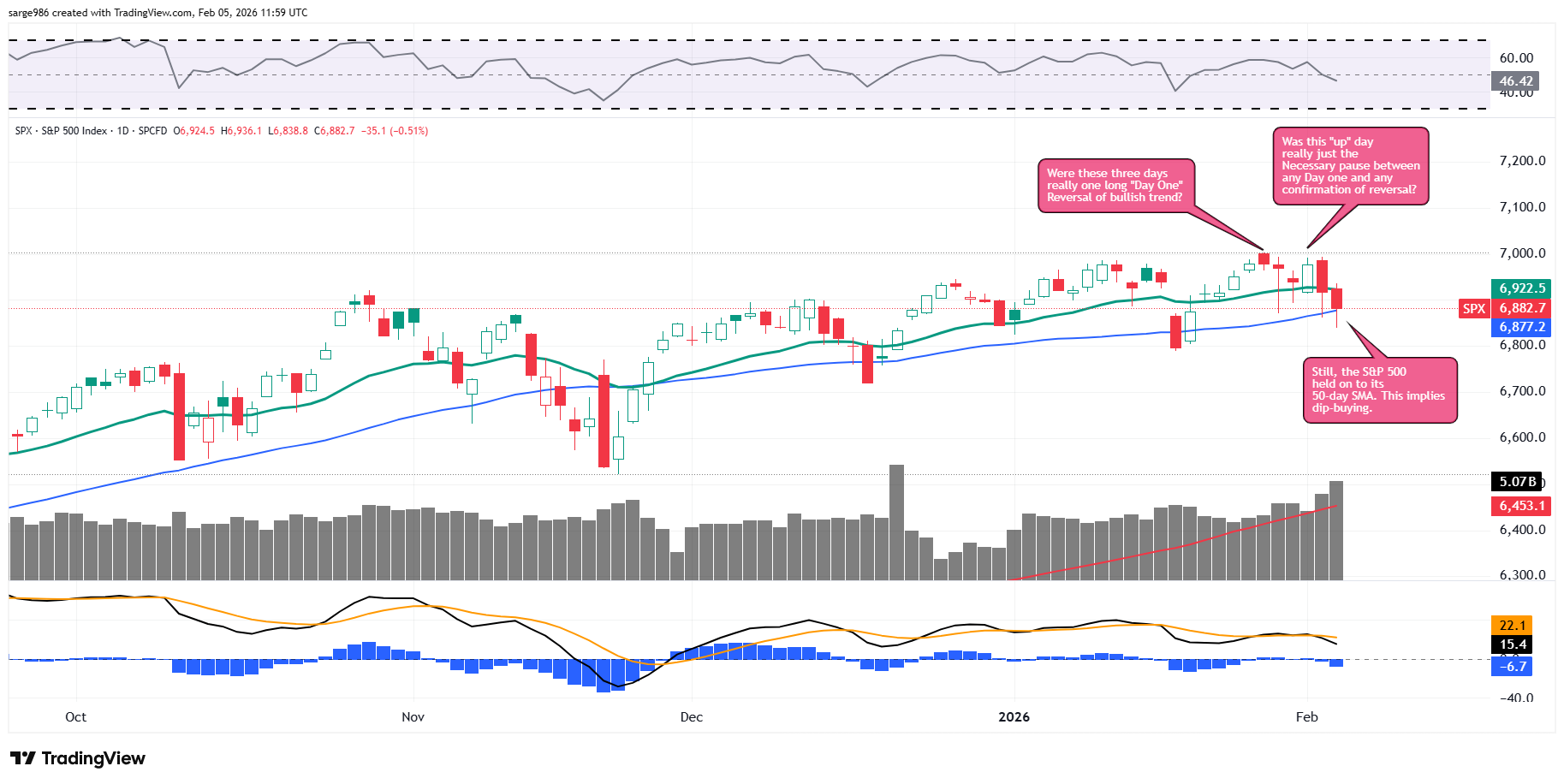
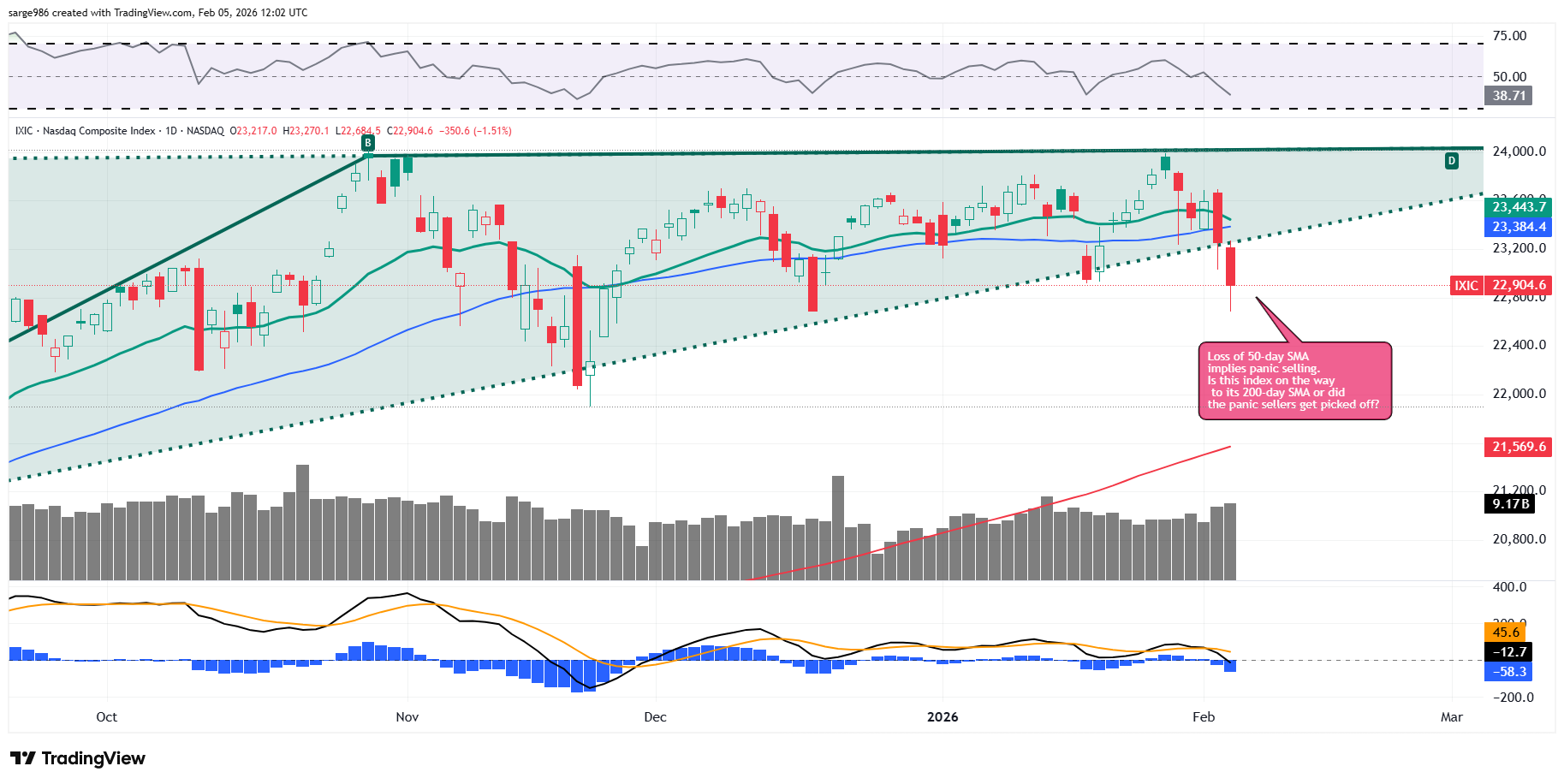
The S&P 500 really did hold its own on Wednesday, surrendering "just" 0.51%. The tech-heavy Nasdaq Composite gave up 1.51% as the tech-centric Nasdaq 100 backed up 1.77%. There was some divergence in where the small caps went. While the Russell 2000 joined the Wall Street pity party and gave up 0.9%, the S&P 600 actually gained 0.87%.
The real twist was visible in the breadth of activity. Check this out... Winners beat losers by better than four-to-three at the NYSE as advancing volume took a nearly commanding 58.8% share of composite NYSE-listed trade. This also came on a 6.5% day-over-day increase in aggregate trade. Pretty close to checking most of the boxes needed for a "Day One" upside reversal of trend.
But losers beat winners by about five to three at the Nasdaq as advancing volume took just a 39.8% share of composite Nasdaq-listed trade. This came on 5.4% day-over-day growth in aggregate trade. We have two major equity exchanges in New York, and they told two different tales on Wednesday.
“It was the best of times, it was the worst of times, it was the age of wisdom, it was the age of foolishness, it was the epoch of belief, it was the epoch of incredulity, it was the season of Light, it was the season of Darkness, it was the spring of hope, it was the winter of despair, we had everything before us, we had nothing before us, we were all going direct to Heaven, we were all going direct the other way"
- Charles Dickens (from "A Tale of Two Cities), 1859
Breakdown
On Wednesday, the materials (XLB) and energy (XLE) both ran more than 2.25%, expressing economic optimism, and that came on rising dollar valuations relative to peer reserve currencies. That makes it meaningful. Then, the REITs (XLRE) , staples (XLP) , and health care (XLV) all gained between 1.25% and 1.59%. These are defensive-type groups and reflect a "fear trade" as investors fled the tech trade.
Then there is the beatdown city. The communication services (XLC) sector SPDR lost 0.8%, weighed down by the Dow Jones U.S. Internet Index that surrendered 2.33%. Now, we move on to Technology (XLK) . The SPDR was down 2.79% after giving up 2.19% the day prior. Within that group, the Dow Jones U.S. Software Index lost "just" 0.7% after a 3.48% loss on Tuesday. The Philadelphia Semiconductor Index suffered a drubbing of 4.36% on Wednesday coming off of a 2.07% smackdown on Tuesday.
Of course, AMD led the parade of losers on Wednesday, followed, though, by the memory / storage shooting star that had been SanDisk (SNDK) at -16%. Even Micron (MU) , facing dramatic shortages, still rising demand and suddenly granted the ability to charge whatever they want for their high-bandwidth products, surrendered 9.6% for the session. My thoughts? Taiwan Semiconductor (TSM) is a good place in the tech space to sort of hide. Still the world's largest foundry by far and without serious competition until Intel (INTC) gets its act together.
As Night Evolves
The man in the blackened window stared back in silence at the trader as he tried to put together a strategy for the coming day after being hit by a right cross and then a devastating uppercut for what seems like more than two days. Suddenly, an angel appeared as inspiration as night melted into morning. Sounded like a little bell. The only sound. Kind words from afar. The trader and the man in the blackened window looked back upon each other. Still silent. Much more confident. Bring on this day. Yes, we can.
Hopeful?
Read the Captions...
Sub-Optimal
Economics
(All Times Eastern)
08:30 - Initial Jobless Claims (Weekly): Expecting 211K, Last 209K.
08:30 - Continuing Claims (Weekly): Last 1.827M.
10:30 - Natural Gas Inventories (Weekly): Last -242B cf.
The Fed
(All Times Eastern)
10:50 - Speaker: Atlanta Fed Pres. Raphael Bostic.
Today's Earnings Highlights
(Consensus EPS Expectations)
Before the Open: (BMY) (1.21), (HSY) (1.40), (PTON) (-.05), (RL) (5.80), (RBLX) (-.49)
After the Close: (AMZN) (1.94), (FTNT) (.74), (RDDT) (1.45)
At the time of publication, Guilfoyle was long PTON, AMZN, NVDA, AMD, TSM, INTC equity.