After Sharp GDPNow Drop Investors Should Prepare for Recession
Stocks could be just at the beginning of a long descent and it's time for investors to develop a game plan.
You've reached your free article limit
You've read 0 of 1 free Pro articles.
On Monday, the S&P 500 fell for the sixth time in the past eight sessions. Since closing at an all-time high on February 19, the large-cap index has lost 295 points, or just under 5%.
Is this just another selloff before the bull market resumes, or is something else happening here?
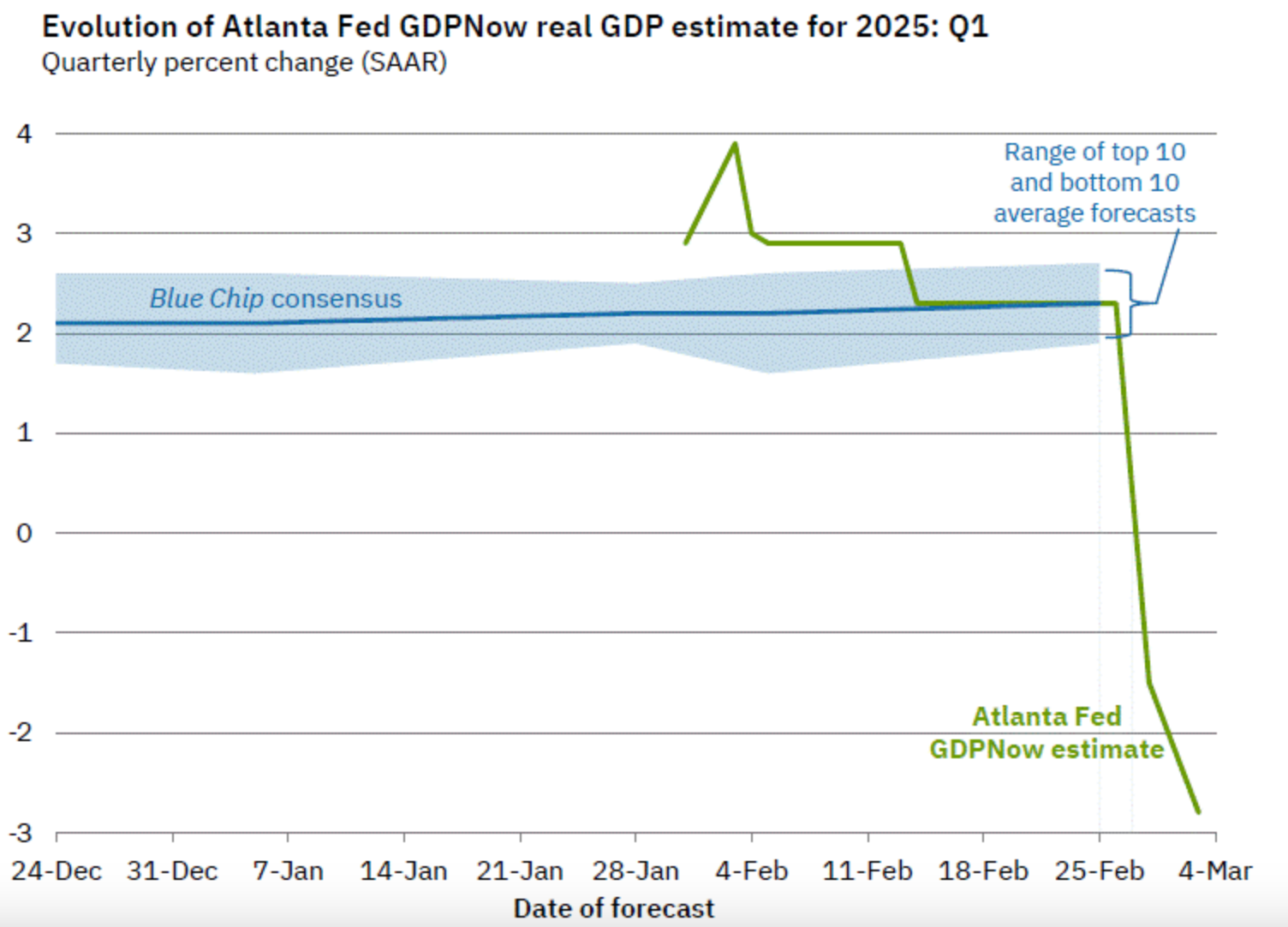
Much of the chatter on Monday involved the recent swing in the GDPNow model. Over the past few days, the Atlanta Fed’s first quarter GDPNow estimate has dropped sharply, suggesting a decline of 2.8%.
This, in turn, has sparked fears that a recession could already be underway.
The U.S. hasn’t seen a major recession since December 2007 through June 2009. A minor recession did occur in March 2020 to April 2020, but that’s to be expected during a pandemic.
I don't believe the U.S. is currently in a recession, but if one does occur, it won’t be due to one single data point.
At the start of the 2007 to 2009 recession, a variety of major data points were flashing red. Everything from job creation to housing to retail sales told a similar story.
If you’ve been around a while, this isn’t news to you, but there is a generation of market participants who’ve never lived through a recession — at least not as financial professionals or full-time investors.
To this group, I have one message: learn to hedge.
The market has rewarded bulls for so long, that now there is a sizable crop of traders and investors who've never experienced a deep recession or a stock market crash. They might not realize that those two things go hand in hand.
It’s not their fault. The S&P 500 bottomed at 666.79 in March 2009 (arrow below), and has gained about 886% since then. During that stretch of time, if you weren’t long, you were wrong.
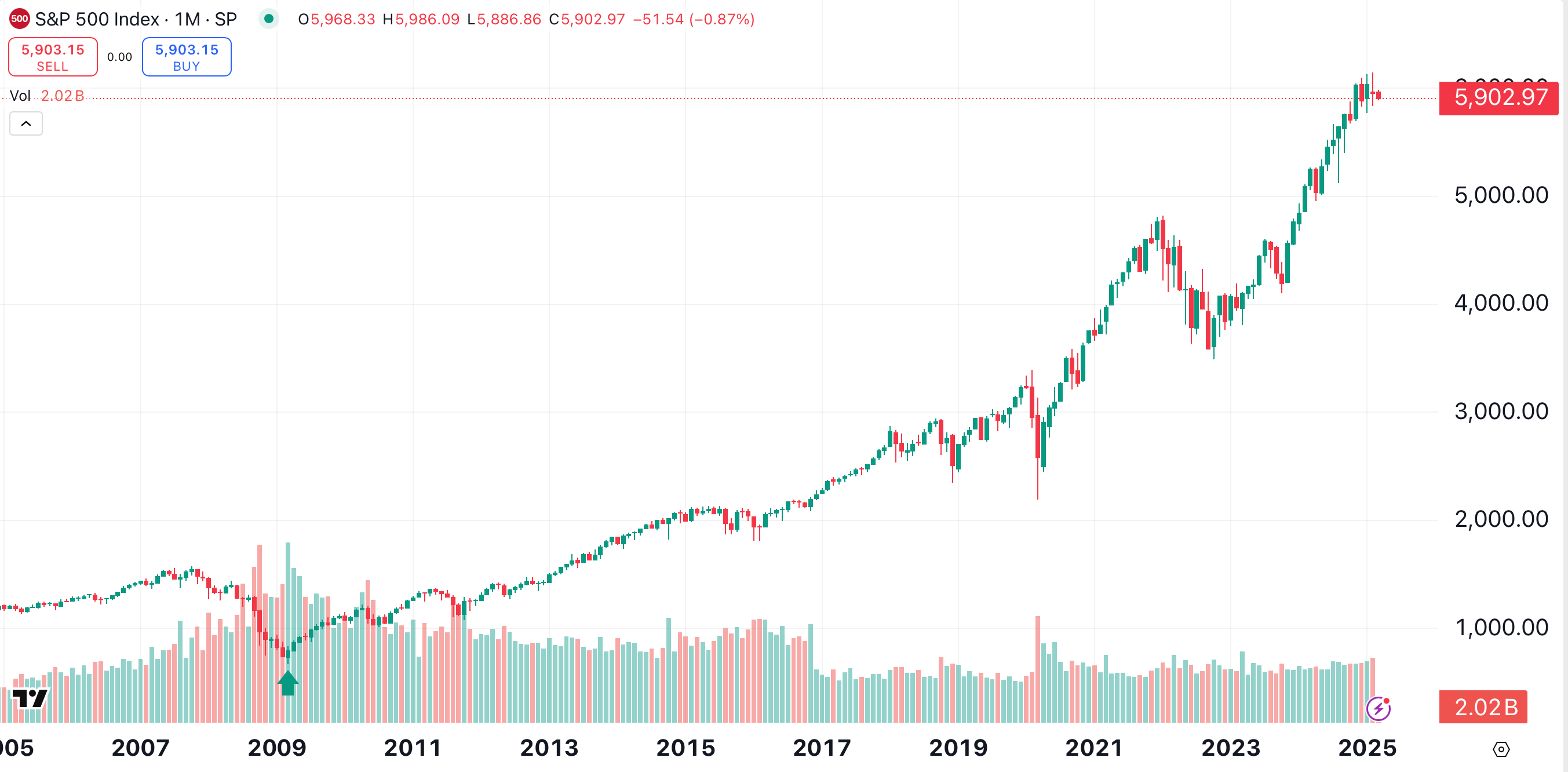
Perhaps the most disturbing aspect of this chart is the fact that the crash of 2008 now looks like a speed bump when compared with the activity that has occurred since then.
During the 2008 to 2009 crash, the S&P 500 lost over 50% of its value, falling from a peak of 1,576 to the aforementioned 666 low. The preceding crash in 2000 through 2002 also led to a decline of about 50%.
In both cases, the S&P 500 reached an all-time high before losing half or more of its value.
On February 19, 2024, the S&P 500 closed at an all-time high of 6,144. If the index were to lose half its value from that point, it would fall to 3,072. That's a long way down from Monday's close of 5,849.
It would be a disaster for retail traders and investors, most of whom have no idea how to protect their accounts in such a scenario. There is an entire generation that has no idea of what could be coming, or how to handle it.
If you are among those who YOLO'd their way to financial independence over the past decade and a half, I congratulate you.
The past two weeks of volatility should act as your wake-up call. Now is the time to create your game plan to ensure that you keep what you have gained.
At the time of publication, Ponsi had no positions in any securities mentioned.