A Step Ahead on Taiwan Semiconductor, Operation Venezuela
Let's look at the capture of Maduro, an update on TSM, inflation progress, the markets' charts, and the week ahead.
You've reached your free article limit
You've read 0 of 1 free Pro articles.
It's old news by now. U.S. military forces, in an early Saturday morning raid that incredibly cost no U.S. casualties or loss of equipment, captured Venezuelan socialist dictator Pres. Nicolas Maduro and his wife, Cilia Flores. Estimates are that U.S. forces killed between 40 and 80 enemy combatants. Maduro and Flores were flown out of that nation and held aboard the USS Iwo Jima. The two were to be taken to the U.S. naval station at Guantanamo Bay, Cuba and eventually on to New York.
The mission was apparently led by the U.S. Army's "Delta Force." Identifying Delta as the lead operator was a break from tradition and something I found interesting. In the past, whether U.S. special operations raids were led by Delta, Seal Team 6 or MARSOC (Marine Raiders), past administrations simply identified the operators as Navy Seals in order to misinform enemy combatants. Specifically naming what is perhaps the U.S. military's most secret and most elite unit, was a change. It also could be misinformation itself, as at that level, components from all special ops type units work together depending on the needs of the mission.
Maduro, Flores and several other members of the Maduro inner circle have already been indicted in the Southern District of New York and face charges with potential sentences of life imprisonment. Maduro has been charged with narco-terrorism conspiracy, cocaine importation conspiracy, possession of machine guns & destructive devices, and conspiracy to possess machine guns & destructive devices.
Speaker Mike Johnson, among other legislators, have estimated that as the leader of a narco-terrorist regime, Maduro is responsible for the deaths of "hundreds of thousands" of Americans over the years. In a Saturday press conference, U.S. President Donald Trump surprised many, including your author, when he said, "We're going to run the country until such time as we can do a safe, proper and judicious transition."
While that statement more than implies a deeper commitment than many may have been mentally prepared for, the U.S. has left much of the Maduro regime in place in Venezuela notably including loyalist Vice Pres. Delcy Rodriguez. Obviously, Rodriguez will have to play by U.S. rules.
What Now?
Vice Pres. JD Vance justified the operation as legal and necessary on social media. Secretary of State Marco Rubio reposted his own post on social media from this past July that reads, "Maduro is NOT the president of Venezuela and his regime is NOT the legitimate government."
On that note, Venezuelan opposition leader Maria Corina Machado, who has been a vocal supporter of Pres. Trump will not be installed, at least not now, as leader of that nation. In Pres. Trump's address, he said that it would be tough for her to lead because she lacks the "support" and "respect" of the country. Corina Machado called for national unity in her own social media post.
The U.S. military strike centered on the Maduro inner circle, his security, known conduits for drug trafficking, the ability for the Venezuelan military to communicate and on diversionary events. Venezuelan oil infrastructure, the legitimate lifeblood of that nation's economy, was spared.
Pres. Trump addressed this: "We're going to have our very large United States oil companies, the biggest anywhere in the world, go in, spend billions of dollars, fix the badly broken infrastructure, and start making money for the country."
Venezuela controls the planet's largest known oil reserve, but production has decreased significantly under Maduro's lack of leadership. Chevron (CVX) is the only large foreign oil company with any current operations in Venezuela.
Taiwan Semiconductor Target
On Friday, as usual, we here at TheStreet Pro, were a step ahead of investment banking giant, Goldman Sachs (GS) . In a piece authored by yours truly, we put a $377 target price on Taiwan Semiconductor (TSM) and informed readership that once the piece went public, I would be initiating a long position in the ADRs which I did. The last sale for TSM was $315.60 by the time the article hit the tape. TSM closed on Friday at $319.61, up 5.17%.
TSM is trading with a $329 handle overnight, up almost 9.5% in response to Goldman Sachs having raised its target for the ordinary shares by 35% to NT$2,330 (new Taiwan dollars). Goldman Sachs analyst Bruce Lu noted the likelihood of increasing margin, which is something we wrote in our piece on Friday. Lu also projects that the firm will spend $150 billion over the next three years increasing capacity in order to meet soaring demand.
Santa Claus Rally?
Quite honestly. Nobody cares. Today is the final day of the traditional Santa Claus Rally period. The S&P 500 is down 0.7% since the close of business on Dec. 23, which covers that period. Should the S&P 500 fail to gain at least that much today, this would mark the first three year losing streak for the Santa Rally period in the history of the index. Why does nobody care? Simple. The S&P 500 is still up 2.1% from its Dec. 17 low. Santa may have just come early this year.
Anyone Else Notice...
That consumer-level inflation models continue to reflect an acceleration in the pace of the recent disinflationary trend. The Cleveland Fed's model now shows December consumer price index at annual growth of 2.57% and projects January CPI growth at just 2.28%. Cleveland is now showing quarterly CPI annualized growth of 2.42% for Q4 2025 and just 1.93% for Q1 2026. The models I track at Hedgeye, which have been very accurate, are showing similar deterioration, which is a positive.
The Week That Was...
Finally, two weeks of little-to-no activity have finally come to an end. Last week's total aggregate trading volume across both the S&P 500 and Nasdaq Composite actually exceeded those paltry totals of the week prior. That said, even if you were locked in and making an honest effort, it felt the same.
There was one "sort of" positive take-away. I had wondered if, as algorithmic trading has taken on such a commanding role in the process of price discovery over time, but especially in 2025, if humans would be missed. The good news is that with many humans taking time off, trading volumes were significantly diminished.
Score on for the good guys? Maybe. Then again, maybe the humans in charge turned off the machines while they were out. As algorithms get more and more complex and agentic artificial intelligence gets smarter and smarter, not to mention faster, these humans will, someday, maybe soon, allow the machines to trade without oversight.
On that cheerful note, let's take a look at the past week...
- The S&P 500 gained 0.19% on Friday but lost 1.03% for the week.
- The Nasdaq Composite lost just 0.03% on Friday, surrendering 1.52% for the week.
- The Nasdaq 100 lost 0.17% on Friday and a gnarly 1.71% on the week.
- The Russell 2000 gained 1.06% on Friday but lost 1.03% for the week.
- The S&P Small Cap 600 added 0.99% on Friday but gave back 1.43% for the week.
- The S&P Midcap 400 roared 1.34% higher on Friday, still losing 0.71% over the week.
- The Dow Transports ripped 1.03% on Friday but still lost 0.63% for the week.
- The Philly Semis sailed 4.01% higher on Friday to add 2.32% for the week.
- The KBW Bank Index jumped 1.75% on Friday but still lost 0.76% for the week.
On Friday, nine of the 11 S&P sector SPDR ETFs closed out the session in the green, led by Energy (XLE) and the Industrials (XLI) . Four of these funds gained more than 1% for the day. The Discretionaries (XLC) finished in last place for the session as Tesla (TSLA) led the autos lower.
For the holiday-shortened week, just four of the eleven S&P sector SPDR ETFs traded higher, again with Energy in the lead. The Discretionaries were pounded as Technology (XLK) and the Financials (XLF) also had tough weeks. One thing was clear. Cyclicals out-performed growth for both the day on Friday and the week. That was with a tremendous run by the semiconductors on Friday led by Sandisk (SNDK), ASML Holdings (ASML) and Lam Research (LRCX) .
The Charts...
This section will look eerily similar to a section I wrote up in this past Friday's Market Recon. Being that this section is a staple of the Monday Recons, and I am guessing that half of our readership may have had something better to do on Friday than stay on top of financial markets, I will more or less re-run this section, albeit with updated charts. Some of the written content has been updated as well.
Almost all of our key equity indexes, despite not only light, but contracting aggregate trading volume, closed on Thursday at or close to levels that would force a reaction on Friday) morning. I warned that either the levels will crack, and the cradle would rock, or we'd see a technical rally. We appear to have been on the receiving end of that technical rally.
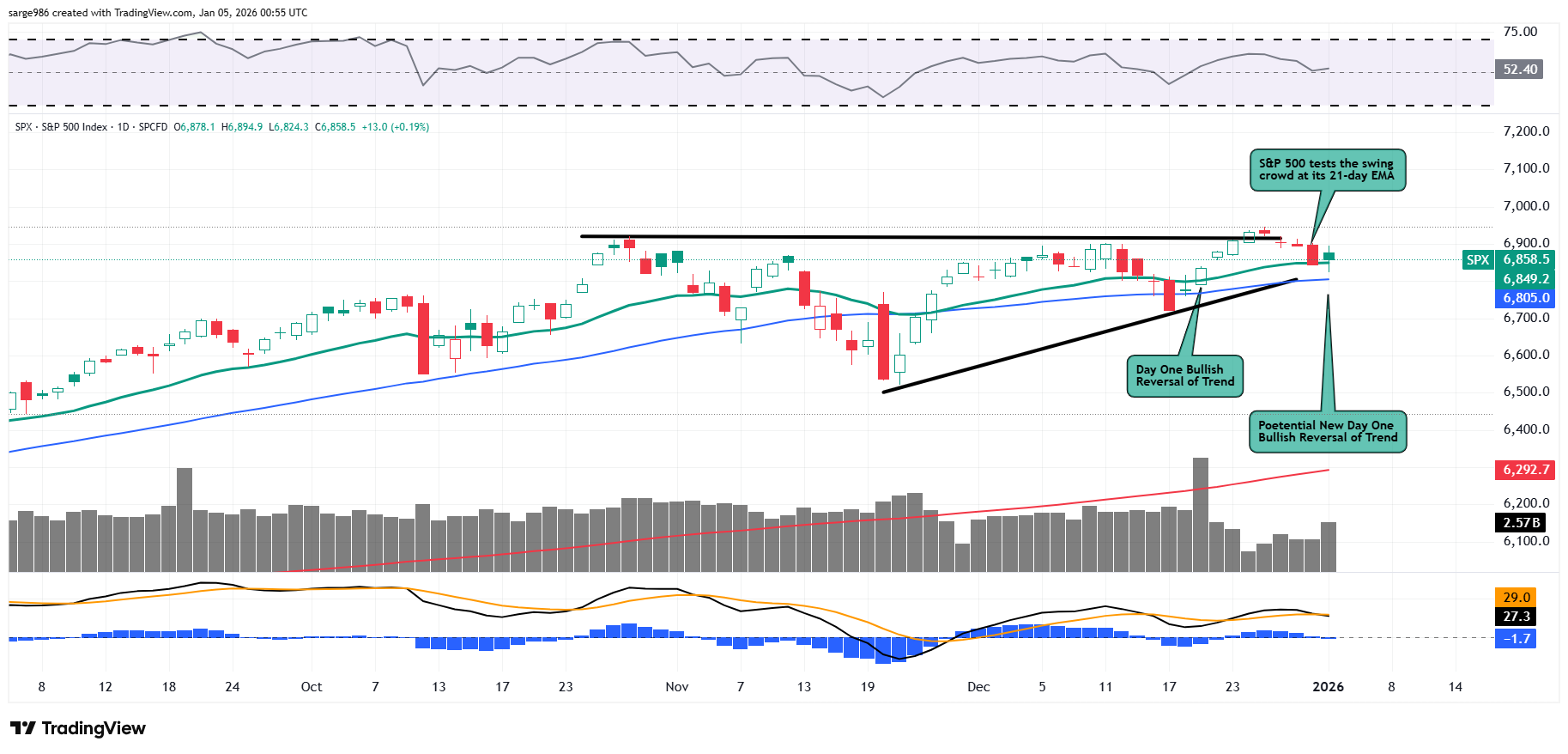
The S&P 500 reacted to a Thursday test of its 21-day exponential moving average that likely provoked the swing crowd in bullish fashion. That said, day traders are watching the daily moving average convergence divergence as the 12-day EMA crossed below the 26-day EMA on Friday. While that is a short-term bearish signal, the increased, but still light trading volume presents Friday as a potential "day one" bullish reversal of trend.
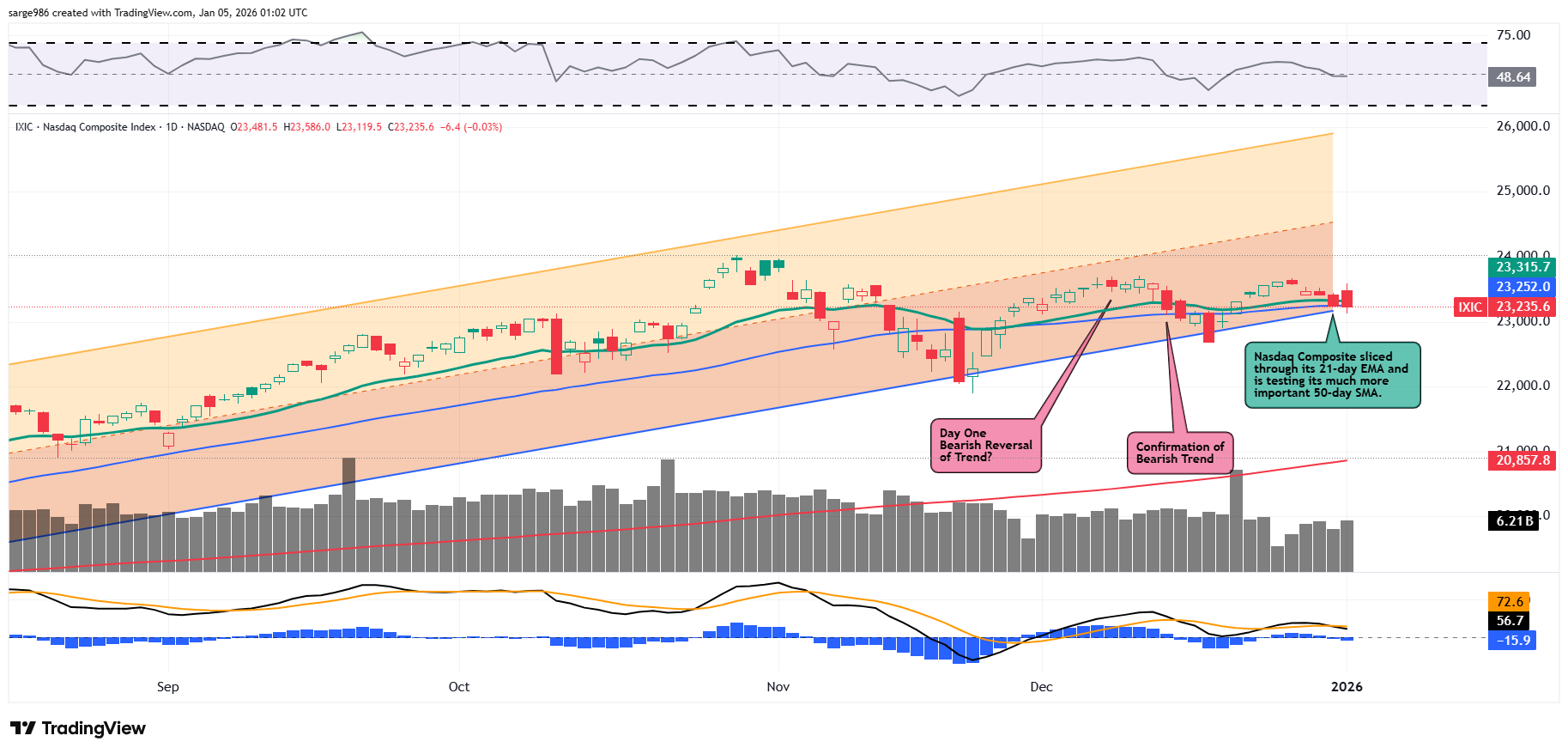
The Nasdaq Composite sliced right through its 21-day EMA and put the test to its 50-day simple moving average at the close on both Wednesday and Friday. This will likely force some kind of technical reaction by professional managers as a group. Should this index fail to defend this level or professional managers could retreat to the 200-day line. That would be a nasty haircut from here.
The daily MACD is also under some pressure. The 12-day EMA moved slightly below the 26-day EMA on Wednesday and held that move on Friday. The 9-day EMA also moved just below the zero-bound. These are bearish, but not yet profoundly bearish signals. It is important to note that while the 50-day SMA has been pierced, the line is not lost until contact is lost. That is yet to happen.
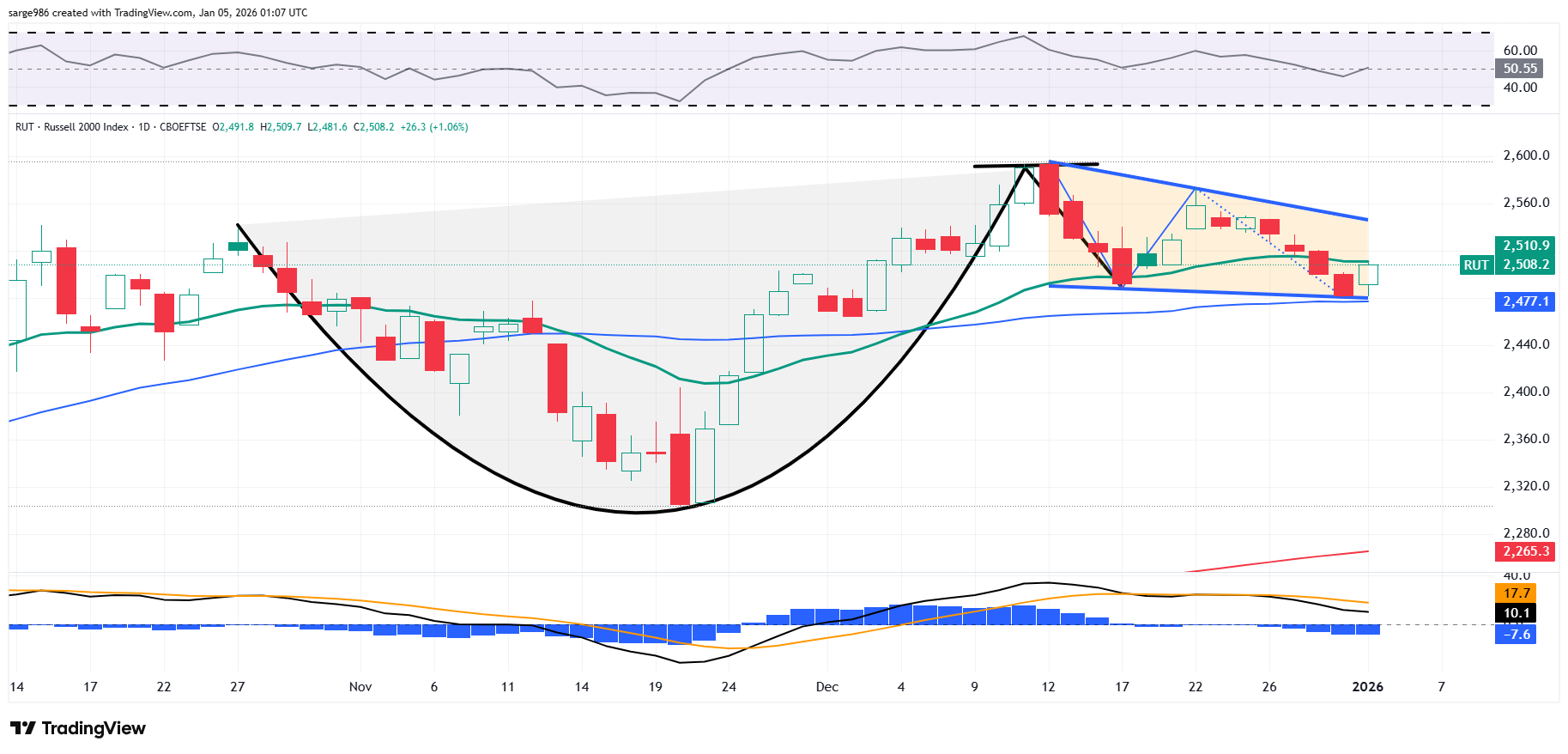
Small caps still have a trickier looking chart than do the other key indices. Readers will note that the Russell 200 came out of a failed Cup with Handle pattern in December (which is bearish) but went right into a Falling Wedge pattern. While the pattern still looks incomplete at this time, that would ultimately be bullish.
The index reacted well on Friday to Wednesday's test of the lower trendline of that wedge, which also happens to be the Russell 2000's 50-day SMA. This provoked some bullish activity on Friday by professional managers. However, there are still some problems visible for shorter- term traders. The daily MACD for this index went bearish in posture more than a week ago, but the reading for relative strength has returned to something close to "neutral."
The GDP Game
Last week, the Atlanta Fed did not revise their GDPNow model's initial estimate for the fourth quarter at growth of 3.0% (q/q, SAAR). Among other regional central bank district branches running close to real-time Q4 GDP models, the New York Fed and Cleveland Fed left their models unrevised as well at growth of 2.07% and 2.85% respectively. The St. Louis Fed, which has missed the mark quite badly so far in 2025, did revise their Q4 model downward from 1.18% to 1.12%.
Fed Funds Futures
Fed Funds futures trading in Chicago are now pricing in just a 17% probability for a quarter-percentage point rate cut on Jan. 28 when the Federal Open Market Committee next meets on policy, down from 18% last week at this time. As we know, the FOMC will look different in 2026 as Boston, Chicago, St. Louis and Kansas City have lost policy voting rights as part of the Fed's regular annual rotation. Cleveland, Philadelphia, Dallas and Minneapolis have now gained policy voting rights for the coming year. At present, there are now 50-basis points worth of additional rate cuts fully priced in (75% chance, up from 65%) for all of calendar 2026.
On The Docket...
The "holidays" from a market perspective are over. That said, those of you who are going to have trouble re-adjusting to five-day market workweeks, there will be another holiday in two weeks when the exchanges recognize Martin Luther King, Jr. Day. So, hang on, it'll be just two full five-day weeks in a row. Here's what we have going on this week, gang...
.... The Federal Reserve will slowly return to the public scene this week after largely disappearing for more than half of a month for the holidays. That's some job if you can get it. Gee whiz. Currently, I have just four appearances on my radar and Richmond Fed Pres Tom Barkin, who does not have 2026 policy voting rights, is two of them. Barkin will speak tomorrow morning and Friday afternoon. This week's headline speaker will be Fed Gov Michelle Bowman on Wednesday afternoon. Minneapolis Fed Pres Neel Kashkari, who will vote in 2026, is set to speak on Friday morning.
.... The macroeconomic calendar will get active this week, but not until later in the period. This Friday is "December Jobs Day" and those numbers will impact financial markets. Leading into Friday, we'll get the ADP Employment Report for December on Wednesday morning, as well as November JOLTs data for job openings and job quits. Ahead of all of that employment related data, we'll see the ISM Manufacturing PMI for December later this morning and the ISM Services PMI for December on Wednesday. The University of Michigan will hit us with their preliminary January survey results on Friday for Consumer sentiment and for inflation expectations.
.... The earnings calendar is light this week, but at least it's not a complete zero. The closest thing we have to headline level names set to report this week will be Constellation Brands (STZ) and Jefferies Financial (JEF) on Wednesday afternoon and then Acuity (AYI) and RPM International (RPM) on Thursday morning. The big bank will kick off the fourth quarter reporting season next week.
.... In other corporate news, CES (Consumer Electronics Show) 2026 kicked off on Sunday evening in Las Vegas. This evening, at the "media day" event, Nvidia (NVDA) CEO Jensen Huang will speak at 4:00 p.m. ET. Advanced Micro Devices (AMD) CEO Lisa Su speaks at 9:30 p.m. ET. In between the two, Intel (INTC) will also present. Looking over the rest of the schedule, I see a presentation by Caterpillar (CAT) midday on Thursday.
Economics
(All Times Eastern)
10:00 - ISM Manufacturing Index (Dec): Expecting 48.3, Last 48.2.
The Fed
(All Times Eastern)
No public appearances scheduled.
Today's Earnings Highlights (Consensus EPS Expectations)
No significant quarterly earnings scheduled.
At the time of publication, Guilfoyle was long NVDA, AMD, INTC, TSM equity.