A Most Wonderful Rally, CPI Surprise, Waller Advances?
We saw some green on Wall St. as the consumer price index pleased with better-than-feared inflation data; also a Fed update and my view of prices from the ground.
You've reached your free article limit
You've read 0 of 1 free Pro articles.
It's the Most Wonderful Time of the Year
There'll be parties for hosting
Marshmallows for toasting
And caroling out in the snow
There'll be scary ghost stories
And tales of the glories
Of Christmases long, long ago
- Eddie Pola, George Wyle (Andy Williams) 1963
For the Record...
I, nor anyone in my extended family, as far as I know, have ever gathered the kids around the holidays for a gnarly round of scary ghost stories. I guess the writers of my favorite non-religious carol were referring to the Charles Dickens classic, "A Christmas Carol." Otherwise, I have no idea where that came from.
Hey, did you kids see that Munetaka Murakami signed with the White Sox? Either that too came out of nowhere, or I have really been out of the loop as I moved late last week into a new home and office. I do, however, see that Jalen Brunson is still awesome. So, my faithful readers... This is the maiden voyage of Market Recon from our new location. An intended permanent location. May all of your days end profitably and may you find victory in all of your campaigns. Now, we rock.
The Past Week
Major U.S. equity indexes turned the tide on what had been a "down" week last Thursday and then rallied hard on Friday with both the S&P 500 and Nasdaq Composite closing at the highs of their respective sessions. Both of these indexes managed, quite unexpectedly, to post green candle weeks after having suffered three days of selling pressure earlier in the week. That pressure really went back to the tail end of the week prior.
What produced such a strong rally in stocks to end the week? Simple. Yes, Friday was a "Triple Witching" expirations event, but there was also a serious assist to U.S. market performance on the macroeconomic side. The most obvious catalyst would be the November consumer price index data. There is some reason to believe that there could be some technical holes in the numbers due to the lack of data collection in either October or early November. That is something that we can speculate over.
The fact is that the high-speed, keyword reading algorithms that control price discovery in this modern era, don't speculate. They just act, and if they can create momentum, that's considered a positive. We also do not know that the CPI numbers are incorrect. If they were accurate or even close, that would mean that inflation was slowing sharply. We had been expecting some disinflation, but not this quickly nor this dramatically.
Personally, I am seeing some anecdotal evidence of cooling consumer prices in my travels around central Florida. Of course this is not backed by data, and the sample size is minute, but prices do seem to have apexed for many goods to include groceries in this region with an overt decline in fuel prices and at least stalled prices for shelter.
What Now?
The fact that November year-over-year CPI crossed the tape at growth of 2.7% with economists looking for a 3.1% print and with core prices growing 2.6% with economists looking for an even 3% print takes the pressure off of the Federal Open Market Committee. This, at least in theory, improves the possibility if not mathematical probability for short-term rate cuts in 2026. If not, it certainly puts the idea of having to fight an ongoing battle against consumer-level inflation on the back burner. At least until the December inflation prints roll in.
Much lower in profile, but also taken as a positive last week was the weekly data on jobless claims. While those first-time filers for state-level unemployment benefits numbered at 224,000 with Wall Street looking for 225,000, would not move the needle, what happened to continuing claims certainly did. Those currently receiving state-level unemployment benefits, a number that runs a week behind initial filings, grew from 1.83 million to 1.897 million. Awful, right? Yes, but (and this is a big but), economists were expecting a surge to something close to 1.93 million. Hmm. Did those folks find employment? Perhaps. Let's see what the number looks like this week.
The Fed
Last week, Fed Gov. Christopher Waller had what was termed a "strong interview" with Pres. Trump as the process continued to determine who will be nominated to succeed Jerome Powell as Fed Chair in May. Treasury Sec. Scott Bessent was present. The president and Waller discussed the labor market specifically and how to ignite job creation. Blackrock's Rick Reider will interview next week with the president at Mar-a Lago to round out the latest batch of interviews. Fed Gov. Michelle Bowman is no longer considered to be a candidate.
National Economic Council Director Kevin Hassett remains the favorite for the job according to betting markets with former Fed Gov. Kevin Warsh a somewhat distant second. While not indicating whether or not Waler had caught up to the "big two," Pres. Trump did come away from the meeting saying (about Waller) ... "I think he's great. I mean, he's been a man who has been there a long time, somebody that I was very involved with."
Not So Fast...
Late last week, Cleveland Fed Pres Beth Hammack interviewed with the Wall Street Journal for a podcast. That interview aired on Sunday. Hammack said, “Where we are today (on interest rates) is my base case that we can stay here for some period of time until we get clearer evidence that either inflation is coming back down to target or the employment side is weakening more materially.”
Hammack, who like her predecessor at the Cleveland Fed, has built a reputation for leaning hawkish on monetary policy, added... “I’m very focused on making sure that we can get inflation back to target. That is one of our primary objectives and it’s important that we complete the job.” Concerning the much cooler-than-expected November CPI print, Hammack said, “It’s just one number and I want to take some time. Fortunately, we have a lot of time before our next meeting to see how the broader picture comes in.”
Cleveland, by the way, does regain FOMC policy voting rights for 2026.
The Week That Was...
Equity markets rallied on Thursday and Friday after struggling from shortly after the opening bell on Monday morning into the closing bell on Wednesday afternoon. Though performance for the week was moderately positive for the major indexes, the small caps struggled. Speaking for me, and I am just dumbfounded by this... I had a rough three days last week, while I was at my desk trying to make money. Then I made back all of my three-day losses and then some, in just two days while I was moving and had no internet service. Blind squirrel meets nut. Over the past week...
- The S&P 500 gained 0.88% on Friday but just 0.1% for the week.
- The Nasdaq Composite added 1.31% on Friday but just 0.48% for the week.
- The Nasdaq 100 gained 1.31% on Friday and 0.59% on the week.
- The Russell 2000 gained 0.86% on Friday but surrendered 0.86% for the week.
- The S&P Smallcap 600 tacked on 0.25% on Friday but lost 0.92% for the week.
- The S&P Midcap 400 gained 0.86% on Friday but gained 0.93% over the week.
- The Dow Transports added 0.24% on Friday and 0.31% for the week.
- The Philly Semis soared 2.98% on Friday to gain 0.49% on the week.
- The KBW Bank Index gained 1.15% on Friday, to add 0.39% for the week.
On Friday, six of the 11 S&P sector SPDR ETFs closed out the session in the green, led by Technology (XLK) with the Industrials (XLI) a distant second. The losers were easily led by the Utilities (XLU) . Energy (XLE) closed out the day unchanged.
Most notably, as the AI-trade regained its footing on Friday, and the semis caught a bid, Micron Technology (MU) and Advanced Micro Devices (AMD) led the charge, gaining 6.99% and 6.15% respectively. CoreWeave (CRWV) ran 22.64% on Friday, while Palantir Technologies (PLTR) closed up 9.56% on Friday from the stock's Wednesday low.
For the week, just four of the eleven S&P sector SPDR ETFs traded higher with the Discretionaries (XLY) and Technology out in front. Again, Energy was the week's big loser, trailed at a distance by the REITs (XLRE) .
The Charts...
It was just last week at this time that we were discussing the S&P 500 having posted a reconfirmation of the bullish trend on the Wednesday prior. Then we had four straight red candle sessions. On Tuesday, we discussed some of the disturbing signals we were seeing on the daily chart of the Nasdaq Composite. No doubt, trading these markets requires nerves of steel and the ability to accept that sometimes we don't know.
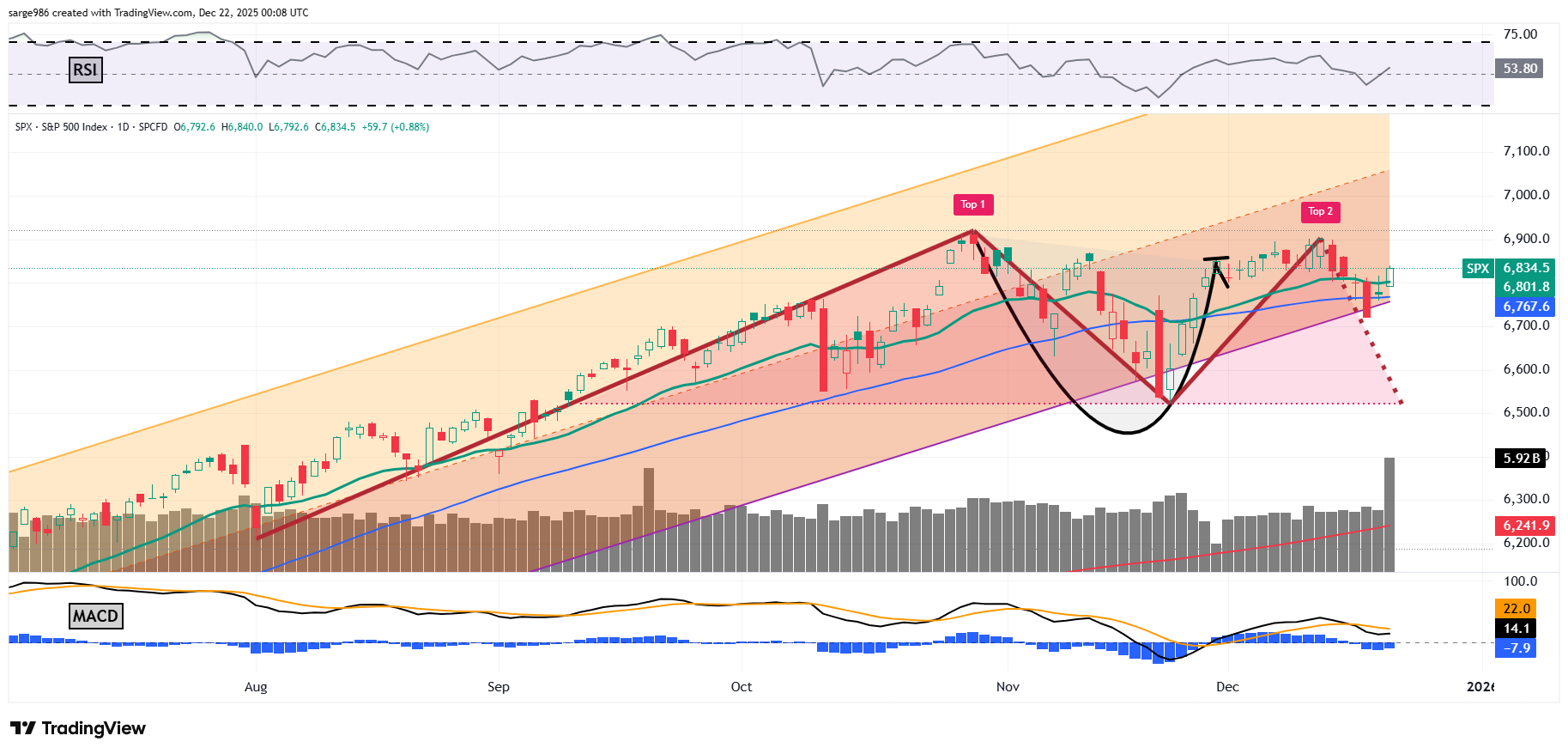
Now, I have a new question. Actually, two questions, check this out. Did the S&P 500 develop a still valid Double Top bearish reversal of trend going into last week after the Cup with Handle pattern failed?
Or.... did the S&P 500 post a brand spanking new "Day One" reversal of trend to the upside on Friday?
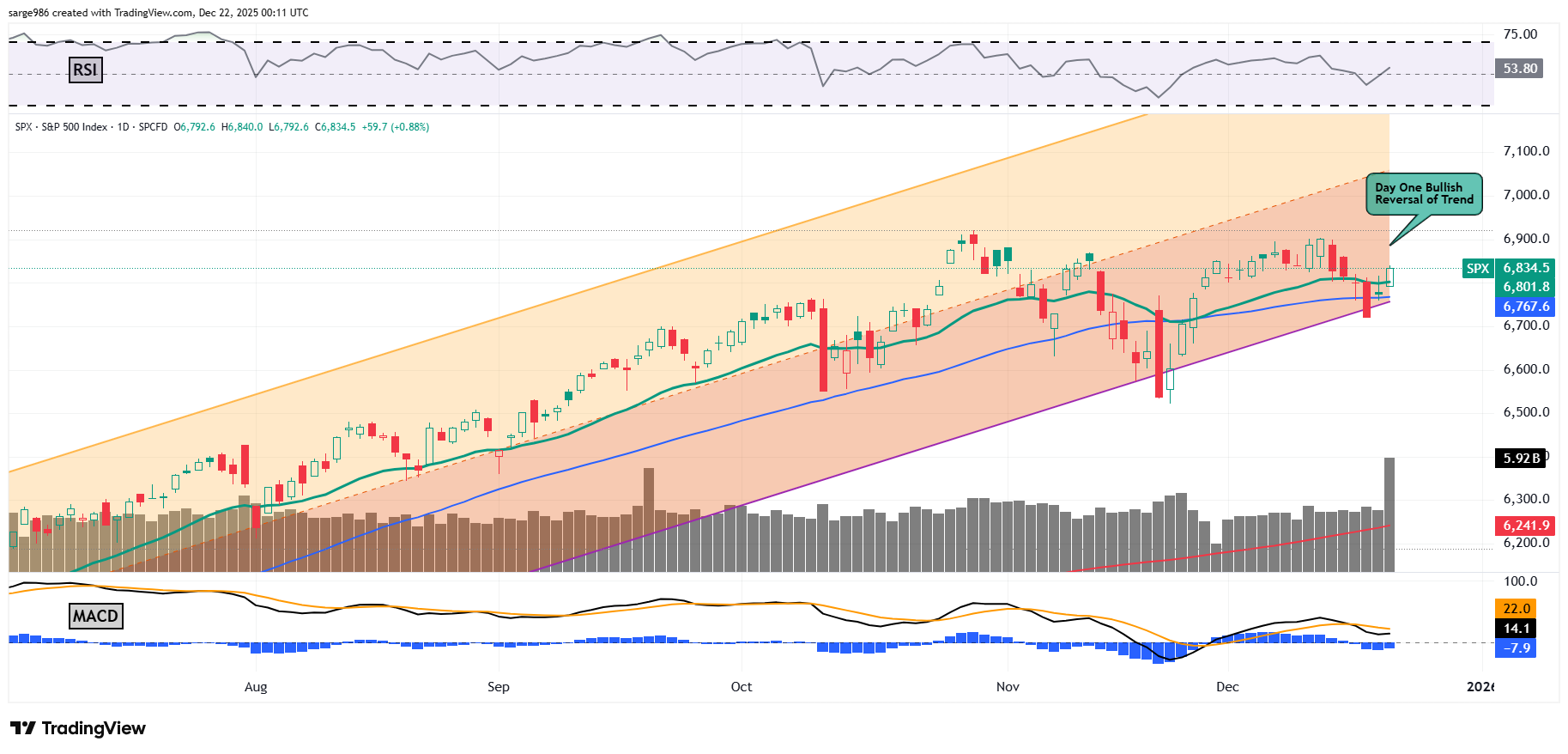
Interesting, isn't it? Yes, I know, Friday was a "triple witching" expiration event. Friday's trading volume reached levels unseen since the September (our most recent) triple witching expiration. Still, one has to wonder just how much of that trading volume was organic. The S&P 500 closed near its highs for the day, regained its 50-day simple moving average on the lower volume, but still positive day on Thursday and then retook its 21-day exponential moving average on Friday. That suggests money put to work by professionals with the swing crowd taking advantage of a momentum trade.
One more question. The traditional "Santa Claus Rally" period starts on Christmas Eve, this Wednesday. and carried through the second trading day of January. On average, about three in four "Santa Claus Rally" periods end in the green. But the last two have gone red. In the history of the S&P 500 there has never been three-straight negative "Santa Claus Rally" periods.
Did we just see the start of what could be a rather strong Santa Rally? As usual, I pose questions that I can't always easily answer. It's kind of fun to think about though. What does our pal Doug Kass like to say... "Often wrong, always in doubt" or something along those lines? Smart guy.
Earnings
As of Dec. 19, according to FactSet, for the fourth quarter, Wall Street is projecting year-over-year earnings growth for the S&P 500 of 8.3%, up from 8.1% a week ago. Wall Street also sees revenue growth of 7.6%, up from 7.5% the week prior. For the full year (2025), the street now sees earnings growth of 12.3% (up from 12.1%) on revenue growth of 7.0%.
At the moment, Technology at earnings growth of 25.7% is the only sector projected to experience double-digit bottom line growth for the fourth quarter. Presently, two sectors (Discretionaries and the Industrials) are projected to suffer a year over year earnings contraction while three other sectors are seen growing earnings by less than 1%.
Valuation
Still using data provided by FactSet, the S&P 500 ended last week trading at 21.8-times 12 months' forward-looking earnings, down from 22.5-times a week ago. This is well above the five-year average of 20.0 times for the index as well as well above its ten-year average of 18.7 times.
The S&P 500 also ended last week trading at 27.6-times trailing 12 months' earnings, down from 28.5-times a week ago. That also stands well above the five-year (25.0-times) and ten-year (22.9 times) averages for the index.
Nine of the eleven sectors are still trading above their five-year average valuations, led by Consumer Discretionaries (28.6 times) and Tech (26.6 times). Only the Utilities (at 17.8 times) and the REITs (at 17.2 times) are not historically overvalued relative to their five-year averages.
The GDP Game
Last week, the Atlanta Fed revised their GDPNow model for the third quarter down to 3.5% from growth of 3.6% (q/q, SAAR). This is Atlanta's final estimate for Q3. The GDPNow model will make public its initial Q4 estimate this Tuesday. Among other regional central bank district branches running close to real-time GDP models, we already know that the New York Fed's final estimate for Q3 economic growth was 2.31%. The Cleveland Fed's model for the third quarter was also left unrevised at growth of 2.05%. Finally, the St. Louis Fed left their model unrevised at growth of just 0.42% . That made St. Louis the outlier.
Both the New York and Cleveland Feds are already running Q4 models. At this time, New York sees fourth-quarter GDP growth at 1.71%, down from 1.81% last week, while Cleveland remains at growth of 2.83%.
Fed Funds Futures
Fed Funds futures trading in Chicago are now pricing in just a 21% probability for a quarter-percentage point rate cut on Jan. 28 when the Federal Open Market Committee next meets on policy. The FOMC will look different at that time as Boston, Chicago, St. Louis and Kansas City will lose voting rights as part of the Fed's regular annual rotation. Cleveland, Philadelphia, Dallas and Minneapolis will gain voting rights for 2026. At present, there are now a half points worth of additional rate cuts fully priced in (77% chance, up from 70%) for all of calendar 2026.
On The Docket...
As readers well know, this is Christmas week. Thursday is a national holiday. Banks and financial markets will be closed. In addition, this Wednesday, on Christmas Eve, both the New York Stock Exchange and the Nasdaq Market Site will ring their respective regular session closing bells at 1 p.m. ET. U.S. bond markets will close an hour later at 2 ET.
.... The Federal Reserve will largely be missing in action this week. I do not currently have a single public appearance by a Fed official on my radar for the holiday-shortened period.
.... The macroeconomic calendar will be light this week with the exception of Tuesday. There will be a lot of data released this Tuesday including first October Durable Goods Orders, and then Industrial Production for both October and November. That same day, we'll also see December Consumer Confidence via the Conference Board and the December Richmond Fed Manufacturing Index.
.... The earnings calendar will be non-existent this week and really for the rest of the year. The large banks are still more than three weeks out from kicking off the fourth quarter reporting season. As far as other corporate events are concerned, Electronic Arts (EA) shareholders will vote later today on the proposed acquisition of the firm by a group led by the Saudi Arabian sovereign wealth fund.
Economics
(All Times Eastern)
No significant domestic macroeconomic data scheduled for release.
The Fed
(All Times Eastern)
No public appearances scheduled.
Today's Earnings Highlights (Consensus EPS Expectations)
No significant quarterly earnings scheduled.
At the time of publication, Guilfoyle was long AMD, PLTR equity.