A Market On Edge and Under Pressure
Stocks were feeling the pressure on Thursday as investors and traders awaited word from the President after the close. And then came the newest tariff news.
You've reached your free article limit
You've read 0 of 1 free Pro articles.
Often, when corporate leaders or elected officials have something to say that they or their advisers believe will impact financial markets once announced, any such announcement will be delayed until after 4 p.m. in New York. The idea is to cause as little chaos or short-term price dislocation as possible. That's why quarterly earnings results are generally not released in between the opening and closing bells at New York's two main equity exchanges. I'm just not that sure how outdated a concept this is.
I mean it made sense back in "the old days" when order flow ran from portfolio managers or prop traders through sales traders on through a clerk (politically correct term: trader's assistant) and then a floor trader that had to at that point be physically present at a designated location on a trading floor where he or she would compete against other floor traders, all while a specialist, who was also trading for him or herself would referee all trading, which could become quite raucous, in that specific stock.
The information once the trade or trades were executed had to go back in that order as well. The floor trader could not leave "the crowd" and still be represented. Once leaving the crowd, things like shares bought or sold and prices had to flow back from the point of sale through the clerk, through the sales trader, and then to the portfolio manager or prop trader who probably worked for a buy-side operation such as a hedge fund, mutual fund or bank. The chain was lengthier than folks think.
When I was a young floor trader, we had three minutes to execute an order once it was clocked. Now, the reception of market-impacting information is spread more evenly, not dependent upon which news service traders subscribe to, and even the slower algorithmic traders execute orders at a number of points of sale in trades that are timed not in minutes, not in seconds, and not even in milliseconds because all of that is way too slow. Trades are now timed in microseconds (one microsecond is equal to one millionth of a second).
Additionally, unlike way back in my twenties and thirties, trades were executed in eighths, not decimals, which led to larger, more impactful individual trades. Trading for the most part, unless one was trading over a landline overseas, began with the opening bell while ending for the day at the closing bell. Modern trade is also now a "24 hours a day" affair with almost no difference in liquidity recognizable just ahead or just after the bells ring aloud. Being few human beings are actually involved in the process, what we refer to as the regular session has become little more than tradition. Now, for the point I'm trying to make...
News broke early on Wednesday that Pres. Trump would make a new announcement after the close, which he made after 5 p.m. on the East Coast, and while the intention was probably to avoid disrupting financial markets, markets were pressured literally all day long in anticipation, until there was a smallish short covering going into the closing bell. Take a look at what the S&P 500 looked like on a minute-by-minute chart for the regular session.
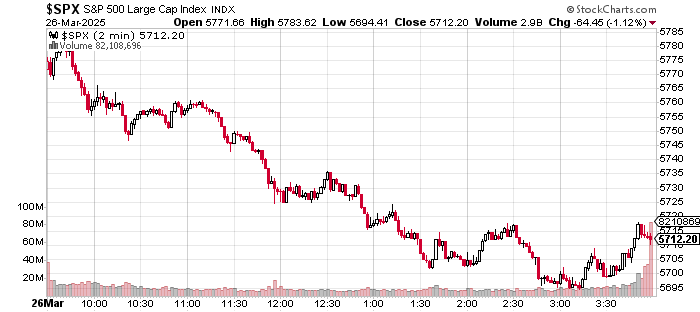
I imagine that the result is nowhere near what had been the intention. So, it is... what trade has become in 2025.
The Announcement: Auto Tariffs
On Wednesday evening, President Trump signed an executive order imposing 25% tariffs on foreign made autos, small trucks and parts for those vehicles. The U.S. will start collecting the proceeds from these tariffs on April 3, which is next Thursday. That's also the day after the president is expected to announce the "reciprocal" tariffs that we have been led to believe will be more targeted than first thought.
Word is that the administration had considered exempting auto parts from this sweeping order, and there is indeed something of an exemption there. Parts imported from Canada and Mexico that are currently compliant with the USMCA agreement will remain tariff-free until the Commerce Department comes up with a process enabling tariffs to be applied to those components.
These tariffs will be added to any tariffs that might already be in place, including completed vehicles from Canada and Mexico. That means that this 25% tariff on finished vehicles will be added to the 25% tariff on all goods imported from those countries as a means towards addressing the inflow of fentanyl into this country. According to S&P Global Mobility, almost 50% of all new passenger vehicles sold in the U.S. in 2024 were assembled elsewhere.
Opinions on the Order
Interestingly, there is varied opinion on this order. Canada's newly minted Prime Minister Mark Carney, who has called for an election on April 28 and is better known as a central banker, after leading both the Bank of Canada and the Bank of England, said “It’s clear that this is a violation, and he has betrayed our trade agreement." Carney added that he sees these tariffs as a direct attack on Canadian workers.
United Auto Workers President Shawn Fain, a vocal opponent of the current president a year ago, however, was now singing a different tune. Fain commented, calling these tariffs “a major step in the right direction for auto workers and blue-collar communities across the country.” The UAW's long-standing position has been that since the original NAFTA agreement in 1994, that outsourcing to Mexico has had a destructive effect upon U.S. manufacturing jobs.
More Than Just Autos...
Though Wednesday's equity market beat-down was at first focused on the autos, it spread quickly to other sectors, especially tech, and unfortunately for actual reason, not just the whims of algorithmic momentum chasers. The Dow Jones U.S. Auto Index gave up 5.1% on Wednesday led in a southerly direction by Tesla TSLA, Ferrari RACE, Stellantis STLA and General Motors GM, all of whom were down more than 3%. Very interestingly, Ford Motor F was up 0.1% for the day as Ford is apparently less heavily exposed to imported cars and parts than are Ford's competitors.
In other news....
TD Cowen released a report claiming that Microsoft MSFT over the past six months had backed out of data center projects that had been slated to use more than two gigawatts of electricity in the U.S. and Europe.
China's National Development and Reform Commission introduced energy-efficient rules for advanced computer chips. These new rules would disqualify Nvidia's NVDA H20 chips for use by Chinese customers building out data centers.
The Financial Times reported that cloud computing startup CoreWeave had breached some terms of a $7.6 billion loan last year. This apparently triggered a series of defaults, where CoreWeave had to ask its largest creditor, Blackstone BX to amend the terms of the loan and waive those defaults back in December. CoreWeave is backed by none other than Nvidia and is in the middle of carrying out its initial public offering. Valuation had been placed as high as $26 billion.
As one might have expected, this placed pressure on the tech sector with a focus on everything AI-related. The Dow Jones US Semiconductor Index gave up 4.6% for the day, followed by the Philadelphia Semiconductor Index at -3.27%, the Dow Jones U.S. Internet Index at -2.84% and the Dow Jones U.S. Software Index that was down 1.83%.
Broad Selloff
Wednesday's selloff was quite broad. But the day does not count as some kind of "Day One" bearish change of trend as trading volume contracted sharply across NYSE-listings as well as across the membership of the S&P 500.
Trading volume, however, increased sharply across Nasdaq-listings. That much is true, but advancing volume took a 54.5% share of that volume and much of that volume was in single stocks such as GameStop GME. That stock ran 11.65% during the regular session after announcing that the firm would start investing in Bitcoin. Overnight however, GME is down a rough 6.6% after announcing a proposed $1.3 billion private offering of convertible senior notes that would come due in 2023.
Don't Be Fooled on Capital Goods
On Wednesday morning, February Durable Goods Orders printed at +0.9% month over month with Wall Street looking for something closer to -1%. That might sound nice, but what counts, orders for core capital goods, which is a proxy for business investment, as it excludes transportation purchases and purchases made for the purpose of national defense, actually printed at -0.3% month over month vs. expectations for something line +0.2%. Boo. Hiss.
Most Importantly...
Today is Opening Day, gang. Optimism, whether or not the markets agree, will be the theme of the day, so Play Ball!!!!
"For Casey, mighty Casey, was advancing to the bat.
There was ease in Casey's manner as he stepped into his place;
There was pride in Casey's bearing and a smile lit Casey's face.
And when, responding to the cheers, he lightly doffed his hat,
No stranger in the crowd could doubt 'twas Casey at the bat."
- From "Casey at the Bat" by Ernest Lawrence Thayer (1888)
Economics (All Times Eastern)
08:30 - Initial Jobless Claims (Weekly): Expecting 225K, Last 223K.
08:30 - Continuing Claims (Weekly): Last 1.892M.
08:30 - GDP Growth Rate (Q4-F): Second Estimate... 2.3% q/q, SAAR.
08:30 - Goods Trade Balance (Feb): Last $-153.26B.
08:30 - Wholesale Inventories (Feb-adv): Expecting 0.4% m/m, Last 0.8% m/m.
09:00 - Pending Home Sales (Feb): Expecting 2.5% m/m, Last -4.6% m/m.
10:30 - Natural Gas Inventories (Weekly): Last +9B cf.
11:00 - Kansas City Fed Manufacturing Index (Mar): Expecting -14, Last -13.
The Fed (All Times Eastern)
3:30 p.m. - Speaker: Richmond Fed Pres. Tom Barkin.
Today's Earnings Highlights (Consensus EPS Expectations)
Before the Open: SNX (2.91), WGO (.21)
After the Close: LULU (5.87)
At the time of publication, Guilfoyle was long MSFT, NVDA equity.