A Major Upset: The Others Took on the Leaders and Won
As Wimbledon kicks off this week, let's see what lessons the grass court tournament has for stock market investors.
You've reached your free article limit
You've read 0 of 1 free Pro articles.
Did you know Wimbledon began this week? And boy, have there been a lot of upsets. So many of the seeded players, both men and women, have been upset in the first round. I don’t have the stats, but as a tennis watcher, it sure seems like a lot to me. For example, on Tuesday, the second day of the tournament, three of the top ten women lost in their first round.
Did you also know Wimbledon is played on grass? Tennis has three surfaces the pros play on: hardcourts (think US Open and Australian Open), clay (think French Open), and grass. The hardcourt season is played most of the year, from mid-July through March, clay courts are played in April and May, and then there is the grass season, which is exactly three weeks long.
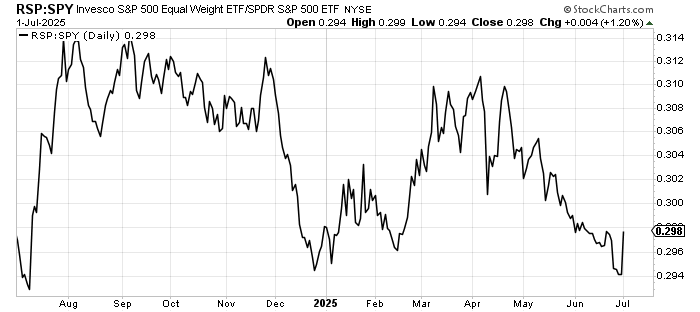
Why am I fussing so much over tennis when the market clearly responded as it should have when the RSP (equal weight S&P) clocked in a huge win vs the weighted S&P? Two reasons: first, Tuesday felt like a lot of big upsets in the market as the ‘seeded’ players (the index movers) got rocked and the down and outers emerged.
But didn’t we just see this a month ago? In fact, a month ago I even said this tends to happen late in a rally, when folks buy the laggards. And sure enough, what happened? The 493 popped, dropped, and lagged once again.
So that brings me to the second point: can the rally last this time? I think it has more than a day in it because last time the ratio wasn’t bouncing off a low. But at the same time, I fret that the rally will be more like the tennis grass season (short) and less like the hardcourt season (long).
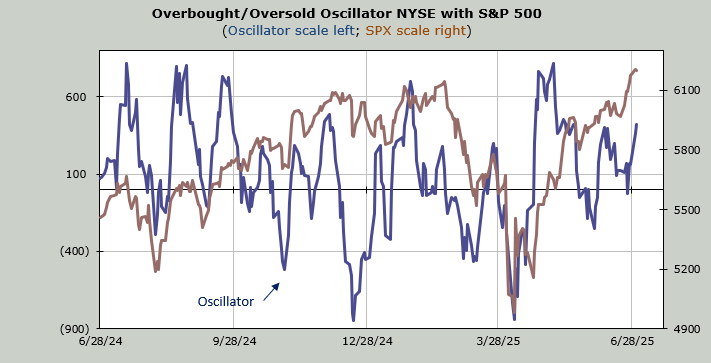
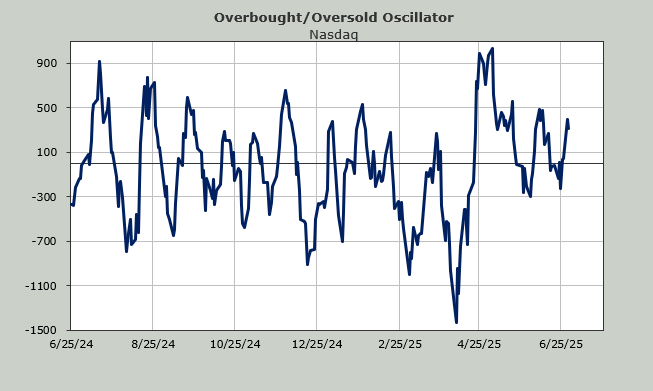
There was very little change in the indicators on Tuesday. The new highs don’t tend to expand when the down and outers rally. And sentiment did not change an awful lot either. Heck, with the S&P and Nasdaq in the red, the Daily Sentiment Indicator (DSI) notched down a few pegs, to 79 for both of them.
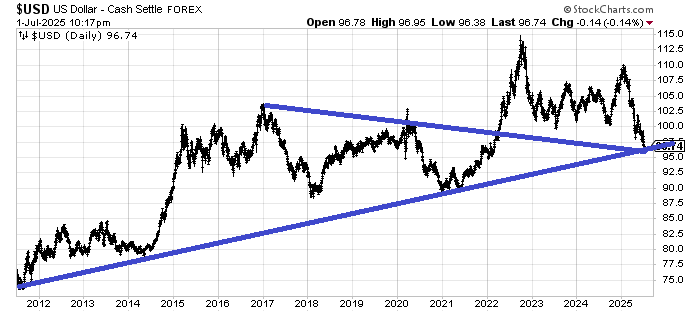
But there is one DSI reading that fell into what I call the yellow zone. Under 15 and over 85 are yellow zones, while single digits and over 90 are red zones. On Tuesday, the US Dollar’s DSI fell to 15.
I know the chart looks awful, but long term, there is quite an uptrend line here, and I cannot get it out of my head that the buck should bounce. Maybe it will just be the grass season type of bounce, but if that DSI gets to single digits, I’d bank on a hardcourt season type of bounce.