A Big Trade-Off
As Trump gives his '104%' in the tariff war with China, where will this end -- and where will the Ten-Year Note, and Apple, go? Also, let's chart the S&P 500.
You've reached your free article limit
You've read 0 of 1 free Pro articles.
While you were sleeping, the Trump administration's schedule of new "reciprocal" tariffs went into effect on imports from 86 countries. These tariffs range from 11% to 84% are on top of the base tariff rate of 10% that had been implemented over the weekend and also on top of any other tariffs that might have already existed. Imports from mainland China will now face a total tariff of 104%, reflecting the 20% fentanyl-related tariff that had already been imposed, a 34% "reciprocal" tariff, and the 50% tariff that had been added on in response to Beijing's response, which was an additional 34% tariff on U.S. exports to that nation.
On the rapidly deteriorating trade relationship between the two largest economies on the planet, U.S. Treasury Secretary Scott Bessent commented on Tuesday: "I think it was a big mistake, this Chinese escalation, because they're playing with a pair of twos. What do we lose by the Chinese raising tariffs on us? We export one-fifth to them of what they export to us, so that is a losing hand for them.”
The Chinese Commerce Ministry responded with a statement. According to a CNBC's translation, that statement read: “The U.S. threat to escalate tariffs on China is a mistake on top of a mistake. China will never accept it. If the U.S. insists on its own way, China will fight to the end.”
How long will this condition last? How much time do you have? Financial markets reacted in a mostly negative fashion around the planet as the costs of doing business in the U.S. and accessing the world's most aggressive consumers, just increased exponentially.
What The...?
Perhaps the most violent reaction was visible in the market for U.S. Treasury debt securities, which had appeared to have been a safe haven asset until this week. As I work on this column through the zero-dark hours on Wednesday morning, I see the U.S. Ten-Year Note yielding 4.35%. That specific instrument paid as much as 4.49% overnight and as little as 4.29% ahead of the open on Tuesday morning. On Friday, U.S. Ten-Year paper, at one point, paid just 3.88%.
Keep in mind that this afternoon, the U.S. Treasury is set to auction off $39 billion worth of Ten-Year Notes and on Tuesday, ran a sub-par auction of $58 billion worth of Three-Year Notes. The high yield awarded of 3.784% tailed the "when issued" by 2.4 basis points as the bid cover ran light. The story there, oddly enough, was an increase in demand from "Indirect" of foreign bidders and a collapse in demand from "Direct" or domestic bidders that forced dealers to eat 21% of the entire auction. That's the largest slice of this monthly pie that dealers had been stuck with since November 2023.
The severity of the move across U.S. Treasuries would suggest to me that perhaps either a very large fund (or more than one) had been put in the position where the raising of cash quickly had become a priority or that a foreign holder of U.S. debt had been "revenge" selling in angry response to, or anticipation of, the new tariffs. The increase in foreign demand at auction, however, throws some cold water on that idea. We'll probably know more about that, if that's the case when the much higher profile Ten-Year Notes go for sale early this afternoon.
Shake, Rattle & Roll
On Wednesday, most Asian stock markets fell sharply with the exception of stocks based in both Shanghai and Hong Kong, interestingly enough. The Reserve Bank of India cut its benchmark interest rate and an attempt to stimulate that economy as U.S. tariffs kicked in. That central bank signaled the likelihood of further policy easing as well. European stocks have now also opened lower as well.
U.S. stocks continued to trade in wildly volatile fashion on Tuesday. The S&P 500 popped for a gain of roughly 4% early in the regular session only to end up down 1.57% as Wall Street realized throughout the day that despite overtures by a number (as many as 70) nations, that even as negotiations may begin and may target a trade deal with the U.S., that there would be no delay and that the U.S. was moving ahead with those tariffs. This was confirmed by White House Press Secretary Karoline Leavitt during the session, adding to the pressure.
As the S&P 500 closed in on bear market territory, the Nasdaq Composite closed down 2.15% after having been up 4.5% early. U.S. Trade Representative Jamieson Greer, who spoke at a U.S. Senate hearing, commented that the Trump administration would not be issuing any tariff exemptions as they had during this president's first term. That was like a dagger through the heart of Apple AAPL stock as Tim Cook had successfully sought tariff relief at that time and was thought to be pursuing such relief again at this time. AAPL gave up 4.98% on Tuesday and is now down 23% over four trading days.
Across the major to mid-major equity indexes, semiconductor stocks were slapped around the hardest. The Philadelphia Semiconductor Index surrendered 3.57% on Tuesday led by ON Semiconductor ON, Intel INTC and Microchip Technology MCHP as those three names gave back 8.9%, 7.4% and 7.2% respectively. The Transports and small to mid-cap indices all under-performed the broader marketplace.
Bad Breadth
Not so minty. No, not at all. On Tuesday, all 11 S&P sector SPDR exchange-traded funds closed the daily session in the red, with the Materials XLB, the REITs XLRE and Consumer Discretionaries XLY down the most. The Financials XLF only gave up 0.39% on Tuesday as yields moved higher.
Losers beat winners on Tuesday at the NYSE by more than 3 to 1 and at the Nasdaq by a rough 7 to 2. Advancing volume was just trounced by declining volume across the listings of both exchanges, taking an 18.3% share of the action across names domiciled up at Times Square and 12.1% of total trade across names domiciled at 11 Wall Street.
Silver lining? Aggregate trade ebbed somewhat. Trading volume across NYSE-listings decreased by 12.1% on a day over day basis as volume contracted by 15.9% across Nasdaq-listings. Does that mean anything?
It could. It could mean that sellers are becoming exhausted. By that, I mean less willing to keep selling, not physically tired. We already know that much of the market has already been de-levered. This could indicate that when leverage is once again extended, it might be in a bullish type deployment of capital. That does not mean that this happens soon.
The S&P 500
I want you to take a look at this, because so far throughout this selloff, we've called a near-perfect game. Not that I have traded the environment perfectly, but the charts have been spot on. We see the bear flag and the two-day "day one" that were highly accurate. It's amazing how much easier charts are to interpret now that Wall Street has removed humans from the equation. That pains me to say, but the uniformity in algorithmic design is now their vulnerability. We take advantage and they don't even know we're here, picking them off.
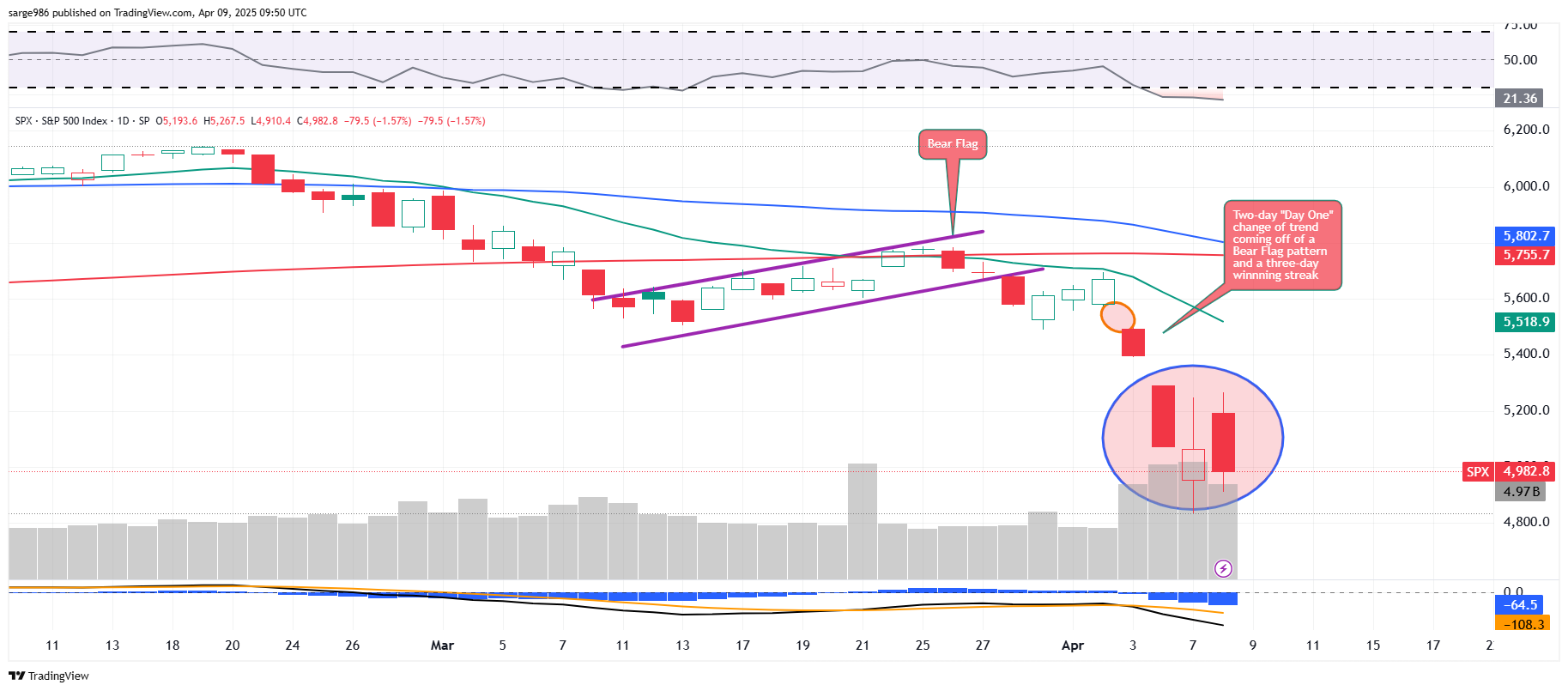
Now, it appears that the S&P 500 is trying to build what's known as an "island bottom." This is when prices gap lower and then trade sideways for a few sessions. At some point, within a few days, markets try to gap higher, leaving a visible "island" in their wake. This is typically caused by an exhaustion of sellers as I have described above.
That island is usually characterized as a period of elevated trading volume (which we have here). The catch, if there is one, is that while tradeable, this development does not necessarily indicate a long-term change in trend. The move higher can be short-term. Keep that in mind as you traverse this difficult environment. Adapt to what you are offered. Force nothing. Alright, it's getting late. I see the 6 a.m. hour approaching on the East Coast. I've got to tend to the rest of my job. Good luck today, gang. We are.... always faithful.
Economics (All Times Eastern)
07:00 - MBA 30 Year Mortgage Rate (Weekly): Last 6.7%.
07:00 - MBA Mortgage Applications (Weekly): Last -1.6% w/w.
10:00 - Wholesale Inventories (Feb-rev): Flashed 0.3% m/m.
10:30 - Oil Inventories (Weekly): Last +6.165M.
10:30 - Gasoline Stocks (Weekly): Last -1.551M.
1:00 p.m. - Ten-Year Note Auction: $39B.
The Fed (All Times Eastern)
12:30 - Speaker: Richmond Fed Pres. Tom Barkin.
2:00 p.m. - FOMC Minutes.
Today's Earnings Highlights (Consensus EPS Expectations)
Before the Open: DAL (.44)
After the Close: CALM (10.91)
At the time of publication, Guilfoyle had no position in any security mentioned.