Who Wants to Be a Millionaire?
You can be a millionaire! It just takes time and diligent savings.
You've reached your free article limit
You've read 0 of 1 free Pro articles.
(updated on 5/25. I incorrectly said that $70,000 over 30 years is $210,000, when it should have been $2,100,000. Sorry!)
In "How Much Will You Spend Each Year in Retirement?" we learned that if you’re making $100,000 a year before retirement, you’ll spend around $70,000 per year once you're retired to maintain your standard of living. Why is it less? You won’t have to pay income taxes on your salary!
But where will you get $70,000 per year? After all, once you stop working, you no longer have an income.
It comes from your own savings!
But how?
If you’re currently working, you might have access to something called a 401 (k). A 401 (k) is a tax-advantaged retirement account that lets your money grow either tax-deferred, where you pay the tax when you retire, or tax-free, in a Roth 401 (k) that uses money you’ve already paid income tax on.
The good news is that you can become a millionaire. Well, it's not easy, but if you're willing to save some money every month, you can.
To illustrate this easily, let’s create a best-case scenario that will give you much more money than you need.
First, you’ll retire at age 65 and have 30 years to support yourself. So, you’ll need $70,000 to spend in each of the 30 years. That's $2,100,000, which is a lot of money!
Second, let’s say that you’re using a Roth 401 (k) and don’t have to worry about taxes. You also liquidate the account on your 65th birthday and have a pile of cash.
Third, when you invest the money, you'll earn a conservative 6% from a mutual fund portfolio that owns stocks and bonds. Stocks return an average of 8%-10% per year, so this is very realistic.
Earny Asks:
The current maximum that you’re allowed to put into a 401 (k) each year is $23,500. If you’re lucky enough to be able to save that much each year from when you’re 25 until you retire, you’ll have saved $940,000. But remember that you’re investing this money and it will compound, just like it did for the vampires.
Earny Asks: If you put $23,500 each year into your 401 (k), how much will you have when you retire, assuming that your portfolio earns a 6% annual return?
- $940,000
- $3.9 million
- $2.1 million
- $165,440
Answer
This question is pretty similar to the vampire question from a couple of weeks ago.
There are some differences. For one thing, unlike Vlad the Impaler, we didn’t start with a pile of cash. We invested more money each year from what we earned at our jobs. Another thing is that we didn’t spend any of this money. We let it ride, through the ups and the downs.
In fact, down markets were our friend. They let us buy stocks and bonds when they were on sale. Don’t fear down markets when you’re still saving.
The other thing is, saving $23,500 isn’t totally realistic for everybody. It may be more than you make, especially when you’re young. A more realistic question might consider that you’ll start investing small, maybe $5000 or $10,000 in the early years, and then ramp up later on. We can do that in a future question of the week.
So, how much money did we end up with? Remember, we’re planning to need $2,100,000 to support us after retirement.
Saving $23,500 for 40 years and earning an average return of 6% means that we’ll have $3.9 million at retirement. Boom! That’s a lot of money.
How did I calculate that? There are two ways.
First, in a spreadsheet, I can use the Future Value function. My inputs are:
Rate: 6%
Number of Periods: 40
Present Value (Starting value): 0
Payment (yearly investment): -23500 (why is it negative? Because it’s money coming out of my pocket and going into my retirement account. It’s just how Excel works.
Hit enter, and you'll see that the correct answer is $3,855,121.
Second, I can build out a big spreadsheet like this.
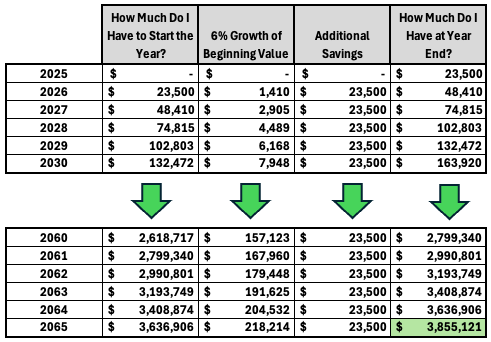
I did basically the same thing for Vlad's wealth. This time, however, I added another column for "Additional Savings," which represents the money you could save each year.
Again, I know it's not realistic to save $23,500 in a year, especially when you're young. It's more likely that you'll start off saving a lesser amount and then increase it as you receive pay raises. And, when you're in your 40s or 50s, the maximum amount might even be higher.
The takeaway from this week's question is simply that you can do it. Even if you save just $500 a month, you'll be a millionaire by the time you retire.
So, get started today!