Tracking Your Trading Stats Is a Game-Changer for Investors
Here's why it matters, the stats you need to track and how to make these stats work for you. It’s your roadmap to better performance.
You've reached your free article limit
You've read 0 of 1 free Pro articles.
Tracking your trading stats isn’t just smart — it’s the key to unlocking better performance by revealing the exact moves that can transform your strategy and boost your returns.
Why It Matters
If you’re a stock trader or investor who doesn’t track your statistics, it’s like being a baker without measuring cups — you might eyeball some flour and sugar, but without measuring the ingredients, you’ll end up with a mess.
The Stats You Need to Track
In a long-only stock portfolio, there are only a handful of actions you can ultimately take: enter a new position, add to an existing position, reduce an existing position, or exit a position altogether. For each, there’s the question of “how much.” To answer that and get better results, you need to track these stats.
- Your Win Rate: This is your percentage of profitable trades. A higher win rate shows how often you’re picking winners — aim for improving this as much as you can. But keep in mind some of the best investors are right 60% in the stock-picking world.
- Expected Risk-to-Reward Ratio: Your potential gain versus loss. Top traders like Mark Minervini and Stan Druckenmiller target at least 2:1 — but shoot for much higher, well above 3:1 — so losses don’t wipe out your gains.
- Actual Gain vs. Loss: Your average gain on winning trades versus your average loss on losing ones. If your gains aren’t at least 1.5 times your losses, you need to rethink your approach. You may need to cut losses or let your winners run or re-evaluate your time-frame.
- Length of Time in Winners vs. Losers: The number of days you hold winning versus losing positions. If you’re holding losers too long, you’re likely missing out on bigger wins — cut them faster.
- Drawdown: The maximum percentage decline in your portfolio from peak to trough. Keep this below 20-30% to protect your capital and recover quicker from rough patches. If your drawdown is too large, look at smaller position sizes and more diversifying your universe or scaling in and out of positions over time.
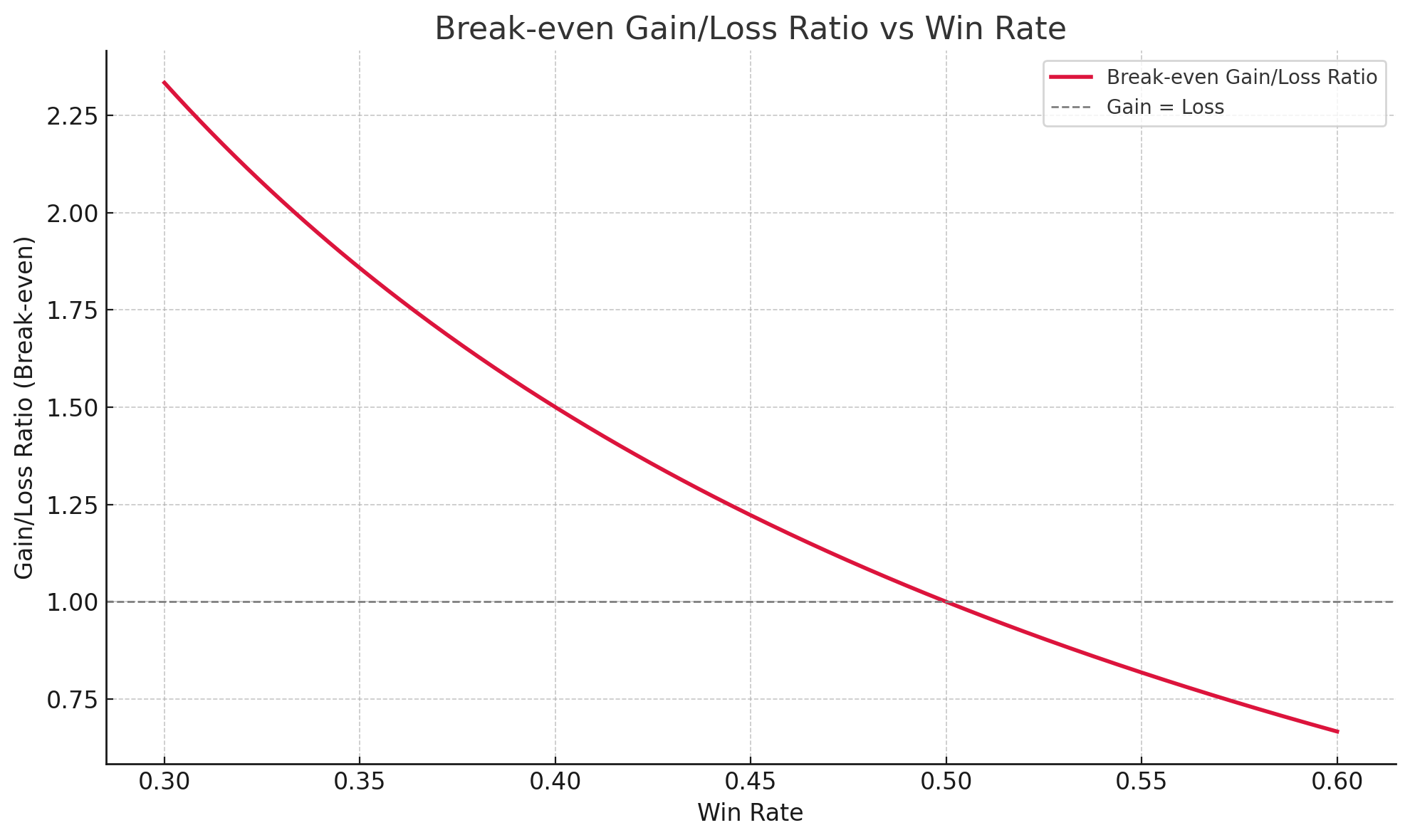
Know Your Break Even Win/Loss Ratio and Win Rate
- If you're only winning 30% of the time, you need to win ~2.33× more than you lose per trade.
- As Win Rate increases, the required Gain/Loss Ratio drops rapidly.
- At 50% Win Rate, you break even with a 1:1 Gain/Loss Ratio.
Here’s is a break-even graph showing the required Gain/Loss Ratio to achieve zero expected return at different Win Rates (30% to 60%).
How to Adjust Your Strategy When Markets Change
One of the hallmarks of great trading is the ability to adapt your method for changes in market conditions. Here are some tactical changes to strive for:
- Bull Markets with Low Volatility: Hold longer term and increase position size.
- Bull Markets with High Volatility: Hold longer term and reduce position size, and possibly increase the number of holdings in your portfolio.
- Sideways Market with Low Volatility: Shorter time horizon with quicker exits and tighter risk management rules.
- Sideways Market with High Volatility: Shorter time horizon with quicker exits, reduced position size, more holdings.
- Bear Market: Universe selection more conservative, smaller position sizes and lower overall exposures.
What’s Next
To make these stats work for you, revisit the raw elements of your stock trading. Look at your past trades, measure these metrics, and figure out what levers to pull —whether it’s improving your investment universe, tightening your entries, adjusting position sizes, or monitoring fundamentals more often, or exiting faster when your original thesis is no longer in play.
Tracking your trades isn’t just data—it’s your roadmap to better performance.
Now that the first quarter is finished in 2025, it is a great time to take stock of your actions in the past three months and find ways to improve.
Let me know your thoughts and feedback and follow for more.
Happy trading!