The Smart Way to Sell a Big Stock Position Without Getting Crushed by Taxes
Here's how to reduce your exposure to a concentrated position and avoid a common mistake.
You've reached your free article limit
You've read 0 of 1 free Pro articles.
If you’ve built up a big position in your company stock or any stock for that matter, you’re probably faced with two competing realities.
On one hand, you feel great about the wealth you’ve built on paper, but on the other, you know you’re carrying too much risk in one company. The catch is that you could pay a massive tax bill when you sell it. This makes it very tempting to hold on.
The problem is, even the greatest company can stumble. Concentrated stock positions often fall much faster than they rise. I’ve seen many people lose millions of dollars because they waited too long because they didn’t want to pay taxes.
Here’s a smart way to reduce your exposure to a concentrated stock position to avoid this mistake so you can manage both risk and taxes.
Why This Matters
- Risk: A single stock should never dictate your financial future.
- Taxes: Selling all at once is painful, but waiting can be worse if the stock drops.
- Goals: Diversification lets your portfolio work for retirement, education, or legacy— not just one company.
Smarter Ways to Diversify
Traditional tax-loss harvesting, which seeks to take losses to offset gains in a long-only portfolio, can help in some cases, but if your cost basis is very low, it may not be enough. That’s where advanced strategies come in.
A long/short overlay can create opportunities to harvest losses consistently, no matter what the market is doing. It can also help you continue to grow capital and diversify your holdings.
Here’s How It Works in Simple Terms
- In rising markets, the short positions lose money — those losses can offset gains when you sell down some of your concentrated stock.
- In falling markets, some of the long positions lose money — again, you can use those losses to offset gains.
- Either way, you generate a steady stream of tax offsets while gradually selling your concentrated position.
This structure makes it easier to chip away at a large, appreciated stock position without triggering a crushing tax bill all at once. It also reduces the risk of being overexposed to a single company while you transition into a portfolio built for your long-term goals.
Explanation of a 130/30 Long/Short Tax Strategy
Here’s a practical example of how this works. Let’s say you have a $1,000,000 stock position in META with a cost basis of $0. That means you’re sitting on a $1,000,000 potential capital gain that could be taxed.
If your manager constructs a 130/30 strategy, you keep your $1,000,000 META holding, then use margin to invest an additional 30% — or $300,000 — in highly attractive stocks, while shorting $300,000 of stocks expected to underperform.
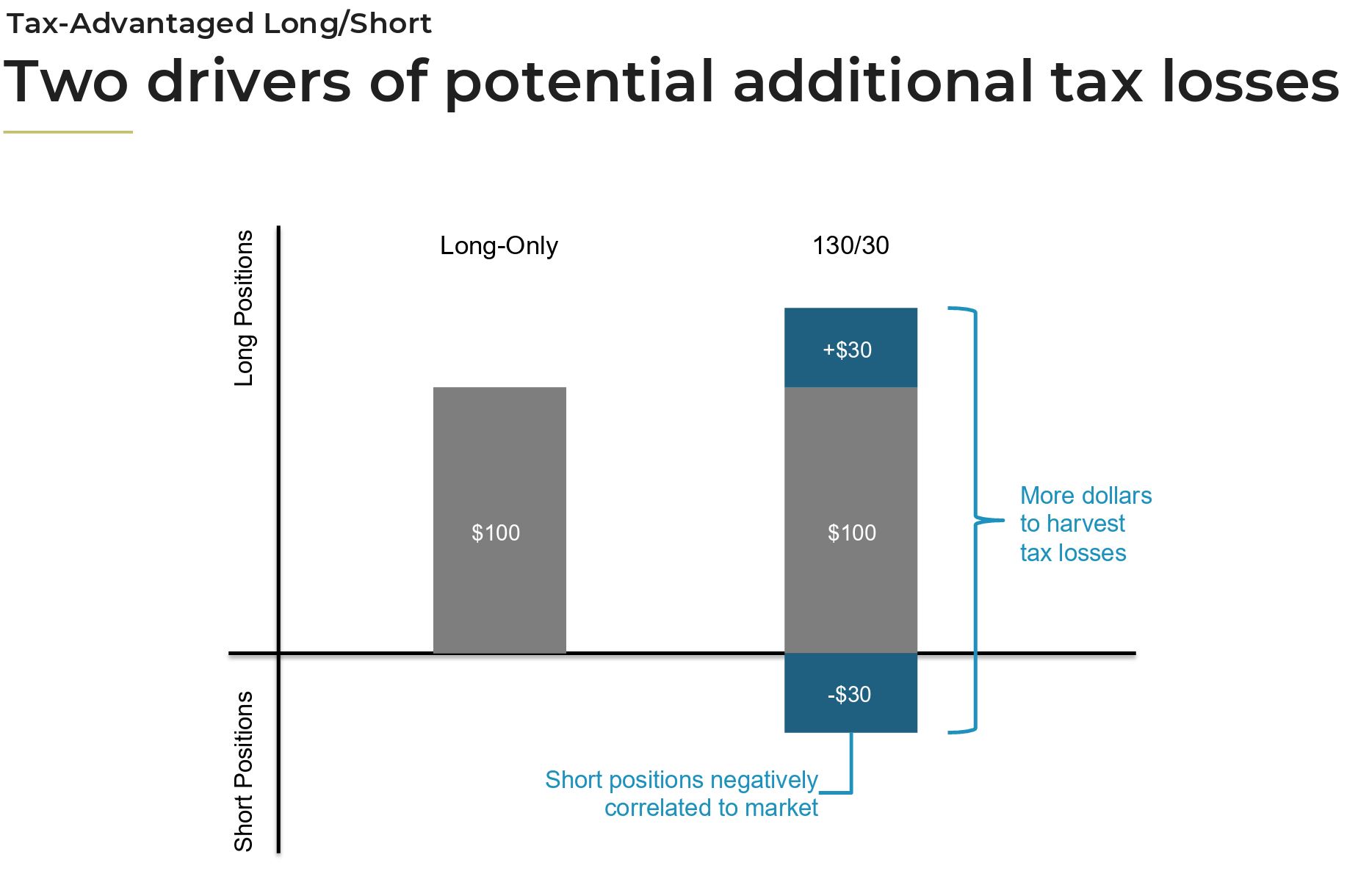
This structure creates the opportunity to generate losses whether the market goes up or down. If the market rises, some of the short positions will produce losses. If the market falls, some of the long positions will. Those losses can then be harvested and used to offset gains as you sell down part of your META position.
In some cases, this can even make the sales tax neutral. The proceeds can then be reinvested into a diversified portfolio, while the manager rebalances the long/short overlay to keep the portfolio market neutral.
Transitioning to the Right Portfolio for You
This approach allows you to move out of a concentrated stock position more quickly into a customized portfolio aligned with your long-term goals while reducing risk and saving significant money in taxes.
The tax savings can be substantial. For example, a high-income investor in California could face 20% federal long-term capital gains tax, 3.8% in Net Investment Income Tax (NIIT), and up to 13.3% in state tax. That’s a combined rate of 37.1%, or $371,000 in taxes on a $1,000,000 META position. And if META keeps going higher, the tax bill only grows.
The Bottom Line
Holding a big, highly appreciated stock position feels good until it doesn’t. Taxes shouldn’t be the reason you stay overexposed to one company.
With the right strategy, you can sell down, capture consistent tax advantages, and move toward a portfolio that gives you true financial security.
If you have any comments or question, hit me up in the comments.