Revenge of the 'Dumb Money' Nerds?
I have a theory on why groupthink might be infecting so many otherwise bright people with the urge to sell, not buy, at extremely cheap prices. And we'll see soon what Warren Buffett did.
You've reached your free article limit
You've read 0 of 1 free Pro articles.
Being a contrarian investor is never easy.
You will, by definition, be defying the current mood of the crowds. In addition, you will be doing the opposite of what most media ”talking heads” are recommending.
Mom and Pop investors have traditionally been labeled “dumb money” as many times they panicked out when the pain got too severe, going to cash only after major damage had already occurred.
Perhaps now, they have finally learned enough to be taking a different approach.
The weekend edition of the Wall Street Journal contained the following headline article.
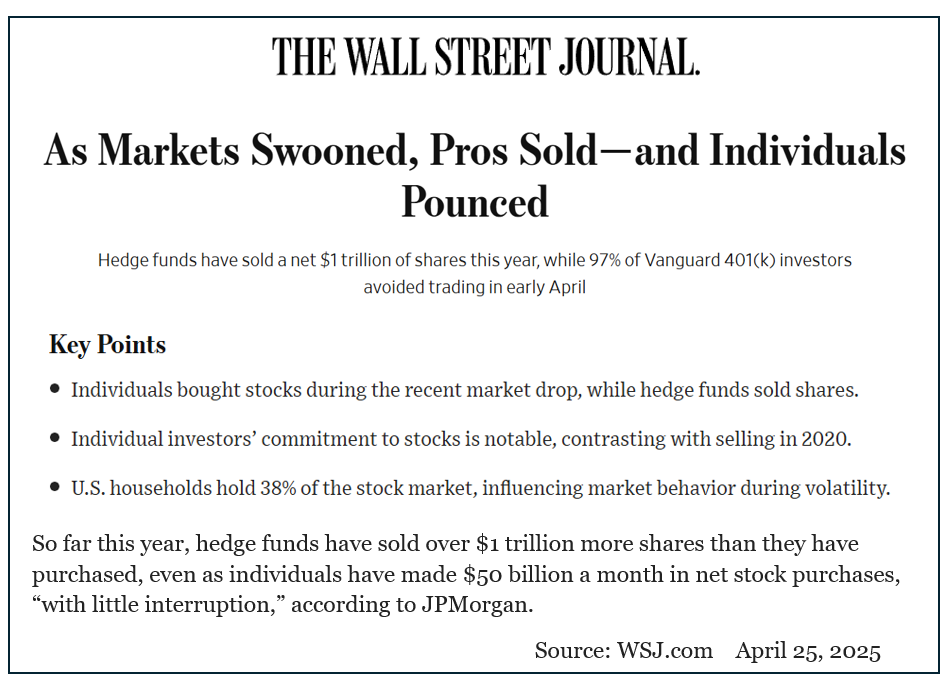
It noted that professional money managers were huge sellers of equities during the recent melt-down while individuals were snapping up shares in retirement accounts. That was in stark contrast to what happened during the Covid panic of 2020.
Financial planners, who are supposed to be providing guidance to less savvy individuals, were worse than useless back in late 2019 and right through 2020.
During November and December 2019 the broader market was quite expensive. As of year-end 2019, though, planners had average equity-based asset allocations of almost 63%.
Stocks cratered during March 2020 as the Covid panic mindset dominated. As it turned out, Mar. 23, 2020 was the final nadir for the S&P 500 even though the government-imposed business, school and church shutdowns had just begun.
“Two weeks to slow the spread” morphed into months of closed restaurants, stadiums and various other “non-essential” activities remained restricted.
As of March 31, 2020, financial planners’ client asset allocations to equities were down to just 35.3%, a 43.89% decline from December 31, 2019.
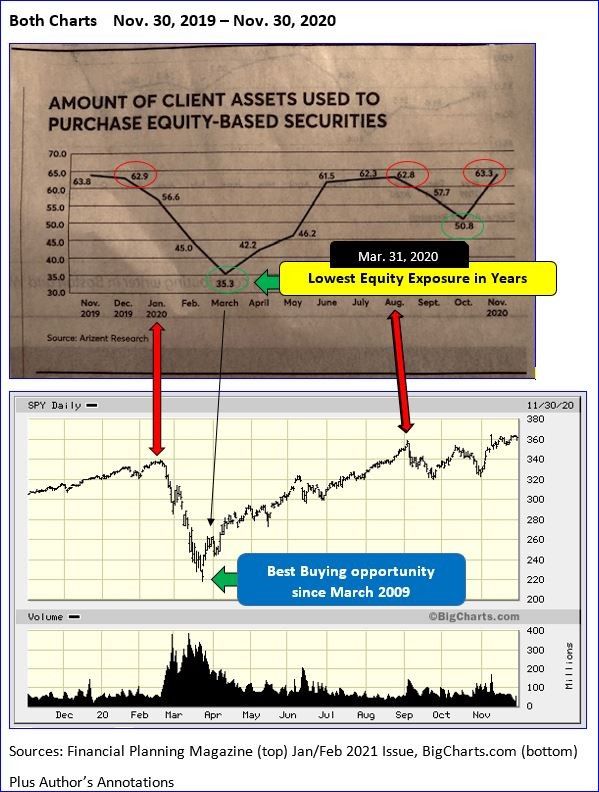
When most stocks were insanely depressed and ready to surge higher IRAs and 401(k)s were vastly underweight equities.
Berkshire Hathaway BRK.A BRK.B, run by legendary investor Warren Buffett, completely missed the boat along with many other supposedly knowledgeable people. When CNBC’s Becky Quick interviewed him in April 2020 viewers were dying to know what bargains were bought at rock bottom prices.
Instead, Berkshire was a net seller of stocks in the quarter ended March 31, 2020, pushing the company’s cash pile to about $280 billion.
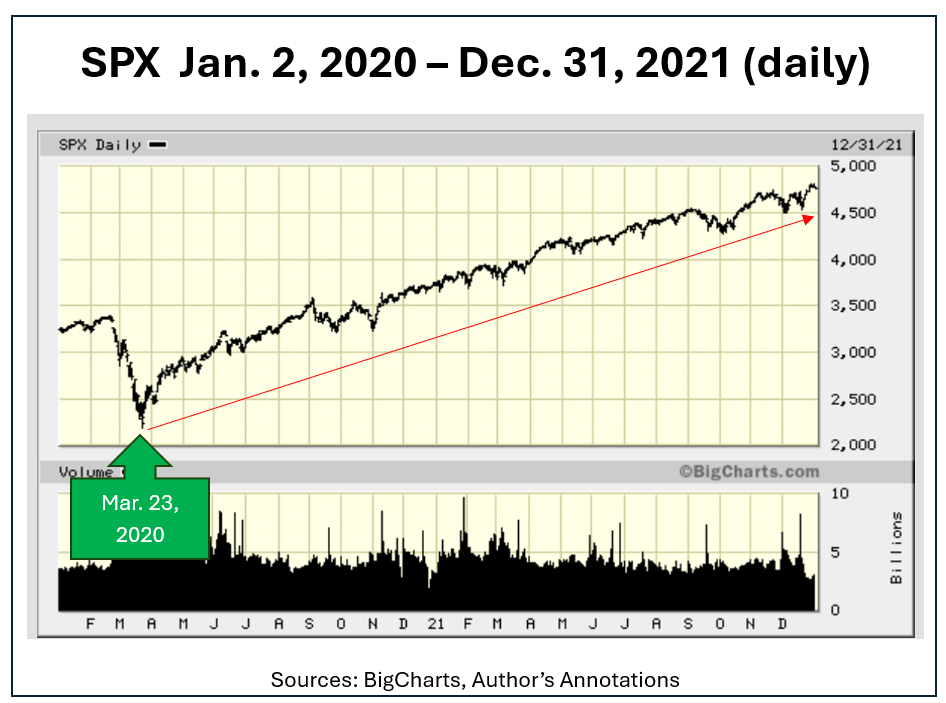
In fact, Berkshire continued to raise cash for about 1.75 years after the Covid crisis while the market surged much higher.
Recently, in 2025, Berkshire’s cash hoard had reached around $380 billion.
Once again the world is eagerly awaiting Berkshire Hathaway’s annual meeting on Kentucky Derby day (May 3, 2025) to see if Berkshire bought during the tariff policy-induced market selloff or not.
If they did not, they would be in concert with most professional money managers this year.
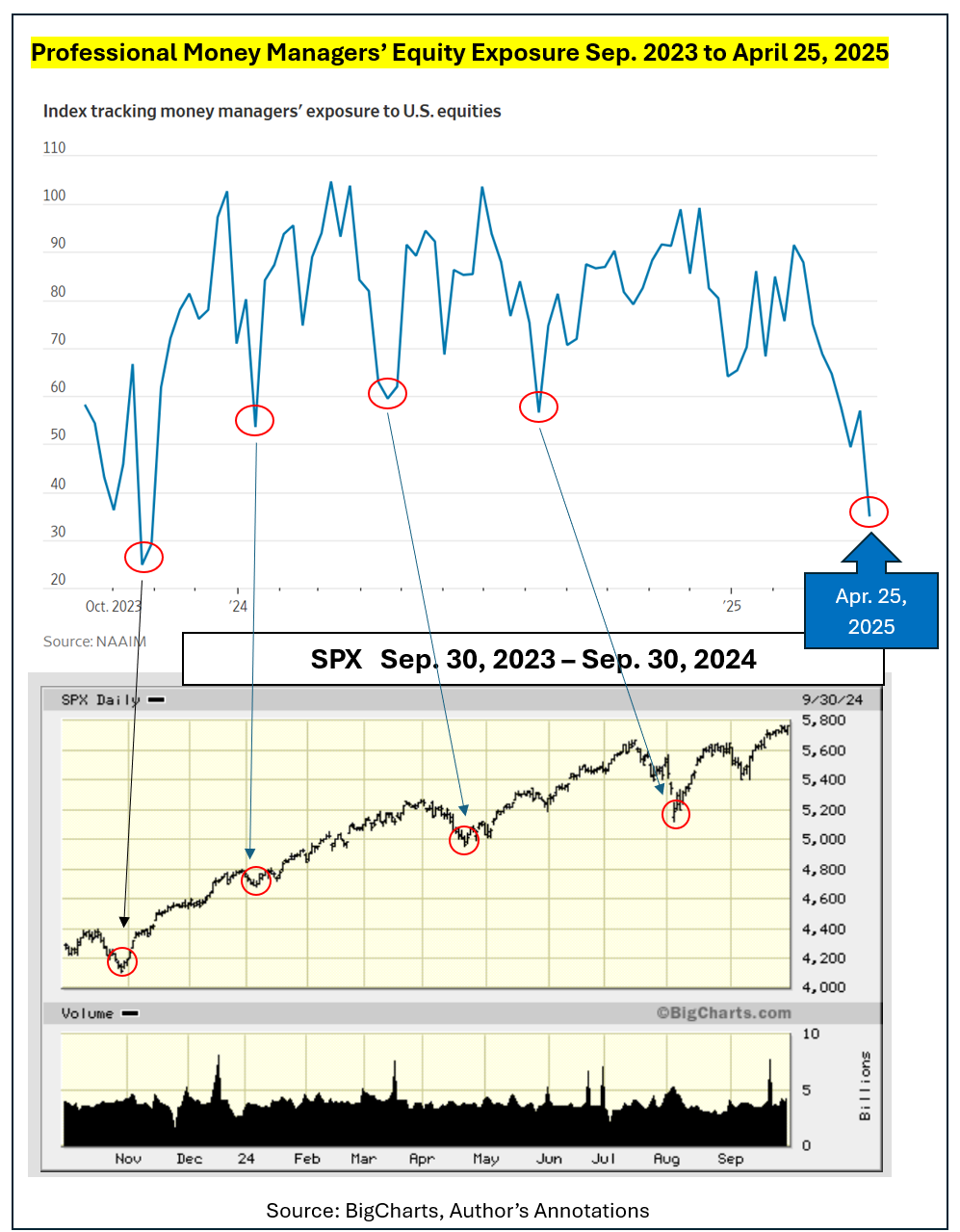
As of April 25, 2025, those sophisticated entities held their lowest percentage of stocks since the late October 2023 period.
That proved to be extremely costly to them as the S&P 500 rose dramatically from there over the coming year as documented in the chart below.
Professional equity managers were caught with meager stock allocations the three other times when the markets pull backed along the way to fabulous 12-month returns.
I have a theory on why groupthink might be infecting so many otherwise bright people with the urge to sell, not buy, at extremely cheap prices.
It could all be AI (artificial intelligence) related.
Many of the largest money managers have purchased AI-directed programs that automatically and instantaneously trade for them without human intervention. Those programs monitor headline news and react immediately to it by dumping, shorting or buying shares before non-owners of their software can trade.
Many institutions own identical, or similarly programed, AI trading apps. That means they are all taking the same actions simultaneously. And all without human thought involved which would slow the reaction time.
No wonder we're seeing so many huge intra-day and day-to-day swings of 1% to sometimes 5% to 10%. A hint of a tariff settlement with China might trigger the largest single-day rise in history as multiple AI directives to buy come in over milliseconds.
After a down Monday last week, the S&P jumped by over 1.5% during each of the following three days.
Back-to-back-to-back gains of that magnitude had only occurred nine previous times since 1953.
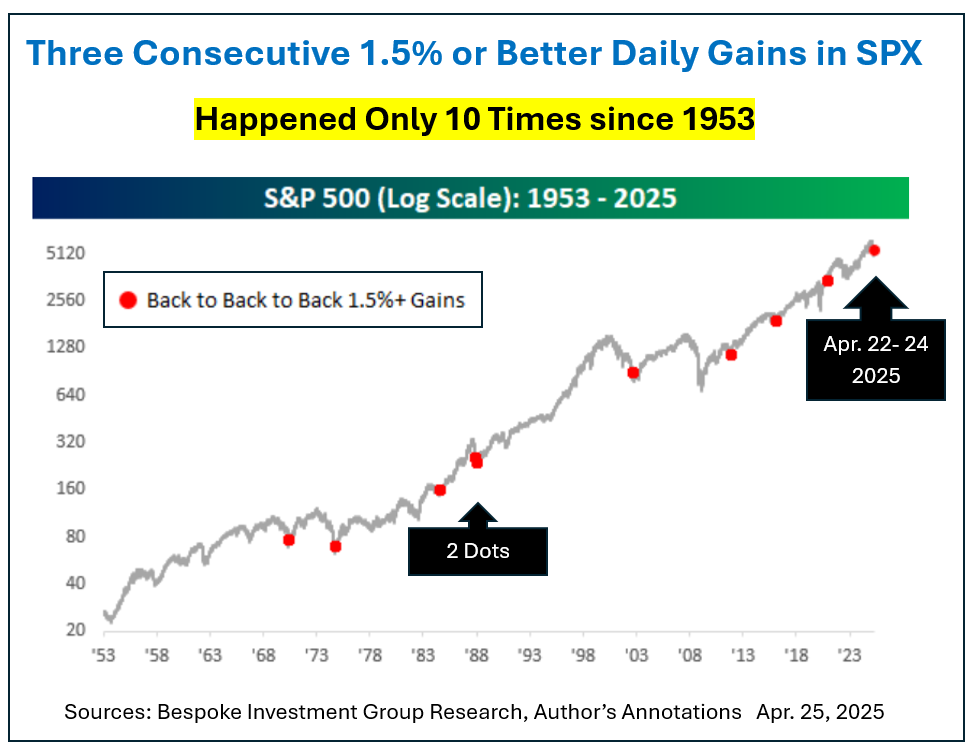
Every one of those gave way to significant market rebounds stretching over months or years, not just short upward blips.
History says the latest one could add to those streaks.
This time around it we might just be seeing the Revenge of the Dumb Money Nerds as they have been the ones doing the bulk of the buying while thinking long-term rather than short.
I have been a large buyer of severely beaten-down shares recently. My next articles will be detailing a few of my absolute best buys right now.
More Paul Price:
- Beware, or Profit From, Extreme Stock Market Deviations
- This Is the Single Most Important Factor in How Wealthy You’ll Be at Retirement
- What Traits Make a Great Stock Investor?
At the time of publication, Price had no positions in any index ETFs or mutual funds. His retirement and other personal accounts are close to 100% invested in individual equities.