Question of the Week: You Won't Go Broke Taking a Profit
This week's Question of the Week asks why we would sell a winning position that we have rated as a buy.
You've reached your free article limit
You've read 0 of 1 free Pro articles.
When I started my career as a trader on Wall Street, my mentor taught me one lesson: to let my winners run and to quickly sell my losers.
In other words, when I owned a good stock, I should hold onto it and let it continue to work. Losing positions should be sold before the loss gets too big.
A metaphor I like that makes this point is that you should invest like a gardener. Water your flowers, but pull your weeds.

So, I’m always interested to see when Chris Versace, portfolio manager of TheStreet Pro’s Portfolio makes a trade. And when he sells shares in a stock that remains highly rated, my interest gets truly piqued.
Back on May 20th, Chris wrote that he was selling shares in six different holdings.
One of those is ServiceNow NOW, which Chris rates as a 1, and means he thinks is a good stock to buy now.
Question:
Why would Chris sell shares in a stock that he likes?
ANSWER
Let's start with a little background information on TheStreet Pro’s Portfolio. It’s a professionally managed portfolio that usually includes around 25-30 stocks and sometimes a few ETFs. It’s a great example of a portfolio for people who like to do it themselves, rather than buy shares in an index fund.
Some subscribers might own the entire portfolio and mimic Chris’ trades. Others might pick only a few of their favorite stocks from among Chris’ list, while still others might only read the portfolio commentary for Chris’ expert opinions and analysis of the markets and the economy.
As for ServiceNow, it’s one of 25 holdings in the portfolio. The company calls itself an AI platform for business transformation, and I remember using it in a prior job as part of my employee portal. Basically, it’s an AI company that helps businesses be more efficient.
Chris publishes a monthly investment thesis for each stock in the portfolio. For ServiceNow, Chris wrote of expected growth in revenues which should help the stock continue trending higher. He also appreciates the company’s AI business will keep pricing and margins strong. In other words, the company is profitable and will continue to be a leader.
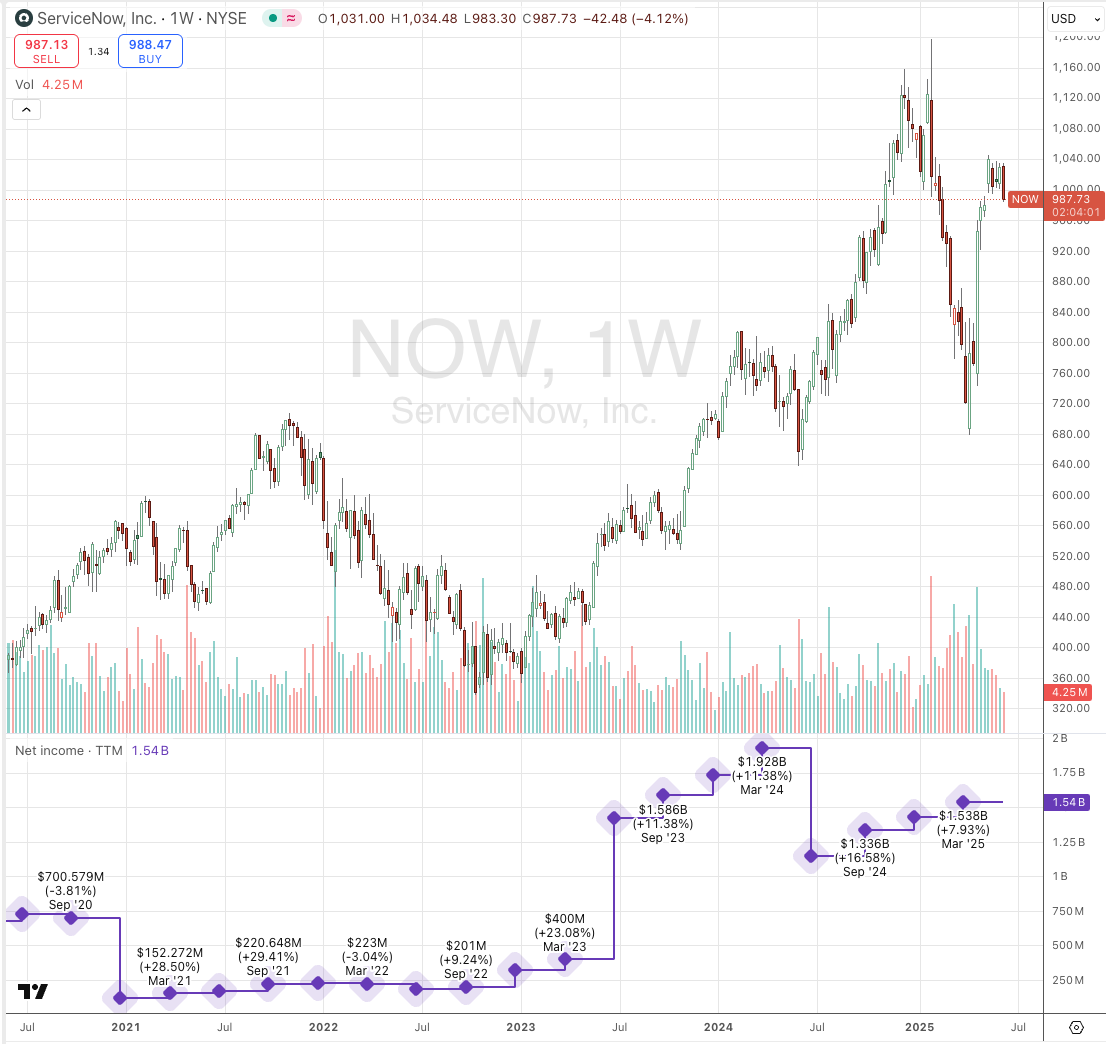
And, here’s a chart. The top panel is the stock price. It’s up almost 3x since late 2022. Earnings are shown in the bottom panel and appear to be growing.
So, why would Chris sell shares?
First of all, Chris had recently added new shares to an existing position as the market dropped in March on tariff concerns. Shares had fallen from $1100 to just $800 at the time. The majority of the shares that Chris sold in May were those new shares he had bought in March.
So this was just some profit taking on a really nice trade that locked in a quick 25% gain.
But there’s more.
Chris also wrote that he was getting nervous about the market as a whole and that it was time to raise money that could be deployed when the market presented new opportunities.
Basically, market risk was greater than the potential reward.
It’s not like Chris was selling everything; he was just lightening up in the hopes of redeploying his cash when the potential rewards were higher than the apparent risks.
Last, NOW is one of 25 holdings and Chris feels that no one single holding should be more than about 4% of the entire portfolio. At the time Chris made the sale, NOW’s weighting in the portfolio was above 4%, and the sale brought it back down to a 4% weighting.
To sum it up…
Chris is an active portfolio manager and a good analyst. He’s also a good role model for all of us as we manage our financial lives!
He decided to sell shares in ServiceNow for three reasons.
- To take profits on shares he had purchased near the market low
- To have cash to spend on new favorites if the market began to decline
- To trim his holdings so that NOW shares weren’t overweighted in his portfolio
My mentor had another saying. He told me that I’d never go broke taking a profit. Taking profits would allow me to take advantage of new opportunities.
So, to all of you, I say that you should let your winners run, but that when the time is right, you should also take profits. That way, you’ll maintain a properly diversified portfolio and be able to shop for the next round of winners.