Question of the Week #5: Are Dividends Good?
Dividends are an important source of an investment's return. But sometimes an investor would prefer not to receive a dividend.
You've reached your free article limit
You've read 0 of 1 free Pro articles.
There are generally two reasons why a person might start a business. The first reason is to make money. The second reason is that the person has the ability to make a product or provide a service that they think people want or need.
The two are related. In both cases, the person hopes to receive money in exchange for some product or service that they offer.
Once the business is started, and money is exchanged for goods and services, the business owner will have to pay suppliers, as well as employees, and other costs of doing business. Whatever money is left over is called profit.

Without getting into accounting specifics (I don’t want to bore either of us!), there are two things that can happen with profits.
For one thing, the company can keep the money and use it to grow the business. Maybe they’ll hire people to build a new product. Or maybe they’ll invest in research and development to try and leapfrog competitors with a big advancement.
The other thing that the company can do is to pay the money out to the owners of the business.
They might do this because the owners rely on the money. It might be one reason why they invested in the business.
Alternatively, the company might pay the money out because they can’t think of anything better to do with it right now. They’ve run out of good ideas!
Before we get to this week’s question, here’s a bit of terminology. When a company pays money to shareholders, we call this a dividend. Normally, the money paid comes out of earnings, but sometimes, it can be paid out of savings, too, if the earnings aren’t large enough.
Question:
The leadership of a high-growth company that has never paid a dividend decides to begin paying regular, quarterly dividends to shareholders.
What will probably happen to the stock price?
- It will go up!
- It will go down!
- Nothing.
Answer:
In the late 1990’s Microsoft was one of the hottest companies out there. In 1999, its stock price gained 68% on earnings that grew by 38%.
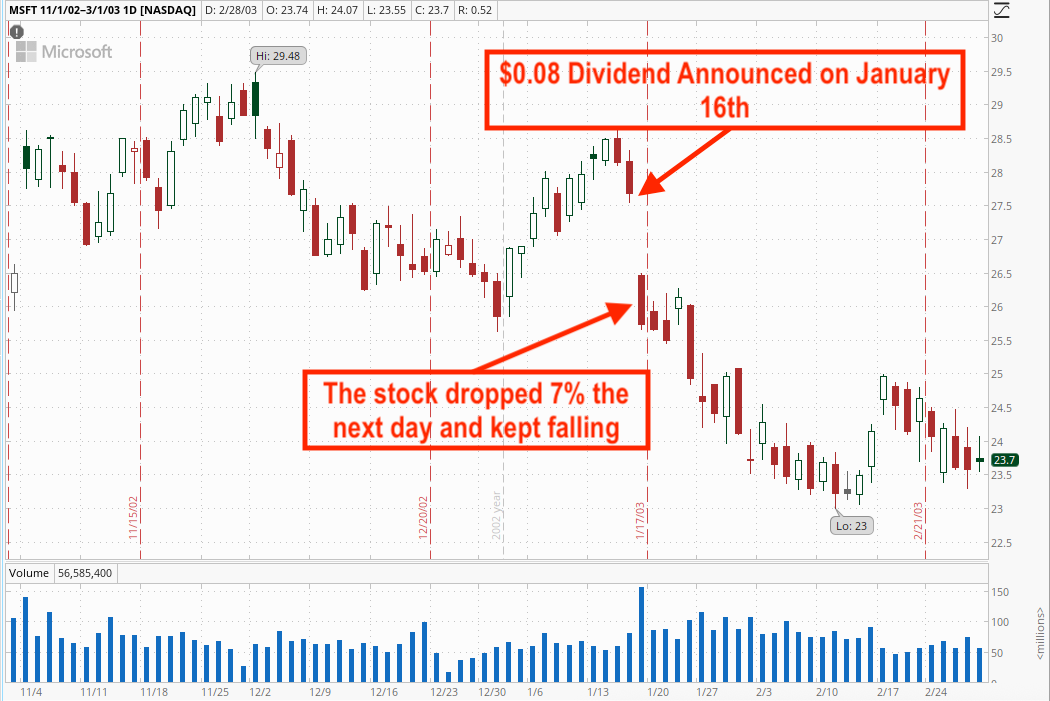
In 2003, the company decided to pay regular quarterly dividends to shareholders. That sounds like good news. I mean, if you like the company and own its shares, isn’t it nice that the company shares their extra money with you?
But the stock fell, and continued to drop.
Why?
Well, for one thing, it was during the tail end of the Dotcom Bust. All stocks were falling. But Microsoft fell harder and faster than the rest of the market.
By announcing a dividend, Microsoft was admitting that they didn’t know what to do with their money. They had money, but no good ideas for how to invest it.
Now, that’s not a bad problem. I wish I had too much money, and you probably do, too.
The thing is, a large subset of Microsoft’s investors had other ideas. These, so-called growth investors, were interested in owning the newest, hottest companies that were growing quickly.
Microsoft was still a good company, but they were no longer a fast grower. In fact, it would be another ten years before Microsoft shares were able to sustainably surpass the level they were at when the dividend was announced.
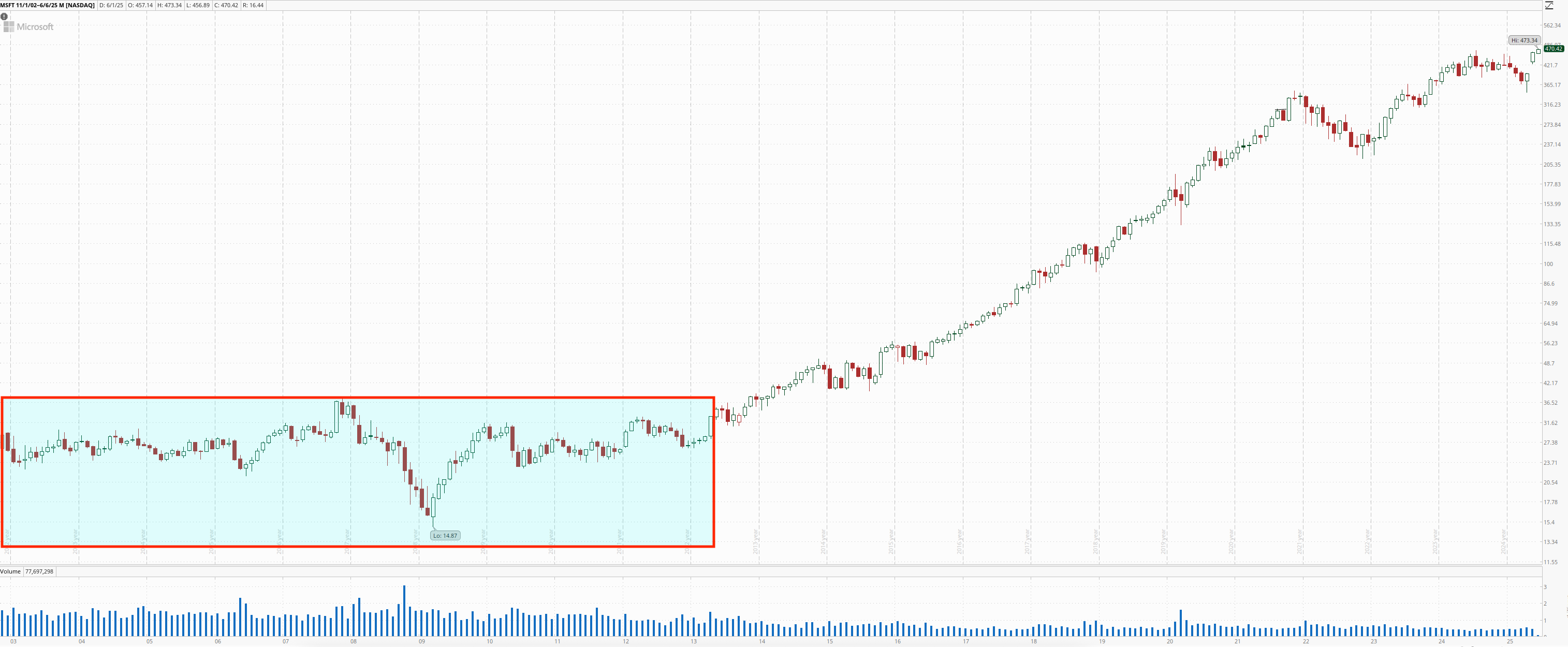
So, those growth investors, the ones who wanted to own the hot companies, sold Microsoft shares. The new buyers, value investors, were the type of investors that like to own slower moving, more mature companies. The kind that pay dividends.
You might think of it like this. Some people want to own risky assets that they think will soar to new heights. Other people want to own safer assets, that will protect their money while also offering a reasonable return.
When Microsoft no longer fit the bill for those risk-loving growth investors, they sold shares to the risk-averse value investors. The shares fell in price because those risk-averse investors are smart and don’t like to overpay.
It's like an investing tug-of-war.
You might look at that Microsoft chart above and think how silly it was for those investors who sold to have done so. But they had no way of knowing that Microsoft would recapture its glory and many of them have probably jumped back in to hold shares today.
Thanks for reading!