New Alibaba Price Target as Boosted AI Presence Attracts Attention
Fresh off its deal with Nvidia, Alibaba is rewarding investors who show faith in its long-term plans.
You've reached your free article limit
You've read 0 of 1 free Pro articles.
It’s the time to shine for Alibaba Group Holding (BABA) (HK:9988).
The shares of China’s largest e-commerce play have been on a high all year, doubling and more for a 125.2% advance in 2025. But they’ve gleamed particularly brightly over the last month, surging 58.3% since the end of August alone.
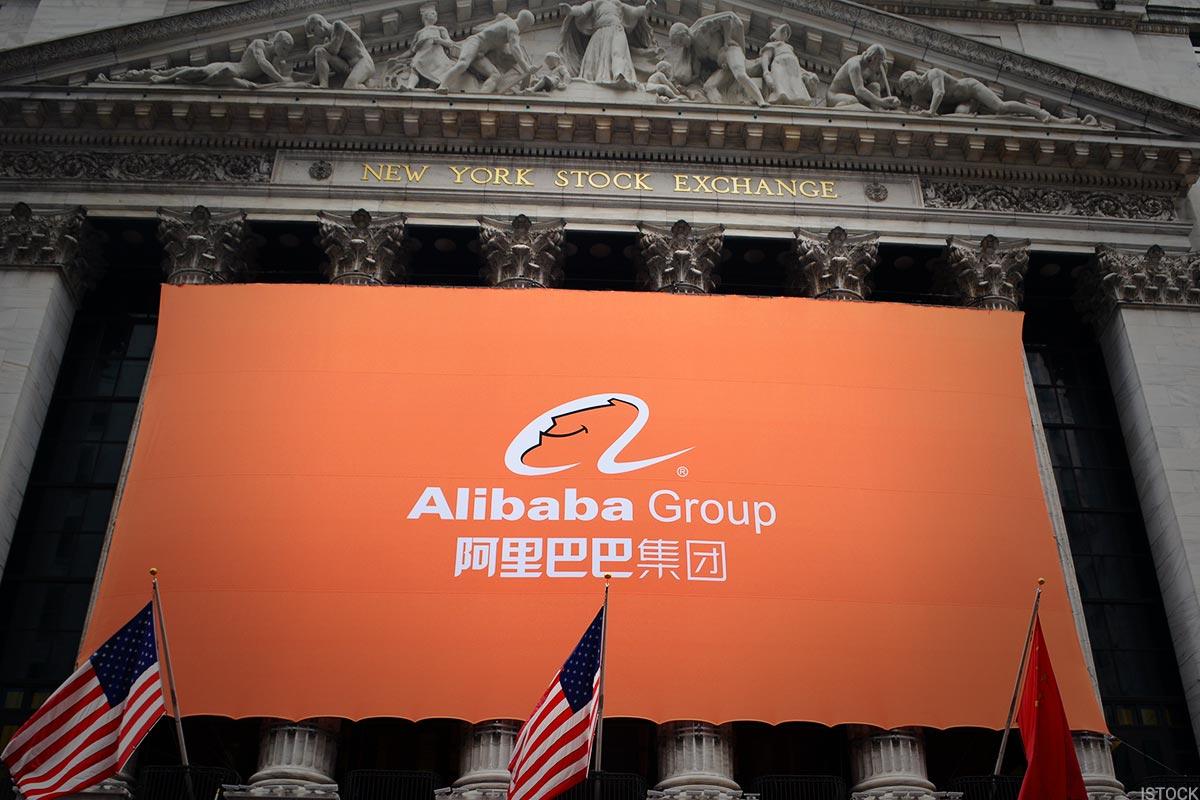
The company has historically been one of the top Asia plays for U.S. investors. But many lost faith in the stock during its time in the wilderness. Alibaba was the first target in what went on to become a multiyear assault on Chinese Big Tech from the Chinese Communist Party.
I flagged in a column in January that Alibaba was making inroads in Artificial Intelligence, stating at the time that the latest version of its Qwen AI model was producing results to outdo rivals from Deepseek and OpenAI. And it’s thanks to these initiatives as well as its forays into “quick commerce” that its shares are back on the advance.
Alibaba Shares Are Still Cheap
Our own James “Rev Shark” DePorre noted in May just how cheaply Alibaba trades compared with U.S. counterparts such as Amazon (AMZN) . Both are e-commerce giants that have also expanded into cloud computing. And while Amazon trades at a price-to-earnings multiple of 33.50, Alibaba was trading at just 15 back in May. Given this year’s runup, BABA now has a P/E ratio of 20.7, but that’s still a discount relative to AMZN, which has much the same multiple.
Back in May, analysts set a price target of US$240.37 for Amazon, an increase of 14% from its price at the time. It’s yet to hit that, now trading at US$221.79 as I write.
Alibaba, on the other hand, was set an average price target of US$167, a 26% increase from its price in May. It has already exceeded that mark, and more, trading at US$182.78 as of Wednesday’s close. It’s up another 4.6% Thursday as I write.
So it’s time for a fresh target!
New Price Target With Significant Upside
JPMorgan has now hiked its price target by almost 45%, to HK$240, from its Hong Kong close Thursday of HK$183.10. That call to hit HK$240 by the end of 2026 indicates upside of 31.1%.
(Although there’s some slight variation, the Hong Kong stock trades at roughly the same price as its U.S. equivalent, with one U.S. share worth 8 of the Hong Kong shares. One U.S. dollar is pegged at HK$7.78.)
The analyst, Alex Yao, is the same sector specialist who in March 2022 dubbed the Chinese tech sector “uninvestable.” Now he sees “significant room” for upside with Alibaba, notes that BABA is outperforming the sector “due to better-than-expected cloud revenue growth rate in 2Q25 and management’s confident articulation of its investment strategy in food delivery and quick commerce.”
Yao was right. China tech was uninvestable after the sector came under attack, an assault that began in October 2020 with the last-minute, embarrassing scrapping of a listing for Ant Group, the payment app Alipay’s parent. What should have been the world’s largest initial public offering on record instead became what I described at the time as a “Communist show of strength.”
Alibaba was slapped with a record C¥18.2 billion (then US$2.8 billion) fine for anticompetitive behavior. While investors hoped that would put the company's issues behind it, international investors fretted that there was no sign the Chinese Communist Party was done yet.
Above all, Chinese President Xi Jinping wanted to take Big Tech down a few rungs, and remind the sector who is really in charge. Alibaba figurehead turned lightning rod Jack Ma disappeared from public view, teaching at the University of Tokyo, traveling, and exploring agricultural technology. Only in March 2023 did he reappear inside China at the behest of Chinese Premier Li Qiang, confirming his rehabilitation.
How things have changed. Amid long-running signs of economic stagnation for China’s economy, President Xi is once again courting the tech industry. That support for the sector underpins Alibaba’s expansion plans, with the company last month cementing a partnership with Nvidia (NVDA) , and upping its investment into AI infrastructure to C¥380 billion (US$53 billion) over the next three years.
Now, Yao draws encouragement from Alibaba’s Apsara conference held last week at the company’s headquarters, in Hangzhou. “We believe the positive development in both cloud and China domestic e-commerce warrants a higher valuation multiple as the narrative of Alibaba shifts towards ‘a tier-one asset in China Internet’ from ‘a domestic e-commerce market-share loser.’ ”
Avoiding Single-Stock Risk
Alibaba looks set to reward its investor “fans” once more. There’s no indication its run is done yet. I should note that I bought a long position in BABA shares last month, missing out on much of this year’s run. But even in my short timeframe, I’m looking at a gain of 14.9%.
There are a couple of dedicated vehicles for investors who would rather avoid single-stock risk. Both, however, have Alibaba as their top holding.
I’ve championed the KraneShares Hang Seng Tech Index ETF (KTEC), which tracks tech shares listed in Hong Kong. It is up 45.8% so far this year. It has a 10.2% allocation to Alibaba.
Investors can also consider the KraneShares CSI China Internet ETF (KWEB) . It is up 47.8% in 2025. KWEB captures the performance of China-based Internet companies that are listed offshore, whether in Hong Kong or New York. It has 11.4% of its assets in BABA.
The two ETFs track much the same universe. The KWEB product would capture a handful of companies such as the Temu app parent PDD Holdings (PDD) , which is listed in New York but not in Hong Kong. PDD is in fact the third-largest position for KWEB, at 7.6% of assets.
However, until recently, it was Hong Kong stocks that were leading the way among China plays, since investors can easily buy into and exit the Hong Kong market. The KTEC vehicle does include some tech-adjacent companies such as the electric-vehicle maker BYD, and has slightly less of an emphasis on e-commerce than KWEB, as indicated by their allocation to Alibaba rival JD.com (JD) (HK:9618): it’s 5.2% of KWEB, the fourth-largest holding, but 4.5% of KTEC, which makes it ninth-largest in that fund.
Hong Kong stocks are back in action as of Thursday, after a one-day break for China’s National Day. But the markets in Shanghai and Shenzhen will remain closed until next week, resuming trade next Thursday, October 9.
At the time of publication, McMillan was long BABA and KTEC.