Loading Up Your Portfolio With 'Stuff' Isn't Helping You
Diversification is more than just buying random stocks and bonds.
You've reached your free article limit
You've read 0 of 1 free Pro articles.
About a decade ago, I attended a seminar for financial advisors given by Matson Money, a large registered investment advisory firm that offers a platform for other advisors. Its services include not only globally diversified portfolios, but also investment coaching.
In one of the sessions, CEO Mark Matson made the point that when new clients sign on with an advisor, their investments amount to what Mark called “a bunch of stuff.”
Various funds in a 401(k) from a job they left 15 years ago.
Shares of an actively managed Japanese fund that was hot in 2018.
Random shares of some long-out-of-favor erstwhile “blue chip” that has since been displaced by the likes of Nvidia NVDA or Microsoft MSFT. Who knows? There might be some of those shares in there, too.
Why That 'Stuff' Isn’t Diversification
There’s often a lot of cash in these disorganized accounts. Maybe the investor just ignored the account and forgot to invest, missing out on big rallies. Maybe the investor was scared and didn’t want to put the money at risk, but still missed out on big rallies.
That’s what Mark Matson meant by “a bunch of stuff.” There’s no rhyme or reason, and no thought to how investments should complement and enhance each other like colors in a painting or instruments in a song.
It’s easy to think you're diversified because you hold a handful of mutual funds or ETFs, maybe even from different providers. None of that by itself guarantees diversification. Owning five large-cap U.S. equity funds isn’t diversification, it’s overlap. Same goes for owning a large-cap fund from Vanguard and another from Schwab.
A 2019 white paper from Blue Granite Capital laid out the problem:
“[C]onsider the shares in 3 of the most popular and widely owned stocks, Apple (AAPL), Microsoft (MSFT) and Amazon (AMZN). If an investor only owns one mutual fund everything might be okay. However, with 10 mutual funds, it’s likely that several funds hold a 3%-4% weighting respectively in Apple, Microsoft and Amazon.”
Watch for Overlap in Popular Funds
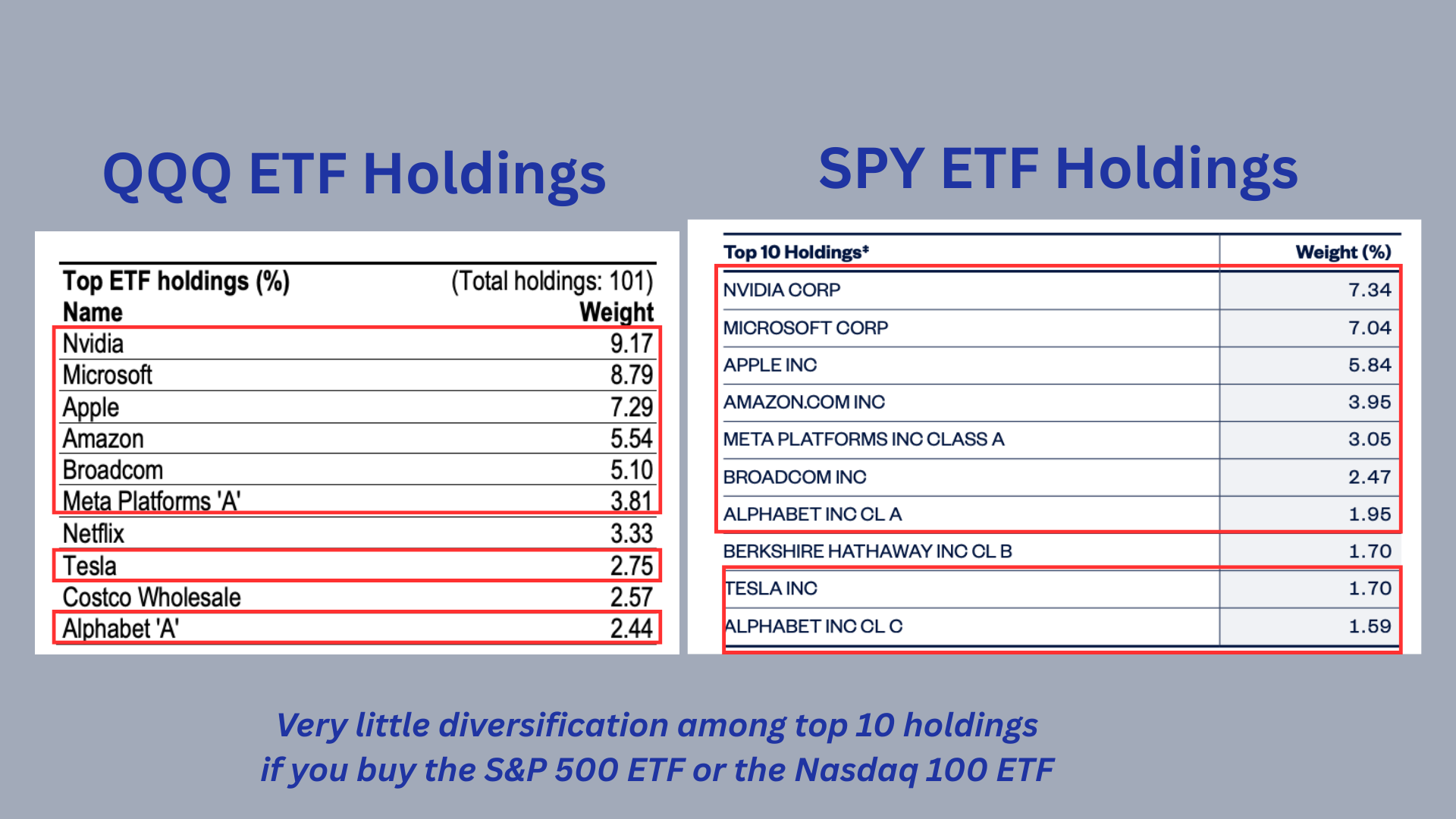
Below are the top holdings of the Invesco QQQ Trust ETF QQQ, which tracks the Nasdaq 100, and the SPDR S&P 500 ETF Trust (SPY), which tracks the S&P 500.
If you think somehow you’re getting “blue chip” exposure with an S&P ETF and tech exposure with the Nasdaq, you’d be wrong. The top 10 holdings of the two ETFs are substantially identical.
When It Looks Like Diversification … But It Isn’t
In its report, Blue Granite went on to note that these funds may appear to have different investment strategies. One may be a value fund, another a growth fund, another a global fund. But collectively the investor has a higher concentration in just these three stocks that could exceed 10%-12% of total investments, significantly increasing not only stock and sector risk, but also broader market risk and portfolio volatility.
“All might seem well when markets are rising; however investors with similarly composed mutual funds in their portfolios are particularly vulnerable during stock market declines,” Blue Granite wrote. “This is both unwelcome and avoidable and too often occurs when advisors and investors have an incomplete understanding of their mutual funds’ holdings and the necessary elements for effective and constructive diversification.”
A Better Way to Invest
Diversification may sound like a tired buzzword, but it’s a valid concept. The idea is to spread risk. As Blue Granite noted above, investors who don’t spread the risk feel more pain in market downturns.
True diversification spreads risk across:
- Asset classes (stocks, bonds, real estate, cash)
- Styles (growth, value, core)
- Regions (U.S., international, emerging markets)
- Strategies (dividend income, low-volatility, ESG)
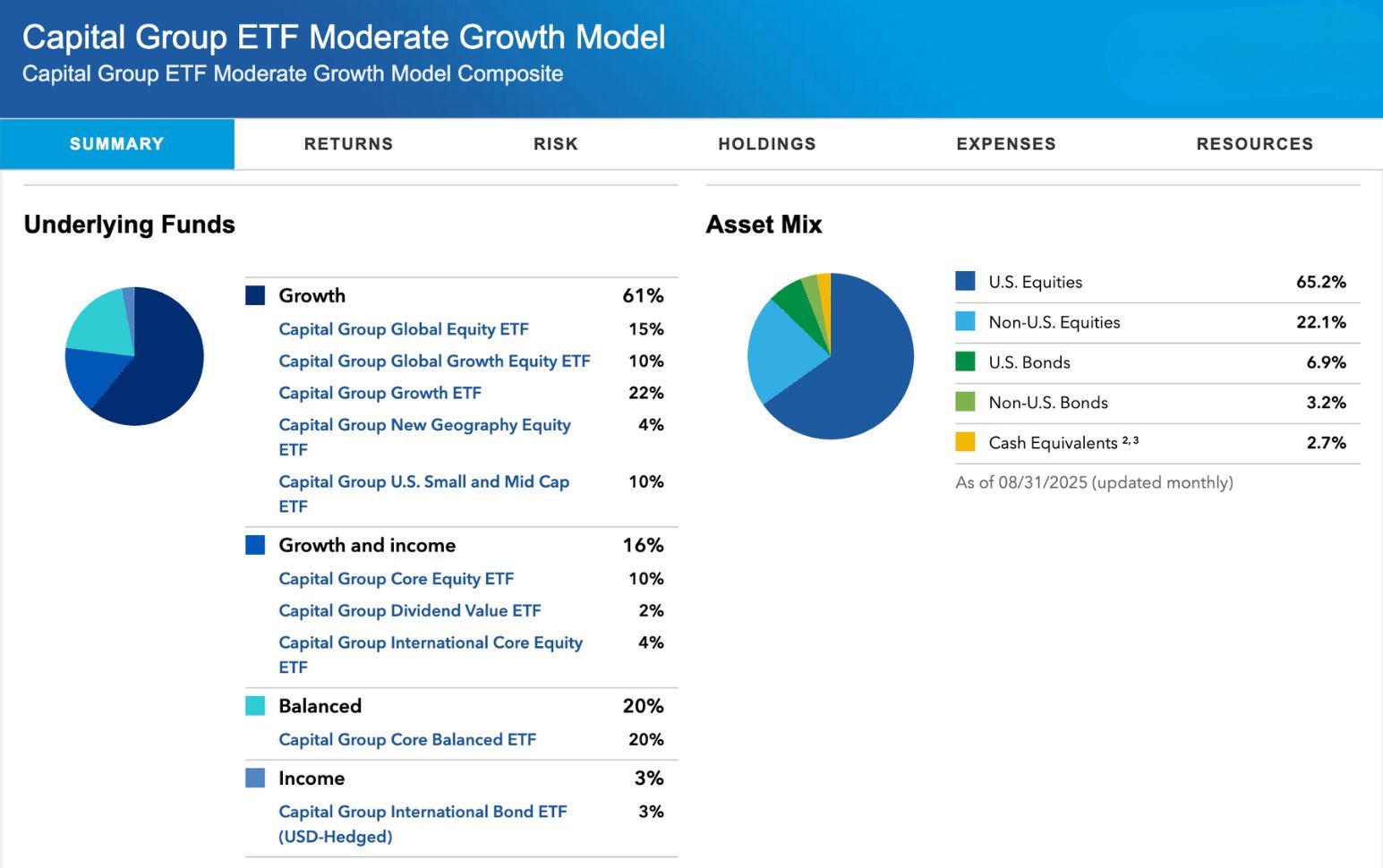
Example 1: Capital Group’s Moderate Growth ETF Model
This model allocates very carefully into specific stock and bond asset classes. Its objective is to achieve long-term growth of capital using primarily equities, with a small allocation to fixed income to provide diversification.
It’s constructed using only Capital Group ETFs, but investors can get the same benefits using funds from other families. Asset classes include:
- Dividend-focused U.S. equity
- Core and growth ETFs
- International developed-market exposure
- Investment-grade bonds and U.S. Treasuries
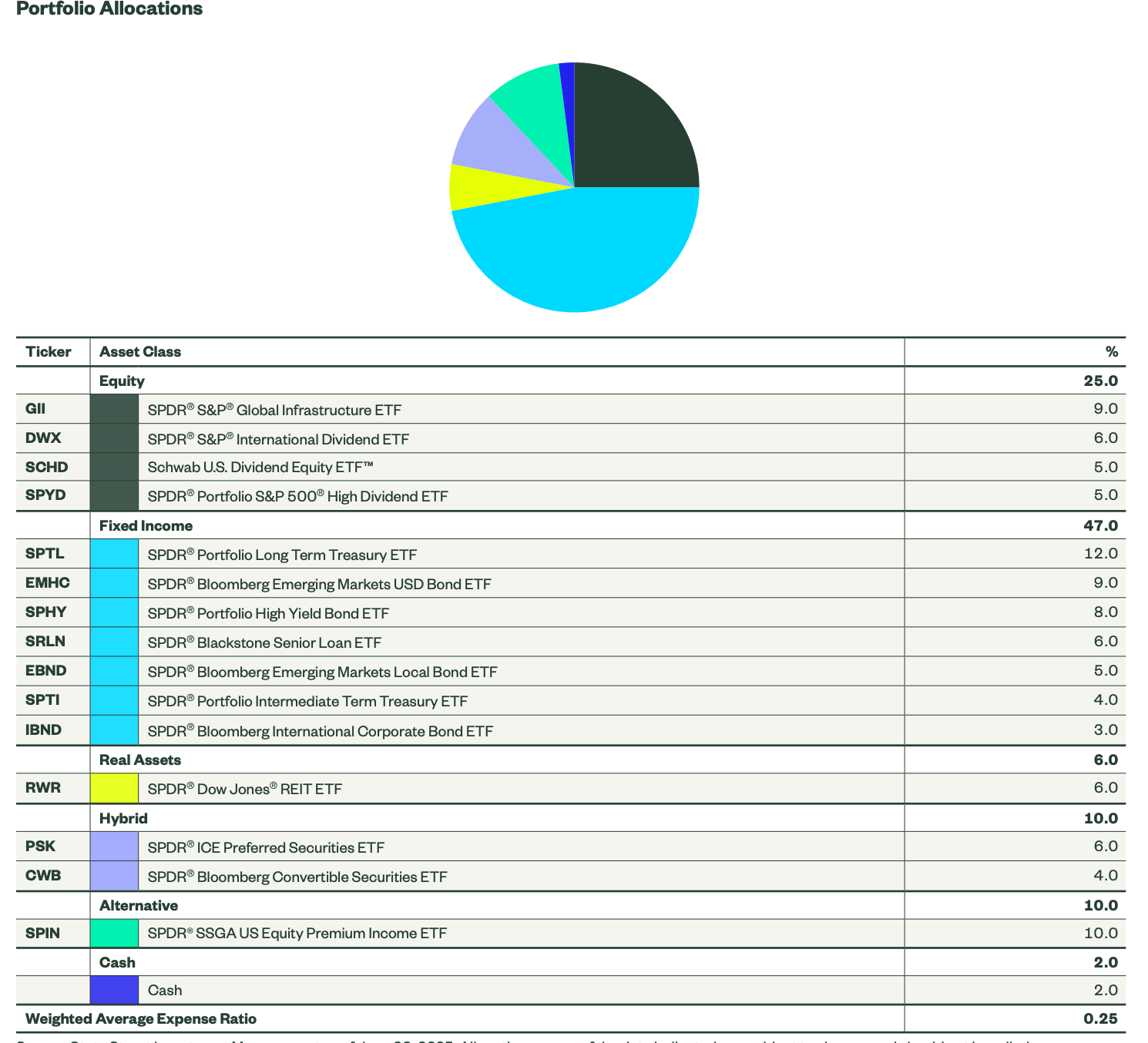
Example 2: State Street’s Risk-Based Models
This model is carefully constructed to generate a high level of income while simultaneously diversifying to achieve favorable risk-adjusted returns.
What does that mean, exactly? It means that State Street uses its own ETFs to give investors exposure to a broad range of income-producing assets including dividend-paying stocks, investment-grade bonds, high-yield bonds, bank loans, convertible bonds, preferred securities and REITS.
Asset classes include:
- Dividend-focused U.S. equity
- Global fixed income exposure
- Real assets and alternatives
- Hybrid securities and cash
What Diversification Is Not
Diversification isn’t about just loading up with a bunch of different funds or stocks. As we’ve seen, sometimes what seems different actually isn’t.
Instead, make sure each investment plays a distinct role in your financial plan by including various styles, regions, and strategies. Adjust your allocations based on your time horizon and goals.
And, especially if you enjoy trading stocks, don’t overlook the need to layer in some income-generating assets to meet retirement needs.