Like Pumpkin Spice Latte, the 60/40 Portfolio Keeps Coming Back
And neither of those is a bad thing.
You've reached your free article limit
You've read 0 of 1 free Pro articles.
Tailgate parties, pumpkin spice lattes, changing leaves and the 60/40 portfolio.
OK, three of those are fall traditions, but the last is a perennial favorite.
There’s a reason that a long-term investment portfolio of 60% stocks and 40% bonds became the gold standard: Historically, it’s offered a solid combination of growth, stability and peace of mind.
In a roaring bull market some investors get impatient if their 60/40 lags the S&P 500, but in a bear market their tune changes when their portfolio holds up better than one loaded up with suddenly slumping growth stocks.
The Timing Matters
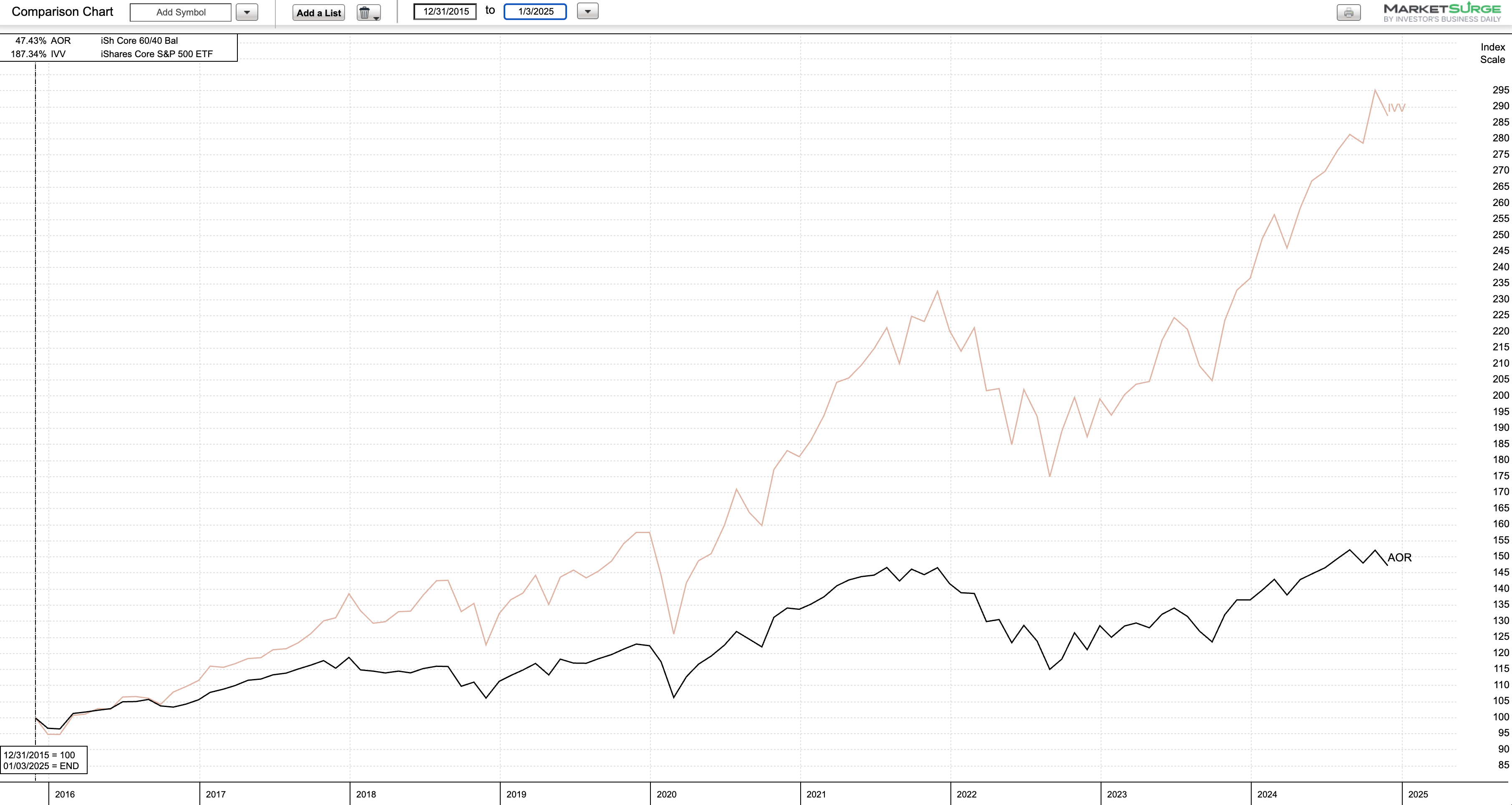
Let's continue with the seasonal theme. Portfolio composition is important. The two charts below compare the performance of the iShares Core 60/40 Balanced Allocation ETF AOR with the iShares Core S&P 500 ETF IVV.
In the first chart, you can see how the S&P 500 has trounced the performance of a 60/40 ETF over time. No big surprise there.
But things get more interesting with this second chart, which shows how these two ETFs performed in 2022, a year when both stocks and bonds were down.
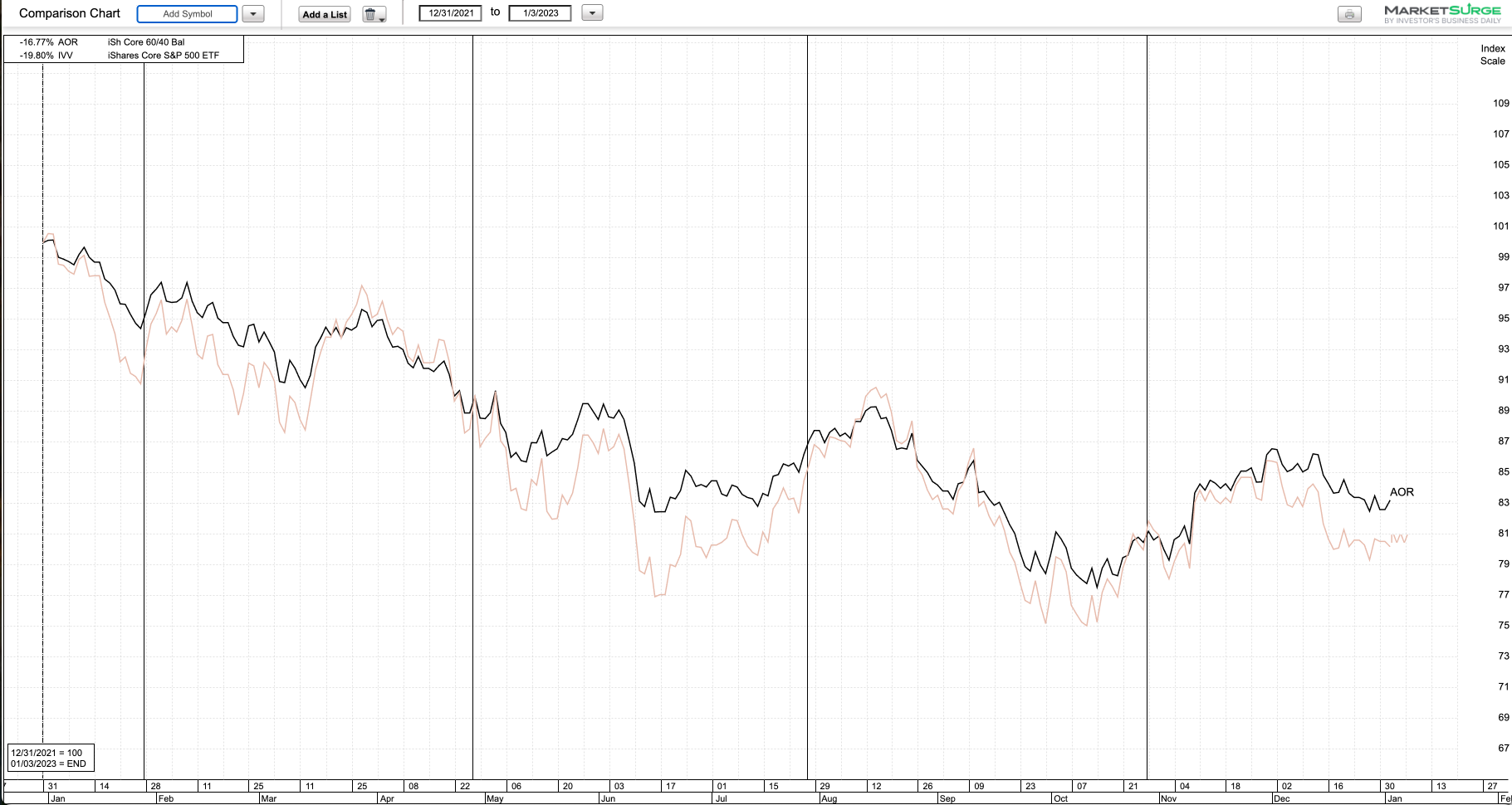
Here’s why it’s important to maintain a balanced portfolio, even though stocks have historically risen over time.
- A 60/40 buffers losses when both stocks and bonds decline.
- Smaller portfolio declines early in retirement reduce sequence-of-returns risk, which we talked about here.
- Preserving capital when markets drop supports your ability to withdraw funds over the long term
- Diversified exposure reduces your emotional stress and discourages panic-selling.
- Your portfolio bounces back faster when you avoid steep losses.
- Sharp market declines are a greater risk in retirement than in your working years.
It Boils Down to Capital Preservation
Don’t get me wrong. This isn’t a commercial for 60/40 portfolios. There’s no marching band on my street celebrating the endless virtues of holding 60% stocks and 40% bonds.
In fact, as we saw in 2022, traditional ways of investing don’t necessarily offer protection that savers expect. It’s true in years like 2022, when both stocks and bonds broadly declined, but taking heavy losses at the wrong time can put a permanent dent in your lifetime wealth.
Alternatives to a Classic 60/40
While a 60/40 mix might be exactly the right approach to generating income for some investors, others might need to consider other approaches.
And whether you’re in a 60/40, 50/50, 70/30 or some other mix, ensure that your allocations to equities and bonds enable growth but also preserve capital. In other words, you want your investments to capture the market's gains, but not fall as much when the market drops.
Growth is the easy part; lately it’s been centered in large U.S. stocks.
On the capital-preservation side, here are some potential vehicles to consider. These are examples, not recommendations.
- Annuities: These come in a lot of flavors. Be careful about talking to someone who’s purely an insurance agent; he or she has an interest in selling you something rather than seeing how an annuity fits into a comprehensive plan.
- TIPS: These are inflation-adjusted bonds designed to protect purchasing power.
For example, the iShares TIPS Bond ETF TIP. - Cash reserves: We are not talking about your grandmother’s coffee can of cash in the back yard. As you well know, that has zero inflation protection and is effectively losing money over time. Instead, money market funds like the Fidelity Government Money Market Fund can be used to stash a couple years of living expenses to avoid selling when the market falls.
- Alternatives: Much has been made lately about the additions of alternatives like private equity and private credit to 401(k) accounts. I’d use caution where these are concerned; better to focus on less exotic assets, such as the SPDR Dow Jones REIT ETF RWR. This offers exposure to real estate for diversification.
It’s Not All Logic and Numbers
I get a kick out of people who believe investing is only about math.
Nothing could be further from the truth.
Portfolios aren’t just numbers. Sure, stocks yield the highest returns. But a portfolio loaded with high-beta small-cap stocks will, by definition, be more volatile than one that includes those assets, in an appropriate allocation, alongside other investments.
A strategy that sounds exciting and “maths well” isn’t usually workable.
Retirees who kept cash or had guaranteed income sources, like annuities. avoided panic selling in 2022.
As we head into the fourth quarter, enjoy that pumpkin spice latte while you consider some potential portfolio upgrades for 2026.
- The 60/40 isn’t dead, but its contents may need to be fine-tuned. Over time, the 60/40 portfolio has proved a successful way to create growth and income. But it’s OK to consider ways to augment this and understand that not every 60/40 portfolio is the same.
- Long-term savers, especially those approaching retirement, might benefit from diversifying with tools that balance protection and growth. (I’ll repeat the caveat here: Annuities can be very helpful, but use caution and consult a planner!)
- True success means money that lasts as long as you do, not a fun story about that one stock that ran up 200% in a week.
OK, now that I've reminded myself of favorites that fit in to a pattern, it might be time for my annual pumpkin spice latte. Just one. Every year. It's about balance, you know.