In Defense of the Defense Sector?
Europe and our Asian allies are going to have pay more for their own defense. Will that help U.S. military contractors? Also, trading notes and charting the markets.
You've reached your free article limit
You've read 0 of 1 free Pro articles.
American and Russian officials met for peace talks in Riyadh, Saudi Arabia on Monday. The meeting followed the phone call last week between U.S. Pres. Donald Trump and Russian Pres. Vladimir Putin. Ukraine was not represented. Secretary of State Marco Rubio, U.S. Middle East envoy Steve Witkoff and White House National Security Advisor Mike Waltz (former U.S. Army Green Beret, decorated with four bronze stars) represented U.S. interests. Russian Foreign Minister Sergei Lavrov and Kremlin foreign policy aide Yuri Ushakov took the other side of the table, with the host nation also sitting in.
The agendas of the two sides involved are not clear. While it is believed that the U.S. side is in Saudi Arabia with the intent to kickstart negotiations that would ultimately bring an end to the violence in eastern Europe, the Russian side may simply be there to try to improve relations with the U.S. with an aim toward having sanctions already placed on the regionally aggressive nation eased somewhat. Ukrainian Pres. Volodymyr Zelenskiy has stated that Ukraine will not recognize any peace agreement where his nation is not involved in any negotiations.
Admittedly, I had seen a reduced bull case for the large defense contractors, with an exception made for Palantir Technologies PLTR as the Trump administration continues to target fiscal largess. But, as these talks in Riyadh are ongoing and as European leaders have met in Brussels to discuss ways to bolster defense spending, these stocks have rallied on Monday overseas and overnight here in the U.S.
One thing is clear... the European Union, NATO, and even our Asian allies are going to have to take on increased financial responsibility for their own defense. That could be a net positive for the purveyors of large ticket hardware such as fighter aircraft, drones, missiles systems, precision artillery and main battle tanks. Whether or not U.S. defense contractors have a leg up without the added leverage of the U.S. spending muscle flex behind them remains to be seen.
Wild Week
The week just ended proved to be quite volatile, at least at the start, then as the five-day period wound down, the environment around U.S. financial markets showed the improvement necessary for U.S. dollar valuations to come way off of their highs as Treasury Yields did the same. This set up an optimistic end of week close for equities as both the S&P 500 and Nasdaq Composite posted weekly wins after having suffered back-to-back negative weeks.
Markets started out last week on edge as Pres. Trump on Monday announced 25% tariffs on all imports of steel and aluminium into the U.S. from all external sources. Later last week, the president signed a memo tasking the Commerce Department and U.S. Trade Representative with looking into steps that might be taken to eventually implement reciprocal tariffs on a country-by-country basis. Markets had been prepared for an immediate implementation of these new tariffs and found relief in the fact that it could be six weeks or more before these levies start landing. The news of delayed tariffs outweighed surprisingly hot midweek prints for both consumer-level and producer-level inflation for January.
The news also seemed to outweigh Fed Chair Jerome Powell's somewhat cautiously hawkish appearances before the Senate Banking and House Financial Services Committees. An incredibly weak print for January retail sales on Friday also helped debt and equity markets hold onto the weekly gains as this makes it that much more difficult for the central bank to take a hawkish turn.
Marketplace
Among the major to mid-major U.S. equity indexes....
- The S&P 500 gave up just 0.01% on Friday, gaining 1.47% for the week.
- The Nasdaq Composite gained 0.41% on Friday, and 2.58% for the week.
- The Nasdaq 100 gained 0.38% and 2.9% for the week.
- The Russell 2000 gave up 0.1% on Friday but gained 0.01% for the week.
- The S&P Small Cap 600 gave up 0.16% on Friday, and 0.1% for the week.
- The S&P Mid Cap 400 gave up 0.08% on Friday, and 0.25% for the week.
- The Dow Transports gained 1.29% on Friday, and 2.84% for the week.
- The Philly Semiconductors gained 0.09% on Friday, and 3.03% for the week.
- The KBW Bank Index gained 1.07% on Friday but gave back 0.45% for the week.
On Friday, seven of the 11 S&P sector SPDR exchange-traded funds closed in the red, led lower by Health Care XLV and the Staples XLP. For the week, nine of the 11 S&P sector SPDR ETFs closed in the green, as the "growth" sectors led the way north. Tech XLK and Communication Services XLC gained more than 2.5% apiece, while four other sectors gained at least 1%. Health Care was the big loser for the week as well as for Friday, giving back 1.11% over the five days.
The Charts
Readers will note that the pennant formation discussed over the past couple of weeks, may have closed this past Thursday.
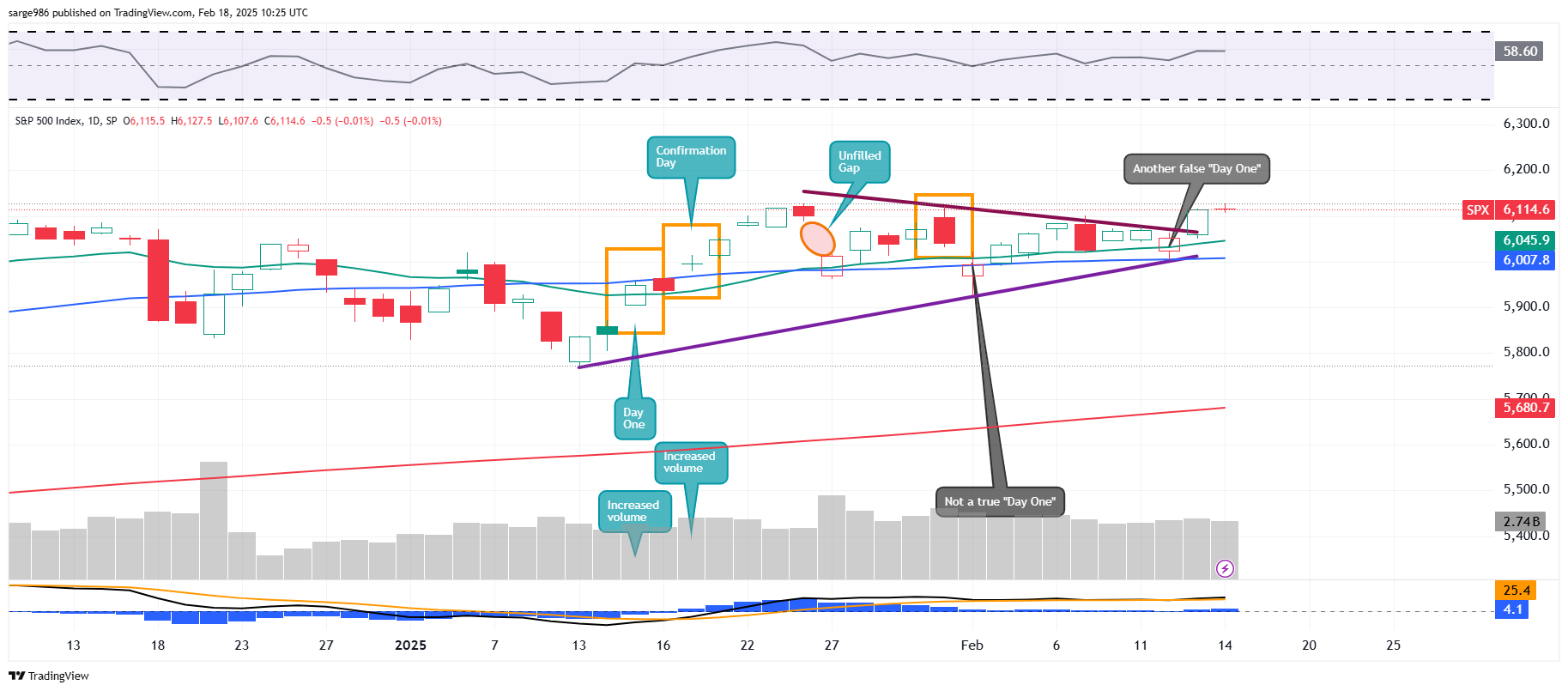
The S&P 500 traded sharply higher that day and largely held that gain on Friday. Bear in mind that closing pennants, flags and triangles often produce explosive moves in one direction or the other. Relative strength has improved as the daily Moving Average Convergence Divergence has taken on a more bullish posture with all three components above zero -- and with the 12-day exponential moving average above the 26-day EMA.
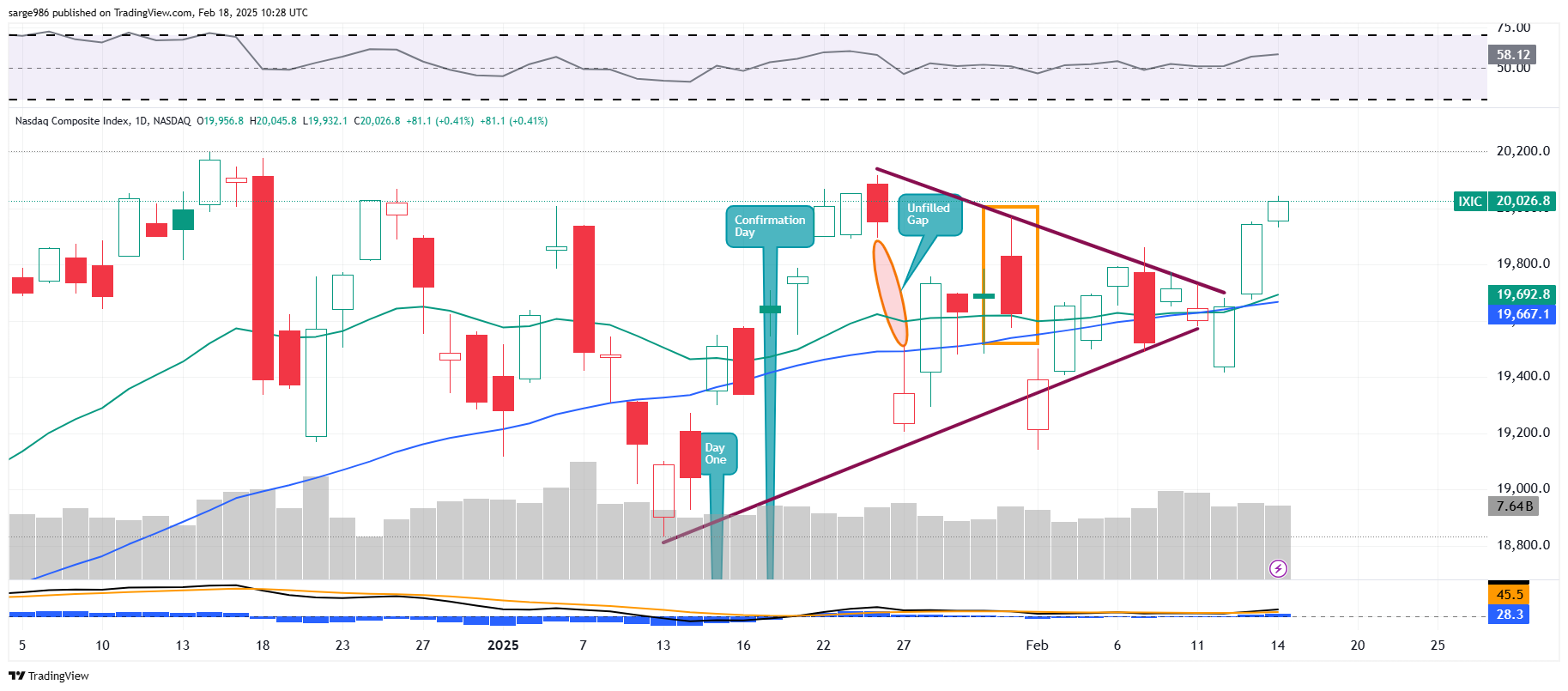
The breakout from that closing pennant formation is much more visible on the chart of the Nasdaq Composite. Here there was an intraday head-fake to the downside on Wednesday followed by Thursday's breakout and then that breakout was not merely held but extended on Friday. Both the Relative Strength Index and daily MACD are postured bullishly for this index as well.
Earnings
According to FactSet, with 77% of the S&P 500 having reported their fourth quarter earnings, 76% of those firms reporting have beaten earnings expectations, while 62% of those reporting have beaten revenue expectations. At this point, for the quarter, earnings growth is running at a blended (results & expectations) rate of 16.9% (up from 11.7% several weeks ago) on revenue growth of 5.2%.
For the quarter, the financials are expected to post by far the greatest earnings growth at +51.8%, with communication services in second place at +30%. Just two sectors are expected to show a year-over-year earnings contraction at this point, led lower by Energy at -27.5%. The industrials and staples have moved from contraction to expansion over the past two weeks.
As for the current quarter (Q1, 2025), consensus is currently for earnings growth of just 8.1% (down from 11.3% a few weeks ago) on revenue of 4.4%, down from 5% over several weeks. For the full year 2025, Wall Street sees earnings growth of 12.7% (down from 14.8% over a few weeks) on revenue growth of 5.5%. Yes, as Q4 results have come in much better than expected... projections for Q1 2025, and full year 2025 have been contracting rapidly.
As for valuation, the S&P 500 went into the long weekend trading at 22.2 (up from 22.1) times 12-month forward looking earnings and 27.6 (down from 38.4) times 12-month trailing earnings. These ratios both remain well above their respective five-year and ten-year averages.
The GDP Game
This past week, the Atlanta Fed revised their GDPNow model for the first quarter down to growth of 2.3% (quarter over quarter, seasonally adjusted annual rate) from 2.9% the week prior. Among other regional central bank district branches running close to real-time gross domestic product models for the current quarter, the New York Fed revised that estimate for first quarter growth down to 3.02% from 3.12%, while the Cleveland Fed yet again... kept its view for Q1 growth at 1.85%. The St. Louis Fed, however, also revised their model for Q1 GDP growth higher, to 2.11%.
What's obvious is that there is no consensus on the current pace of economic activity. The economy is growing. That much seems certain, but the pace of that growth appears to be a huge question mark. Hedgeye's view, which I won't give away because this is their business, is more optimistic concerning first quarter growth than any of these regional Fed models. As you know, I trust Hedgeye significantly more than the almost purely academic (implication: no real-world experience) staff economists at our central bank's regional branches.
Trading Notes
Note 1: Last week, Wells Fargo WFC confirmed that the Office of the Comptroller of the Currency had terminated a consent order related to the firm's risk management program and legal compliance requirements. This is the fourth consent order closed this month as investors speculate that the Federal Reserve may terminate the cap placed on the bank's assets back in 2018 after a series of scandals (under different management) marred its reputation at the time. This is the primary reason why I have been long this stock.
Note 2: Over the long weekend, headlines surfaced at the Wall Street Journal that Taiwan Semiconductor TSM and Broadcom AVGO are considering separate deals (they are supposedly not working together) that could ultimately split beleaguered U.S. chip designer / manufacturer Intel INTC into two businesses. The U.S. government would definitely have a say in any outcome where Taiwan Semi ends up owning or running Intel's foundry business as Intel is one of two U.S. foundries and TSM is easily the largest foundry in the world.
Intel and Taiwan Semi have both been beneficiaries of the Chips Act. Intel, readers may recall, is a name that we got into after the dismissal of former CEO Pat Gelsinger. We thought that a potential bottom at that time and on that count, so far... so good.
What's Ahead?
Yet another holiday shortened week lies ahead. Just four days until Saturday. Can we please be done with all of this time off over the past few months? Those of us working off of a profit /loss ratio and/or for commissions would appreciate it.
...The Fed will be active this week. Though we will not hear from the Fed Chair this week, the Fed will release the Minutes of its Jan. 29 policy meeting on Wednesday afternoon. That release will be sandwiched by at least eight appearances by other Fed officials over these four days. Vice Chair Philip Jefferson will speak publicly both on Wednesday and Friday afternoons.
... The Macroeconomic calendar will be active this week, but without the headline making level events of the past two weeks. January Housing Starts will print on Wednesday morning followed by January Existing Home Sales on Friday. On the regional level, the Empire State and Philadelphia Fed Manufacturing Surveys for the month of February will be released this morning and on Thursday morning respectively.
... The earnings calendar, similarly, will not go cold, but will be lacking in results released by many high-profile large cap names. Clearly, the best-known name releasing numbers this week will be Walmart WMT on Thursday morning. Other names that investors can look forward to hearing from this week will be Medtronic MDT this morning and Occidental Petroleum OXY this afternoon followed by Etsy ETSY Hasbro HAS, Wayfair W, Dropbox DBX and Vipshop Holdings VIPS as the week winds down.
Economics (All Times Eastern)
08:30 - Empire State Manufacturing Index (Feb): Expecting 0, Last -12.6.
10:00 - NAHB Housing Market index (Feb): Expecting 47, Last 47.
4:00 p.m. - Net Long-Term TIC Flows (Dec): Last $79B.
The Fed (All Times Eastern)
10:20 - Speaker: San Francisco Fed Pres. Mary Daly.
1:00 p.m. - Speaker: Reserve Board Gov. Michael Barr.
Today's Earnings Highlights (Consensus EPS Expectations)
Before the Open: FLR (.77), MDT (1.36), VMC (1.75)
After the Close: CE (1.20), IFF (.82), OXY (.67)
At the time of publication, Guilfoyle was long PLTR, WFC, INTC equity.