Earny Asks: What Do Stock Options Have to Do With Hockey?
In this week's Earny asks, we discuss call options and how much money you can make or lose when you trade them.
You've reached your free article limit
You've read 0 of 1 free Pro articles.
Know Your Options
Earny, despite being a squirrel, loves hockey. He plays the sport whenever he can, but he loves watching it on TV, which is lucky for him, because it’s one of those sports with a pre-season, a regular season, and then a post-season. Is there even a month where hockey fans don’t have hockey to watch?
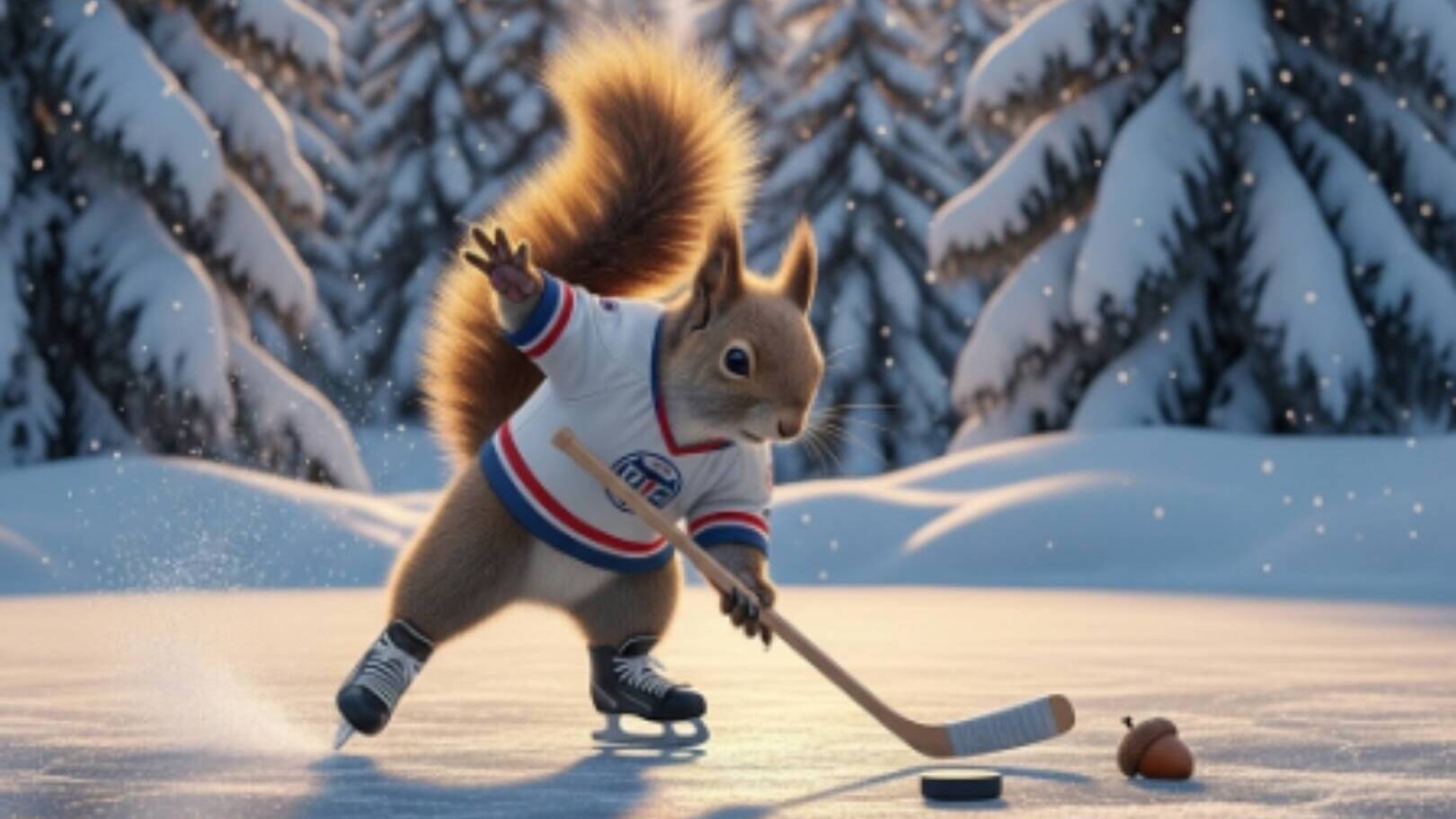
Now, Earny doesn’t always watch hockey. He’s got other hobbies, like investing! But lately, Earny has been hearing about a type of trading vehicle called an option. He’s even heard that options have something in common with hockey, but he’s not sure what it is. So, he asked me.
Earny asks: what do options have in common with hockey?
ANSWER
It's all about the payoff. When you buy a stock, two things can happen to the stock’s price. It can go up or it can go down.
While this makes sense for most of us, there was once a group of traders who thought that wasn’t enough. They wanted more possibilities. Sometimes, they wanted to limit the amount that they could lose on a stock. Sometimes, they wanted to increase the amount that they might gain. Still other times, they didn’t want to make money on the stock’s up or down movements-they wanted to make money on its volatility, or how much it went up or down.
They invented options.
There are basically two kinds of options: a call and a put.
A call option is a little bit like owning the stock. If the stock goes up in value, the option will, generally, go up, too. If the stock drops, the option has a floor.
A put option is sort of a bearish bet on the stock. If the stock goes up, the put may lose value, again, until it hits that floor. If the stock goes down, the put will gain in value.
Here’s a little chart cheat sheet (this is only for when you buy a put or a call).
| Option Type | If the Stock Goes Up | If the Stock Goes Down |
|---|---|---|
Call Option | Call gains in value | Call falls in value (to a point) |
Put Option | Put falls in value (to a point) | Put gains in value |
If you wanted, you could get a PhD in options strategy. They’re really complex! So, let’s just focus on call options here.
What is a call option?
A call option is a contract that gives the call buyer the right to “call away” shares of the stock from the call seller. Get it? That’s why it’s called a call. Because you get to buy, aka call away, the shares from someone else.
Now, it’s not always advantageous to call the shares away. You see, since a call is a contract, it will have various stipulations.
A call contract gives the call buyer the right, but not the obligation to buy the shares. They'll buy them only if it makes sense. If not, they just tear up the contract.
For example, Nvidia (NVDA) is currently trading at $176.07.
I might decide that I’m interested in owning NVDA but think it’s a little risky. I might even think the stock could hit $200, but am nervous that it might also drop to $150. So, an option might be right for me because I can define my risk.
I can buy a call option today that will let me buy NVDA at $175 on October 17th, if I’m still interested in owning it at that time. Why would I want to own it? If the stock is trading above that price! If it’s trading below, then I wouldn’t want to buy it, because I could just buy it at the lower price and tear up the call contract.
The thing is, I have to pay for that contract. As I’m writing this, the October 17th 175 call is priced at $6.60. So, really, I won’t make money unless NVDA goes up to $181.60, which is the price that I’d buy the shares at ($175) plus the price I pay for the option ($6.60).
And this is where hockey comes into play. The payoff, or value of my trade, looks like a hockey stick!
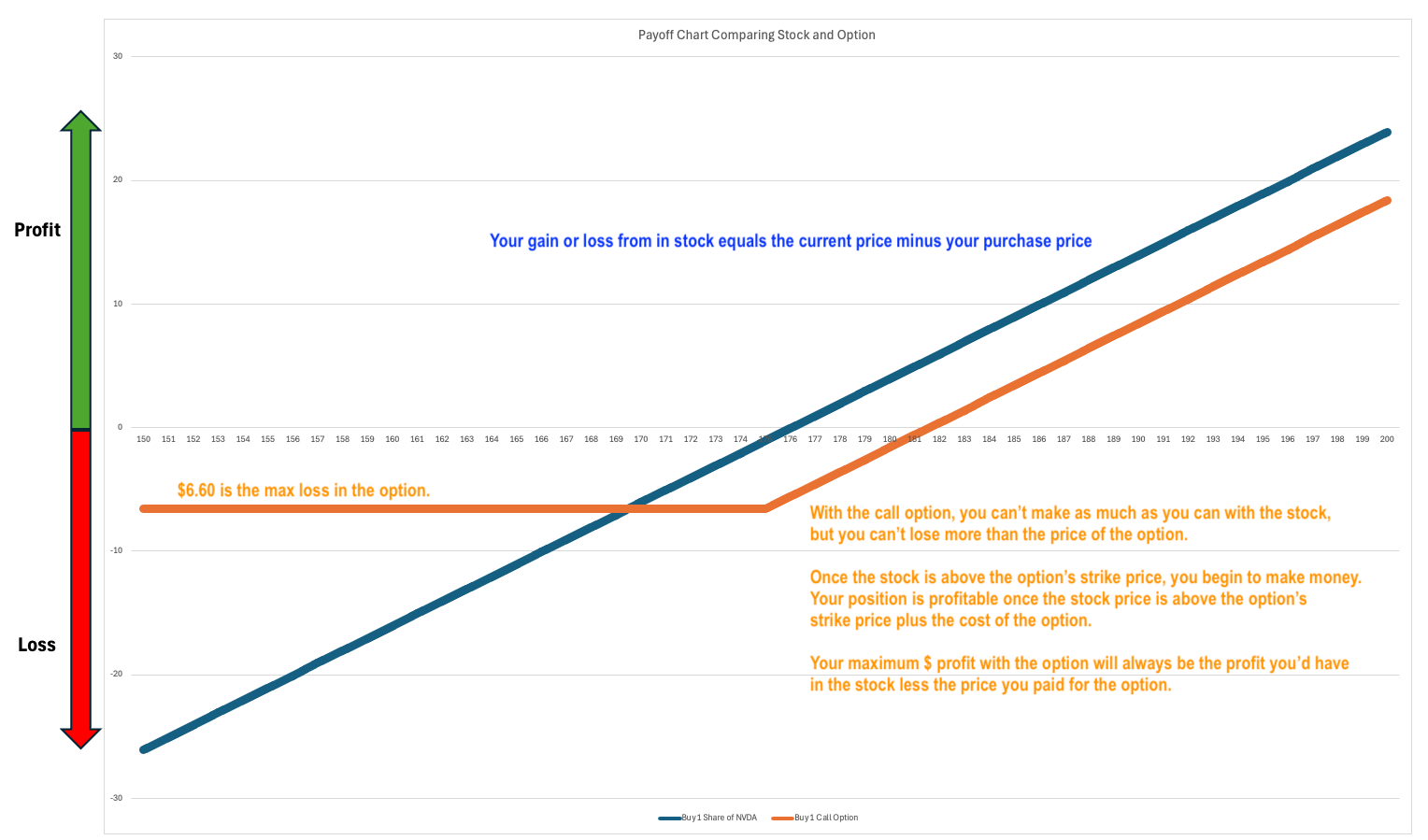
Imagine this. If I buy a stock, for every dollar the stock goes up in price, I make $1. For every dollar it goes down, I lose $1. It’s a linear payoff. Notice the blue line in my chart.
If I buy the option, the most I can lose is the price I paid for the option. In the chart above, you can see how as the stock price declines, the option value (in orange) stops declining. It flatlines.
The point is, with an option, your loss is potentially limited. With the stock, it's less so.
I've oversimplified it here. This isn't an all-inclusive options course. It's an intro to help you understand what a call option is and how it can be used.
A few things that I've ignored:
- Options are sold in contracts of 100. You can’t just buy 1 option the way that you can buy 1 share of stock.
- Lots of people use options to speculate. If the NVDA option is only $6.60, vs. the $176 that a share of NVDA costs, some people might take on more risk by trading more options and having exposure to more shares than if they had just bought the stock. They might go broke more quickly!
- I haven’t gotten into all of the complicated options terminology and math (you’re welcome).
- For every buyer, there has to be a seller! Who is selling these contracts and why??
I know! It’s confusing. We’ll come back to this again in the future. I just wanted to introduce the concept to you today, in part, because TheStreet Pro's Bob Lang will start sharing some of his options trading ideas on TheStreet Pro. If you're a subscriber, then you'll have access to them! If you're reading this in our Filthy Rich Animal newsletter and are not a subscriber, you'll be able to read two free articles on TheStreet Pro each month before we ask you to try out a membership.