Earny Asks: What Can F1 Teach Us About Becoming a One-Person Investment Team?
The Question of the Week is now Earny Asks. And Earny wants to talk about car racing and how you can use this one lesson from the F1 movie to become a better investor.
You've reached your free article limit
You've read 0 of 1 free Pro articles.
Last weekend, my family and I went to see the F1 movie starring Brad Pitt. I’m a huge car fan, so this was a must-see for me. In fact, while you’re reading this, I will be doing my own impression of the movie’s lead character, Sonny Hayes. Unfortunately, I won’t be driving a sophisticated F1 car; instead, I’ll be racing a battle-scarred Miata.

While the movie didn’t teach me lessons that I could employ on track this weekend, it was interesting to me as an investor. You see, it wasn’t just about racing. The movie was about how three hyper-competitive people could learn to work together in order to succeed.
Teamwork makes the dream work.
Investing in individual stocks is the same. A large fund company might hire different analysts, as well as a portfolio manager, and others, to build a portfolio that they hope will beat the market. Having a team like that is a huge advantage over the modest resources that you and I have as individual investors.
But you and I can create a similar team, virtually, on our own. Just like an F1 driver might, we need to expand our field of vision and learn to consider the information that each member of the team would.
In other words, we need to develop a framework, with rules, that can help us to employ different types of analyses and put them together to pick great stocks. This is what most great investors do.
One of my favorite comes from Louis Llanes, who is a financial advisor and contributor to TheStreet Pro.
Louis uses the acronym QVT to define his framework.
This week’s question is, what does QVT stand for?
- Quality, Value, Television
- Question, Verify, Truth
- Quality, Valuation, Technicals
- Question, Verify, Trade
ANSWER
Honestly, you could make the case that any of those could be a strategy.
For example, Quality, Value, Television, could be a strategy that says to find quality companies at the right price and then go watch TV. Just let them grow. Not a bad strategy, really.
Or Question, Verify, Truth could be framed as: do your research and then learn whether you were right.
Or, Question, Verify, Trade could indicate that you should screen for stocks, find the best ones, and then buy them.
However, Louis’ framework is Quality, Value, Technicals.
Let’s see why.
In his recent article on TheStreet Pro, 14 Stocks Poised for Gains Now as Market Breaks to New Highs, Louis shows us exactly how to implement his framework.
He begins by telling us that investors love a good story. They want to buy stocks that speak to them because of some product that they’re launching or a compelling CEO. They may end up owning stocks like Tesla TSLA, which has basically just traded sideways (with a ton of volatility!) since 2020.
Instead Louis says that “you can buy companies in the right market conditions based purely on quantitative metrics, without relying on any metric.” Louis is rules-based.
His quantitative metrics are broken down into three categories which we defined above:
- Quality
- Valuation
- Technicals
Quality
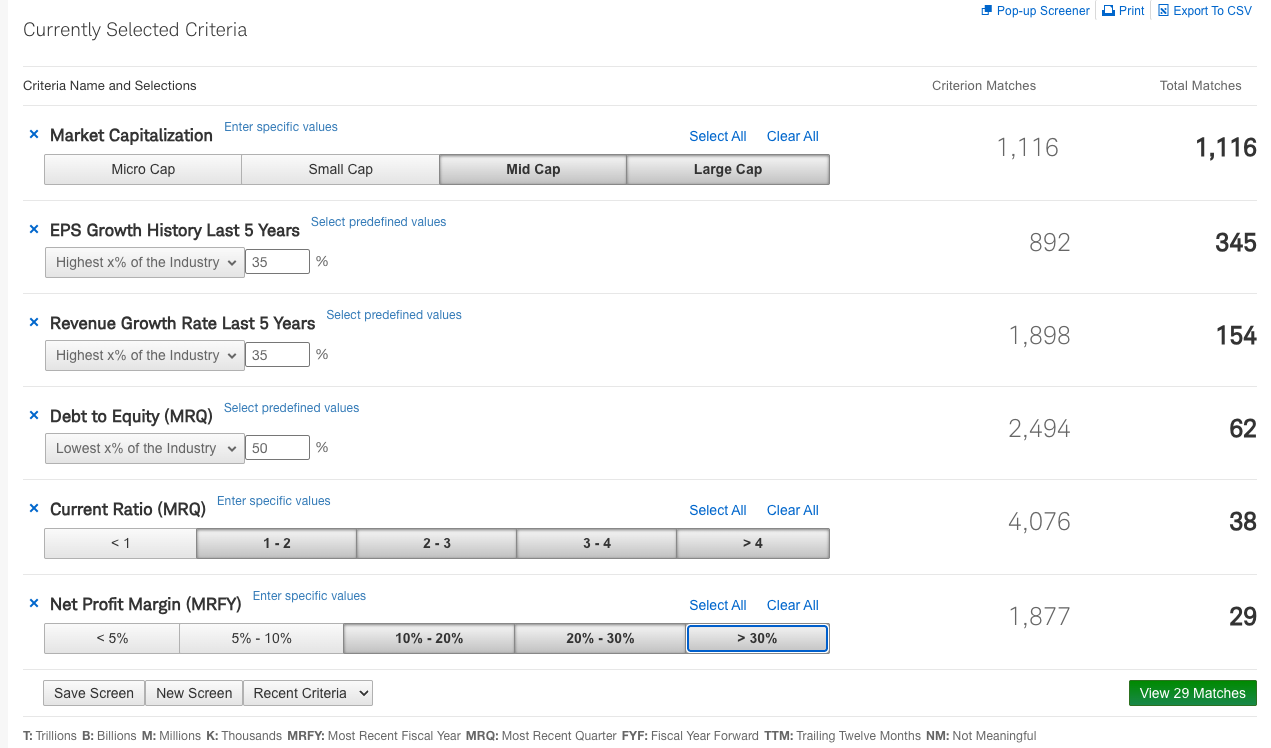
Quality is measured by the underlying company. Are they growing earnings and revenues? Are they able to manage their debt load? Or, are they at risk of struggling if the economy turns south?
You can go to your broker’s website to screen for companies meeting these criteria.
For example, in my Schwab account, I was able to use their screener to find companies whose Earnings and Revenue growth for the last five years was among the highest in their industries, had manageable levels of debt, and seemed able to make interest payments.
Below is a sample, only, to show you how you might implement the Quality component.
Valuation
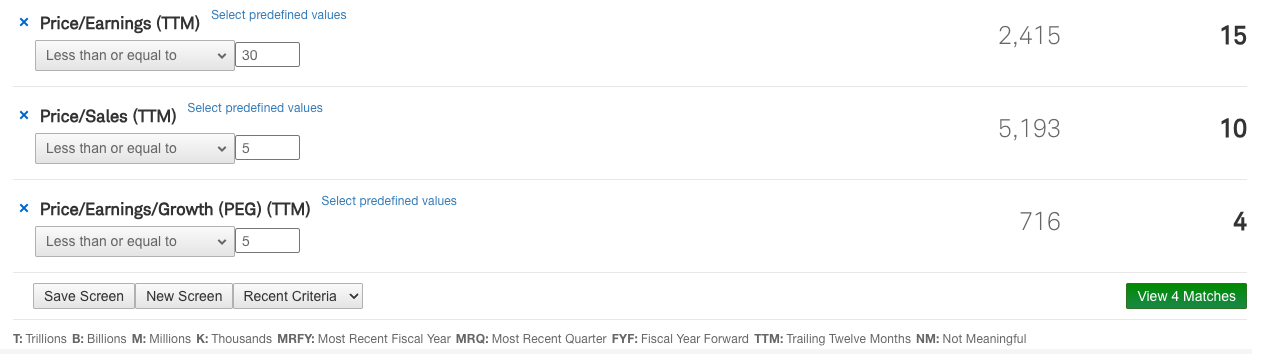
Valuation considers how much you’re paying relative to what you’re getting. In other words, how much value you’re getting for your money. For example, if there are two companies, both trading for $100, and one company earns $100 per share each year, while the other earns $1 per share each year, you’re better off buying the one that earns $100 each year. The company makes enough money that they could simply buy the share back from you! The other company could never afford to do that!
So, we look at things called valuation ratios, that compare the cost of a share to some metric like earnings per share or sales per share. We might even use a ratio called PEG, or PE/Growth, that compares a stock’s PE ratio to the company’s earnings growth. We discussed PEG two weeks ago in Question of the Week: Ferrari is Firing on All Cylinders.
Technicals
Last, we look at the technicals, or price action to see if the stock is a good candidate for an increase in price.
Here, Louis uses the acronym TORQ, which is short for:
- Trend: Is the stock rising or falling
- Overbought/Oversold: has the stock risen or fallen too far, too fast. If so, it might reverse, at least in the short-term, which could give us a better opportunity.
- Relative Performance: Is the stock performing better or worse than the rest of the market?
- Quality Patterns: Are there behavioral shifts in price action signalling a breakout?
Technicals are harder to screen on and you might find it more helpful to use them by looking at a price chart to see if it fits the criteria above.
I will cover technicals in future Earny Asks articles.
Putting it all together
Louis says that this is simply a starting point. From there, the hard work begins. You need to look at each stock in detail to decide whether it fits your portfolio and whether there might be news or other factors that could rule the stock out. It’s all about managing risk and having a framework like this can help you to remove emotions from your investing process.
So, while F1 can be considered the ultimate team sport, you can be a team of one and manage your own portfolio just as well as the big mutual fund companies.