Earny Asks: The Market Is Like a Party and Parties Weren't Meant to Last
Lot's of talk these days about how the market is like 1999, but more explosive. Earny wants to know what he should do.
You've reached your free article limit
You've read 0 of 1 free Pro articles.
Summary
- A legendary trader said today’s market rhymes with the Dot-com boom/bust
- What does that really mean?
- How should you react?
1999
Do you remember 1999? It was the kind of time that people wrote songs about.

You see, we thought the party was about to end. There was something called the Year 2000 Bug or Y2K bug. As I recall, legacy computer code written before the mid-1990s didn’t have a way of rolling over the date to account for the 2000s. And that legacy code ran lots of critical infrastructure! So, as the ball dropped on Times Square, nobody was certain whether airplanes would fall out of the sky, or your bank would lose access to your account, or your Dot-com era employer might just vaporize along with the internet.
Prince wrote 1999 back in the 1980s, before the Y2K bug was a thing. But it was the song of the year as we all worried about what might happen.
I was on TheStreet’s Stocks & Markets podcast this week, and after taping, James “Rev Shark” DePorre reminded us that the party in 1999 was driven by the tons of money that was being pumped into the system in order to correct the Y2K bug. So, tech stocks ripped higher while old economy stocks dropped.
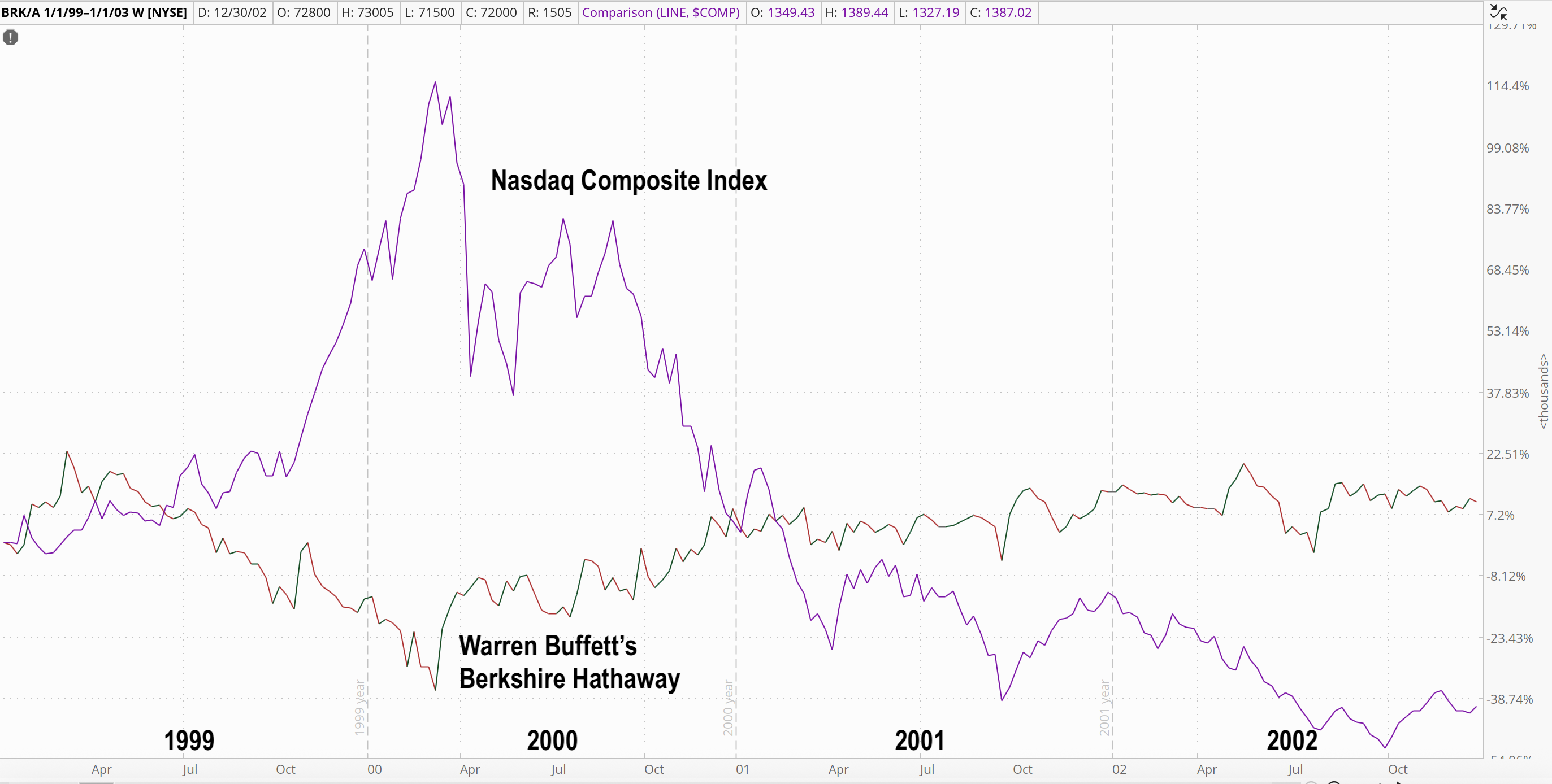
You can see that clearly in the chart below where the Nasdaq soared into early 2000, while Warren Buffett's Berkshire Hathaway (BRK.A) (BRK.B) , which invested in those old economy companies, dropped. The relationship reversed as the economy soured.
Some think that today might not be that different. After all, we have a Fed that’s begun to ease interest rates at the same time that wild amounts of money are chasing AI deals.
A trader named Paul Tudor Jones made waves this week when he said on CNBC that “If anything, now is so much more potentially explosive than 1999.”
The Y2K bug didn’t blast us into oblivion, but stocks broadly dropped. The S&P 500, which includes tech stocks and old economy stocks, fell by 9% in 2000 and then 12% in 2001 and 22% in 2002.
Prince virtually forecasted it!
“Life is just a party
And parties weren’t meant to last”
This has Earny pretty nervous and he’s considering selling it all and hibernating starting today.
Earny Asks, if They’re Saying That This Is Like 1999, Should I Panic?
ANSWER
First of all, Earny needs to remember that it’s bears who hibernate. Squirrels, on the other hand, spend the winter digging up the nuts that they saved during the warmer months.
That’s right. Squirrels are savers. They have a plan to get through the winter.
So, no, Earny. You should not panic.
Does this mean that Paul Tudor Jones is wrong? I have no idea.
What if he’s right. What would that mean?
First of all, 1999 was a great year! Party on. The party went on into early March of 2000.
“If you didn’t come to party
Don’t bother knockin’ on my door”
Paul Tudor Jones says that “you have to position yourself like it’s October 1999.” And that was a party month, with the S&P 500 gaining over 6% and on it’s way to a gain of 18% by August of 2000.
The tech-heavy Nasdaq Composite Index gained 86% from October through that index’s top in February. See the chart above.
So, by itself, Party Like it’s 1999 is pretty much a good thing. When the party ends, watch out. James “Rev Shark” DePorre reminded me, many investors who did well during 1999 lost it all during the 2000-2003 bear market.
It doesn’t have to be like that. When the party ends, you and Earny can take advantage of it. And here’s the secret: nobody rings a bell at the market's top. Nobody knows when the party ends!
Your job as an investor is to have a plan and to work that plan. Be prepared for anything.
We talked about that over here, in How Should You Build a Portfolio.
If you’re a young investor, you’ll continue to put aside a little bit of money each month from your paycheck. If you’re a mid-career investor, you’ll do the same. If the value of your portfolio drops, just pretend that the market is on sale, because it is! Lucky you!
That's the benefit of Dollar Cost Averaging.
If you’re a late career investor or a retiree, you should already be positioned to take less risk. And when the market falls and you find yourself overweight bonds and underweight stocks, you’ll rebalance, buying those beaten down stocks and profiting when they eventually rally back.

Look, every market is different, but as Tudor Jones says, history rhymes and it’s pretty likely that in a year or two or three, your investments will have come back from even the worst market declines.
Final Thoughts
The point is, the market might melt up from here and then crash. Or, it might do something else. If you’re a trader, you should be watching the market like a hawk. There’s a party going on. If you’re an investor, however, check your portfolio. Make sure that you’ve got a plan and that you’re working that plan.
Either way, be a squirrel like Earny. Save today so you can be comfortable in the future.