Earny Asks: Does the Price of a Stock Matter?
Price is what you pay, value is what you get.
You've reached your free article limit
You've read 0 of 1 free Pro articles.
There’s an old saying on Wall Street that “price is fact.” After all, a company's earnings can be restated, and there's no way to know what the future holds. The price that we pay for a share of stock or an ETF — or any asset really — is the price. That's a fact!
Back when I was a young trader, stocks would go public around $20. Investment banks did that because they felt it was a price that people could identify with and not see as too expensive. So, there had to be something to it, right?
Maybe. Or maybe not.
Earny Asks: Does Price Matter?
- Yes
- No
(Before moving on, give some thought as to why you selected your answer.)
Earny's Answer
Let’s start with a simple example:
There are two companies. They make similar products and are of similar size. Each company has 20 employees and earns $2 million a year in profit.
As investors, we can buy shares in both companies because they trade on the New York Stock Exchange.
The first company is called Cheap, and its shares can be purchased for $1 each.
The second company is called Pricey, and its shares are trading at $100 each.
Which would you buy?
If you said, “I don’t know,” then you’re right. We don’t have enough information to make a decision.
Here’s the thing: price doesn’t matter. Value does. Or as Warren Buffett likes to say, “Price is what you pay, value is what you get.”
The correct answer to Earny's question is, no, price doesn't matter.
Let’s dig deeper.
Cheap has issued 5 million shares that are available for people to invest in. So, Cheap, as a company, is valued at a total of $5 million. Said another way, Cheap’s market capitalization is $5 million.
How did I get there? Market cap is calculated as Price x Shares.
$1 price x 5 million shares = $5 million market cap
Pricey has fewer shares trading in the public market. Just 50,000. But it has the same total market cap.
$100 price x 50,000 shares = $5 million market cap
So based on the information we have, both stocks technically offer the same value. Buffett would say that we could buy either one.
Price Does Not Equal Value
Pricey has been spending money on R&D - research and development. The company has developed an advanced version of their product that will help them dominate the market. In fact, the company could double in value, to $10 million, in just a few years.
So now which company is the better value?
Cheap, even though its shares cost just $1, will probably lose customers. Perhaps the company's value will sink by 50%, to $2.5 million. Each share will end up valued at just 50 cents. That’s a bad value!
Pricey, on the other hand, will double. Those $100 shares you buy today will be valued at $200 later on.
Value is about how much money you can make on the investment you made. In other words, what you're getting for the entire amount of money you spent.
The other thing is: You shouldn’t think about the price of the share but the total value that you have to invest.
Perhaps you have $1,000. You can buy 1,000 shares of Cheap or 10 shares of Pricey. Either way, your goal is to have $2,000 in a few years. Pricey wins.
Perhaps you have only $50 to invest. You’re still in luck: Some brokers allow you to buy fractional shares. So, you could invest your $50 to buy one-half share of Pricey. It'll be worth $100 soon!
What About Price Charts? Do They Matter?
Ah, yes, the price chart. When we look at a price chart, it’s true that we’re looking at the company’s price.
But that’s not really what we’re analyzing.
Rather, we’re analyzing investors' demand for the shares. If the stock price is rising, we say that there’s demand for the shares, and that’s good! (Most of the time, at least.) Really, what we’re doing is analyzing whether there’s value in the shares, not whether the price is the right price.
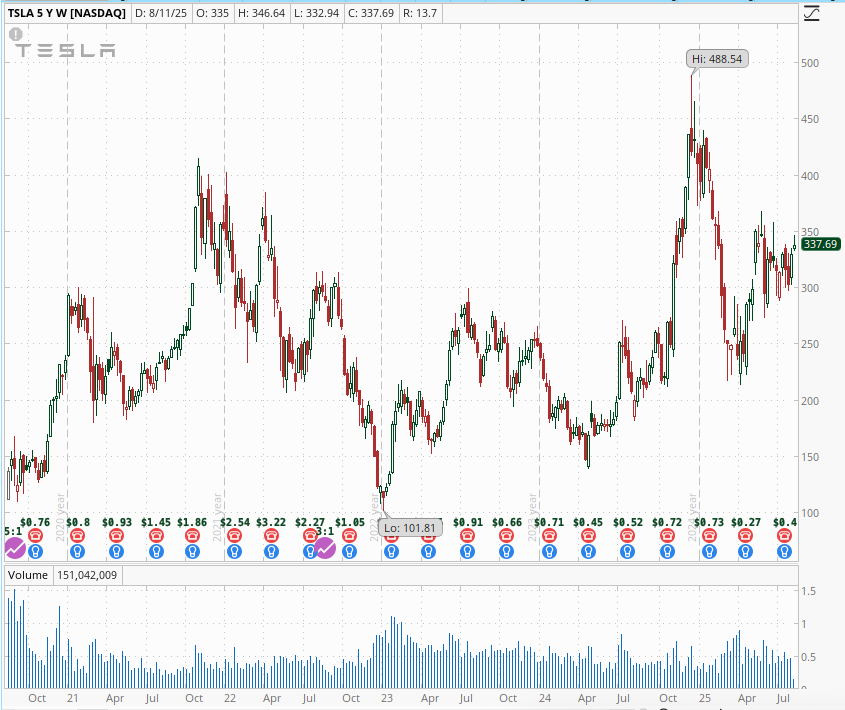
Here's an example. Tesla stock has pretty much doubled over the past five years, since 2020. Most of those gains, however, came in 2020 and 2021. Since then, the electric-vehicle company's shares have mostly gone sideways.
In 2020 and 2021, and again in 2024, there was demand for those shares. Other times, not so much.
Summary
Remember, price is what you pay, but value is what you get.
When you’re investing, it’s about the total amount of money you have to invest and how well those investments do over time. That price that you see is really an arbitrary number that is based on the number of shares that the company sold when it went public. How it moves up and down, or its valuation relative to future earnings, is what we really care about.